Maps Unveil the Source of Starburst Galaxy's Winds
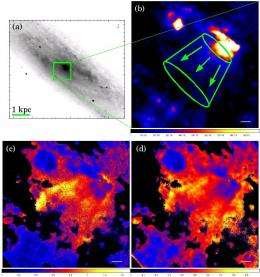
(PhysOrg.com) -- A research group at Kyoto University has discovered that shocks are the primary energy sources that excite the galactic wind region of starburst galaxy NGC 253. Their images of the center of this galaxy, bright with intense star formation, have generated findings that substantially increase our meager knowledge of the physical properties of galactic winds and move us closer to understanding galaxy evolution.
Galactic winds (galaxy-scale outflows) are familiar phenomena in both nearby and faraway galaxies. Stellar winds, supernovae (explosions of stars) or active galactic nuclei (AGNs) can feed their energy. Astronomers believe that they have a significant impact on galaxy evolution. Some suggest that galactic winds may suppress star formation by removing interstellar gas from host galaxies. Nevertheless, investigations of their physical properties have been limited and insufficient, given their likely significance in galaxy formation.
The challenge of observing galactic winds
Because galactic winds appear as faint, diffuse objects with extremely complex structures, they have been difficult to observe. Since the mid-1990s, the advent of large ground-based telescopes with innovative instrumentation has opened the door for more precise observations of these important but elusive targets. It was during the 28 August 2002 testing of the Kyoto tridimensional spectrograph II (Kyoto 3DII), mounted on the Subaru Telescope in Hawaii, that its Kyoto development team observed the central region of NGC 253. The combination of Subaru's large, 8.2m aperture with the sensitivity of the spectrograph's Fabry-Perot interferometer observation mode to faint emissions produced a complete image of the galactic wind in NGC 253 in one exposure. Although partial spectroscopic observations of its wind have been made in the past, this is the first time that a spectroscopic instrument has captured an image of the entire galactic wind.
The results of mapping the center of NGC 253
One of the brightest and dustiest spiral galaxies in the sky, NGC 253 is also one of the most famous. As a nearby edge-on starburst galaxy, it is easily observed from Earth, and its edge-on presentation makes it particularly suitable for viewing galactic winds.
The observational data produced line-ratio maps that allowed the scientists to determine the extent of the galactic wind as well as its mass and kinetic energy; to discover regions with enhanced nitrogen abundance; and to clearly distinguish shocked gas from starburst regions. Line-ratio maps show the relative intensity of line emissions and display their distribution; they are derived from emission lines that show peaks of radiation in a spectrum.
The Kyoto team captured emission line images of sulfur, nitrogen, and hydrogen. Because sulfur emission lines are weaker than those of hydrogen and nitrogen, their images have been difficult to capture. Nevertheless, the large aperture of the Subaru Telescope helped the instrument obtain a sulfur emission line image for the first time. Since these line images did not show active galactic nuclei, the scientists could eliminate AGN as an energy source for NGC 253's galactic winds. The emission lines of nitrogen and the nitrogen/hydrogen ratios helped the scientists to conclude that shocks excited the galactic winds of NGC 253; their emission lines indicate sources of energy that shift gas particles in the wind from a lower to higher level, hence "exciting" it.
There are two kinds of energy sources that excite gas: 1) the strong, abrupt motion of gas that creates shocks and 2) the thermal energy of stars. Based on nitrogen abundance in relation to hydrogen, the scientists can identify which regions in this galaxy are excited by shocks and which, by stars.
Shocks are marked by a transition region that occurs when hydrogen and other elements are partly ionized; much of the sulfur and nitrogen are emitted in this region and the nitrogen/hydrogen ratio is large. In contrast, ultraviolet light from stars produces a completely ionized region, not a transition region; the nitrogen/hydrogen ratio is low. Maps of the nitrogen/hydrogen ratios confirmed that shocks rather than the thermal energy of stars are the driving source of NGC 253's galactic winds.
Although the results from this observation help us to understand more about the physical processes that produce galactic winds, they cannot establish conclusions about the properties of galactic winds in other galaxies. More observations of galactic winds and investigations of their common properties will help to unveil the mysteries of how galaxies evolved.
Provided by Subaru Telescope


