Proton's party pals may alter its internal structure
November 18, 2009
Proton's party pals may alter its internal structure

Enlarge

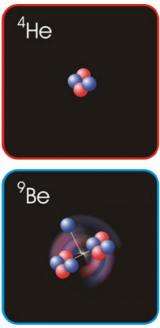
JLab experiment E03-103 made precise new measurements of the EMC effect in a variety of light nuclei. The results indicate that the effect does not depend on nuclear mass or density but rather on the microscopic structure of nuclei, usually neglected in high-energy measurements. This result hinges on the unusual structure of 9Be. Most of the time, it is in a configuration with two 4He-like clusters and an additional neutron orbiting around each other. The orbiting clusters yield a large radius and an anomalously low average density similar to that of the much less massive 3He. But the size of the EMC Effect in 9Be is much more similar to that of the denser nucleus of 12C. This is probably because most nucleons are contained within the high local densities of the clusters. The results suggest that the EMC effect may be entirely generated within these small, high-density clusters, where densities can briefly approach those in a neutron star. Credit: Image: Peter Mueller (Argonne National Lab)

A recent experiment at the DOE's Thomas Jefferson National Accelerator Facility has found that a proton's nearest neighbors in the nucleus of the atom may modify the proton's internal structure.

The result was published in the November 13 issue of the journal .

When comparing large to small nuclei, past measurements have shown a clear difference in how the proton's constituent particles, called quarks, are distributed. This difference is called the EMC Effect.

Many models of the EMC Effect predict that it is caused by the mass or density of the nucleus in which the resides. To test these predictions, experimenters made precise new measurements of the EMC effect in a variety of light nuclei, such as of .

"What we found is that there is a large modification of the quark structure in helium-4, and there was a much smaller effect in helium-3. And even though they were both light nuclei, they had a very different EMC Effect," said John Arrington, a spokesperson for the experiment and a nuclear physicist at DOE's Argonne National Lab.

The results, Arrington added, rules out the idea that the size of the EMC effect scales with the mass of the nucleus.

Next, the experimenters turned their attention to density. They compared the EMC Effect in beryllium to various other nuclei. Beryllium has a mass similar to carbon but a much lower density, roughly the same as helium-3. They found that the size of the EMC Effect in beryllium is similar to that of carbon, which is twice as dense.

"So you have one set of data that tells you the mass-dependence picture doesn't work and another that tells you the density-dependence picture doesn't work," Arrington explained. "So, if both of these pictures are wrong, what's really going on?"

Interestingly, the result did indicate a possible new cause for the effect: the microscopic structure of nuclei. This possible result is hinged on the unusual structure of beryllium. Most of the time, beryllium's configuration consists of two orbiting clusters that look like helium-4 nuclei (each with two protons and two neutrons), and one additional neutron orbiting around.

The orbiting clusters yield a large radius and a low average density for the beryllium nucleus, but most protons and neutrons are contained within the high local densities of the clusters. This suggests that the EMC effect may be entirely generated within these small, high-density clusters.

"That's a hypothesis, but it's certainly clear that it's small groups of nucleons that get together and change things, rather than the whole collection," Arrington said. "In a way, it's not really surprising. If you're at a party, it doesn't matter how many people are in the room, most of the time you're interacting with the people that you're closest to."

Arrington says the next step is to take a new measurement that directly examines the impact of the local density. This can be done by looking at the quark structure of the deuteron, a nucleus consisting of just one proton and one neutron. Most of the time, the proton and neutron are pretty far apart.

"We want to isolate the structure during the moment when the proton and neutron are very close together. If we find a large effect in such a small and simple nucleus by looking when the proton and neutron are closest together, it will demonstrate that the EMC effect does not require a large, dense nucleus - it simply requires two nucleons coming into extremely close contact," Arrington explained.

The experiment, E03-103, ran for 21 days in Hall C in October of 2004. It measured the momenta of protons knocked out of the nuclei of hydrogen, helium, and carbon atoms by electrons from the CEBAF Accelerator.

Source: Thomas Jefferson National Accelerator Facility

4.6 /5 (22 votes)  

Filter


Move the slider to adjust rank threshold, so that you can hide some of the comments.


Display comments: newest first

PPihkala
Nov 18, 2009

Rank: 3 / 5 (2)
To me this makes sense when one considers how nucleus break apart in fission. They typically throw out one of those helium cores when they break by alfa-radiation. This also got me thinking is it so that most stable nucleus are those that have multiples of these helium cores inside?
Question
Nov 18, 2009

Rank: 3 / 5 (2)
It is a little more complicated than helium 4 multiples. For example, the isotope of beryllium 8 is completely unstable.
Question
Nov 18, 2009

Rank: 3 / 5 (2)
Look at the drawing of the beryllium 9 atom at the beginning of this article. Notice where they place the 5th neutron? If one looks at the strong nuclear force as a positive electromagnetic force it explains why the 5th neutron is in the center between the two stable helium 4 nuclei. It shields the positive charge surrounding the two alpha particle from from each other. This permits the beryllium 9 atom to be stable whereas beryllium 8 has a half life of next to zero.

out7x
Nov 19, 2009

Rank: not rated yet
This is a very poorly written article. It does not even mention gluons.
frajo
Nov 19, 2009

Rank: 1 / 5 (1)
Look at the drawing of the beryllium 9 atom at the beginning of this article. Notice where they place the 5th neutron? If one looks at the strong nuclear force as a positive electromagnetic force it explains why the 5th neutron is in the center between the two stable helium 4 nuclei.

No, the 5th neutron is not drawn in the center between the two 4-particle clusters. Instead, the three (net-neutral) groups (two 4-particle groups, one 1-particle "group") are "orbiting around each other".
Question
Nov 19, 2009

Rank: not rated yet
Frajo, you are correct to a point, but these drawing do represent the actual arrangement of the nucleons.
If the 5th neutron is not in between (probably oscillating) the two alpha particles how else could you explain beryllium 9 stability, when beryllium 8 is completely unstable with the two alpha like particle arrangement?
frajo
Nov 19, 2009

Rank: 1 / 5 (1)
I can't explain anything; I'm puzzled. I wonder why the particles inside the nucleus are pictured as particles and not as probability densities like the electrons around an atomic nucleus.
Question
Nov 19, 2009

Rank: not rated yet
Frajo, you are correct to a point, but these drawing do represent the actual arrangement of the nucleons.


The quote from my previous posting should have read, "these drawing do NOT represent the actual arrangement of the nucleons."

I agree with your idea about the "probabilities"
Frajo.
omatumr
Nov 20, 2009

Rank: 2.3 / 5 (3)
Nuclear stability and the internal structure of the nucleus . .

. . is determined by three fundamental forces:

1. Attractive neutron-proton forces,

2. Repulsive neutron-neutron forces, and

3. Repulsive proton-proton forces that are symmetric with neutron-neutron forces plus extra repulsive forces from Coulomb repulsion between + charges.

With kind regards,
Oliver K. Manuel
Rank 4.6 /5 (22 votes)
Related Stories
Relevant PhysicsForums posts
  • Does light travel for ever?
    created1 hour ago
  • Infinity by Particles
    created2 hours ago
  • what does negative resistivity mean
    created3 hours ago
  • Calculating Electrostatic force between parallel plates
    created4 hours ago
  • Strength of induced magnetic field inside an inductor
    created7 hours ago
  • increasing time of daylight
    created8 hours ago
  • More from Physics Forums - General Physics

More news stories

Putting the squeeze on planets outside our solar system

(PhysOrg.com) -- Using high-powered lasers, scientists at Lawrence Livermore National Laboratory and collaborators discovered that molten magnesium silicate undergoes a phase change in the liquid state, abruptly ...

Physics / Condensed Matter

created 7 hours ago | popularity 4.8 / 5 (4) | comments 0 | with audio podcast

Hovering not hard if you're top-heavy, researchers find

Top-heavy structures are more likely to maintain their balance while hovering in the air than are those that bear a lower center of gravity, researchers at New York University's Courant Institute of Mathematical Sciences ...

Physics / General Physics

created 8 hours ago | popularity 5 / 5 (1) | comments 1 | with audio podcast

SLAC, Stanford team focuses on high-energy electrons to treat cancer

Accelerator physicists at SLAC and cancer specialists from Stanford are working on a new technology that could dramatically reduce the time needed for cancer radiation treatments. The team ran an initial experiment ...

Physics / General Physics

created 11 hours ago | popularity 5 / 5 (1) | comments 0

Measurements from high-energy collisions lead to better understanding of why meson particles disappear

For several years, physicists at the Relativistic Heavy Ion Collider (RHIC) at Brookhaven National Laboratory (BNL), USA, have studied an unusual state of matter called the quark–gluon plasma, which they ...

Physics / General Physics

created 12 hours ago | popularity 5 / 5 (1) | comments 0

Explained: Sigma

It's a question that arises with virtually every major new finding in science or medicine: What makes a result reliable enough to be taken seriously? The answer has to do with statistical significance -- but ...

Physics / General Physics

created Feb 09, 2012 | popularity 5 / 5 (16) | comments 50


Google users warned of threat to smartphone wallets

Users of Google smartphone wallets were being warned on Friday that there is a way to crack pass codes intended to thwart thieves from going on illicit shopping sprees.

Anonymous knocks CIA website offline (Update)

The website of the Central Intelligence Agency was inaccessible on Friday after the hacker group Anonymous claimed to have knocked it offline.

Complex wiring of the nervous system may rely on a just a handful of genes and proteins

Researchers at the Salk Institute have discovered a startling feature of early brain development that helps to explain how complex neuron wiring patterns are programmed using just a handful of critical genes. ...

New error-correcting codes guarantee the fastest possible rate of data transmission

Error-correcting codes are one of the triumphs of the digital age. They’re a way of encoding information so that it can be transmitted across a communication channel — such as an optical fiber o ...

The power of estrogen -- male snakes attract other males

A new study has shown that boosting the estrogen levels of male garter snakes causes them to secrete the same pheromones that females use to attract suitors, and turned the males into just about the sexiest ...

Humans may have helped the decline of African rainforests 3000 years ago

(PhysOrg.com) -- Large areas of rainforests in Central Africa mysteriously disappeared over three thousand years ago, to be replaced by savannas. The prevailing theory has been that the cause was a change ...