Just use less: Energy savings to be big part of nation’s energy future
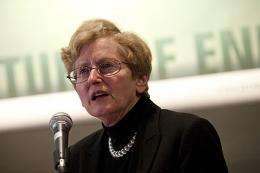
(PhysOrg.com) -- Energy adviser and former Honeywell executive Maxine Savitz says there are enormous energy savings available through increased efficiency, as much as 30 percent by 2030.
The easiest way to reduce U.S. consumption of greenhouse gas-emitting fossil fuels may not involve changing the way it is generated, but rather simply using less of it, an energy expert said.
Maxine Savitz, vice president of the National Academy of Engineering, former deputy assistant secretary for conservation in the U.S. Department of Energy, and a member of the President’s Council of Advisors on Science and Technology, said the energy efficiency gained through new technologies in buildings, cars, and industry could reduce energy use as much as 30 percent by 2030.
Savitz, who spoke at the Science Center as part of the Harvard University Center for the Environment’s (HUCE) Future of Energy lecture series on Nov. 17, presented the results of reports by the National Academy of Sciences and the National Academy of Engineering that assessed technology’s potential to transform the nation’s energy production, distribution, and use.
The reports conclude, Savitz said, that the United States needs a concerted and sustained energy approach, but that potential efficiencies from technology in buildings, transportation, and industry could cut energy consumption 15 percent by 2020 and 30 percent by 2030. The savings from heating, cooling, lighting, and other building systems alone could counterbalance the projected growth in energy consumption through 2030, meaning that no new power plants would be needed. In addition, Savitz said, those estimates were calculated assuming that people continue their everyday behavior. Savings from conservation-related behavior change — such as walking to work instead of driving, turning the thermostat down, and wearing heavier clothes at home — were not included in those calculations and could potentially add significantly to energy savings.
“Deploying existing energy-efficient technology is the nearest term and lowest-cost option,” Savitz said.
Savitz, a retired general manager of technology partnerships for Honeywell Inc., also lamented the country’s shift away from energy efficiency during the 1980s. In response to a question by HUCE Director Daniel Schrag, Savitz said that if the nation had maintained the savings momentum gained in the late 1970s, it would be far ahead on conserving energy now.
Savitz said the last couple of years have been exciting for those involved in energy conservation and efficiency, with public interest at levels not seen since the 1970s. The question, she said, is how long such interest will continue. Savitz said that any U.S. energy solutions will require a portfolio of changes across many fields, not just energy efficiency.
Savitz was part of the team that drafted the report on the potential for energy efficiency through technology, released earlier this year. Other subcommittees looked at power generation from renewable energy sources and at the potential for using coal and biomass to create liquid transportation fuels.
There are several promising options for new electricity supplies, Savitz said, including nuclear power plants that utilize novel technology, coal plants with carbon capture and sequestration technology, and increased use of wind power. Renewables provide just 8 or 9 percent of the nation’s energy, with most of that from hydropower. The United States could draw 20 percent of its power from wind, she said, but that would require a major investment, including building 100,000 turbines at a cost of $100 billion for capital improvements.
There are few immediate alternatives to using gasoline for liquid transportation, Savitz said. Fuel use is projected to reach about 15 million barrels a day by 2035, and just 2.5 million barrels can reasonably be expected to come from clean biofuels or liquid-coal technology.
“We’re going to be using petroleum fuels for a long time in the transportation sector,” Savitz said.
The United States has proven in the past that it can increase energy efficiency, Savitz said. Consumption rose continuously until the 1970s, when it leveled off, before beginning to grow again, increasing 40 percent in the decades since. Now, 40 percent of the nation’s energy goes to light, heat, cool, and otherwise run buildings. Transportation uses another 28 percent, while industry uses 33 percent.
Though the U.S. economy has become more energy-efficient in recent years, it still uses about twice as much energy per dollar of gross domestic product as European economies, Savitz said. Greater energy efficiency is possible for a host of building systems and appliances, in both residential and industrial settings. Savitz cited possible improvements in everything from television sets to heating and cooling systems to windows to clothes washers to lighting, for which new light-emitting diode bulbs are poised to reduce energy consumption even from that of compact fluorescent light bulbs.
Savitz used the example of the refrigerator to illustrate the potential for savings from energy efficiency. Refrigerators in 1947 averaged eight cubic feet and used 400 kilowatt hours of electricity. Refrigerators grew in both size and energy consumption through the 1970s, when their energy use began to decline. That dip continues, and now, although they’re much larger at roughly 22 cubic feet, they use only slightly more energy than they did more than half a century ago.
Though there is great promise of savings from energy efficiency, there are barriers to adopting these technologies too, Savitz said, including lack of information, problems with capital availability, regulatory policies, ownership status, and the uncertain psychological factors involved in making people embrace change.
That last issue has gotten the least attention, Savitz said, but is a significant variable. You only have to consider why consumers suddenly changed driving and car-buying habits when gas prices topped $4 a gallon to understand how significant and difficult to predict it can be.
“How do people make decisions? Why at $4 do people drive less, but at $3 they don’t?” Savitz asked.
Provided by Harvard University (news : web)


