On the trail of a vaccine for Lyme disease: Researchers target tick saliva
November 19, 2009
On the trail of a vaccine for Lyme disease: Yale researchers target tick saliva

Enlarge

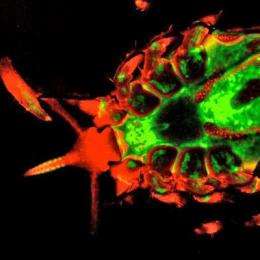
This is a live tick. Credit: Yale School of Medicine

A protein found in the saliva of ticks helps protect mice from developing Lyme disease, Yale researchers have discovered. The findings, published in the November 19 issue of Cell Host & Microbe, may spur development of a new vaccine against infection from Lyme disease, which is spread through tick bites.

Traditionally, vaccines have directly targeted specific pathogens. This is the first time that antibodies against a protein in the of a pathogen's transmitting agent (in this case, the ) has been shown to confer immunity when administered protectively as a vaccine.

The Lyme bacterium known as Borrelia burgdorferi is transmitted by ticks. When it moves through the tick, it is coated with a tick salivary protein known as Salp15. The Yale team injected Salp15 into healthy and found that it significantly protected them from getting Lyme disease. When combined with outer surface proteins of B. burgdorferi, the protection was even greater.

Lead author Erol Fikrig, M.D. of Yale School of Medicine and Howard Hughes Medical Institute said, "The interaction between the Lyme disease agent and ticks is very complex, and the bacteria uses a tick salivary to facilitate of the mammalian host. By interfering with this important interaction, we can influence infection by the Lyme disease agent."

Several years ago there was a Lyme vaccine on the market that utilized just the outer surface proteins of the bacteria. It was taken off the market in 2002, and to date no other antigen has been tested in phase III clinical trials.

The authors believe this new strategy of targeting the saliva - the "vector molecule" that a microbe requires to infect a host - may be applicable not just to Lyme disease but to other insect-borne pathogens that also cause human illness.

"We believe that it is likely that many arthropod-borne infection agents of medical importance use vector proteins as they move to the mammalian host," Fikrig explained. "If so, then this paradigm, described with the agent, is likely to be applicable to these illnesses. Currently, we are working to determine if this strategy is likely to be important for West Nile virus infection, dengue fever, and malaria, among other diseases."

Source: Yale University (news : web)

4.5 /5 (2 votes)  

Rank 4.5 /5 (2 votes)
Related Stories
Relevant PhysicsForums posts
  • Is Everyday Technology Killing Us?
    createdFeb 08, 2012
  • Exercise and weight loss
    createdFeb 08, 2012
  • Why do we have head aches? Our brains can't feel anything.
    createdFeb 07, 2012
  • "The end of diseases" by David Agus, interview from Daily Show with Jon Stewart
    createdFeb 04, 2012
  • Oncolytic adenovirus
    createdFeb 04, 2012
  • Nutrition label stuffs and diets
    createdFeb 02, 2012
  • More from Physics Forums - Medical Sciences

More news stories

Complex wiring of the nervous system may rely on a just a handful of genes and proteins

Researchers at the Salk Institute have discovered a startling feature of early brain development that helps to explain how complex neuron wiring patterns are programmed using just a handful of critical genes. ...

Medicine & Health / Research

created 6 hours ago | popularity 4.9 / 5 (9) | comments 0 | with audio podcast

Both maternal and paternal age linked to autism

Older maternal and paternal age are jointly associated with having a child with autism, according to a recently published study led by researchers at The University of Texas Health Science Center at Houston (UTHealth).

Medicine & Health / Psychology & Psychiatry

created 11 hours ago | popularity 4 / 5 (2) | comments 0 | with audio podcast

New understanding of DNA repair could eventually lead to cancer therapy

A research group in the Faculty of Medicine & Dentistry at the University of Alberta is hoping its latest discovery could one day be used to develop new therapies that target certain types of cancers.

Medicine & Health / Cancer

created 10 hours ago | popularity 4.8 / 5 (4) | comments 0 | with audio podcast

Curry spice component may help slow prostate tumor growth

Curcumin, an active component of the Indian curry spice turmeric, may help slow down tumor growth in castration-resistant prostate cancer patients on androgen deprivation therapy (ADT), a study from researchers ...

Medicine & Health / Cancer

created 12 hours ago | popularity 4.4 / 5 (8) | comments 0 | with audio podcast

Human cognitive performance suffers following natural disasters, researchers find

Not surprisingly, victims of a natural disaster can experience stress and anxiety, but a new study indicates that it might also cause them to make more errors - some serious - in their daily lives. In their upcoming Human Fa ...

Medicine & Health / Psychology & Psychiatry

created 8 hours ago | popularity 4 / 5 (1) | comments 0


Google users warned of threat to smartphone wallets

Users of Google smartphone wallets were being warned on Friday that there is a way to crack pass codes intended to thwart thieves from going on illicit shopping sprees.

Anonymous knocks CIA website offline (Update)

The website of the Central Intelligence Agency was inaccessible on Friday after the hacker group Anonymous claimed to have knocked it offline.

New error-correcting codes guarantee the fastest possible rate of data transmission

Error-correcting codes are one of the triumphs of the digital age. They’re a way of encoding information so that it can be transmitted across a communication channel — such as an optical fiber o ...

The power of estrogen -- male snakes attract other males

A new study has shown that boosting the estrogen levels of male garter snakes causes them to secrete the same pheromones that females use to attract suitors, and turned the males into just about the sexiest ...

Humans may have helped the decline of African rainforests 3000 years ago

(PhysOrg.com) -- Large areas of rainforests in Central Africa mysteriously disappeared over three thousand years ago, to be replaced by savannas. The prevailing theory has been that the cause was a change ...

New power source discovered

(PhysOrg.com) -- Researchers at the Massachusetts Institute of Technology (MIT) and RMIT University have made a breakthrough in energy storage and power generation.