BoarCroc, RatCroc, DogCroc, DuckCroc and PancakeCroc
November 19, 2009
BoarCroc, RatCroc, DogCroc, DuckCroc and PancakeCroc

Enlarge

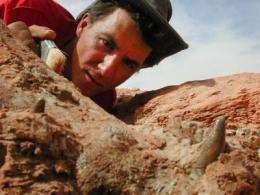
On the cusp of discovery, Paul Sereno, a National Geographic Explorer-in-Residence, closes in on the remains of "BoarCroc," a 20-foot-long meat eater with an armored snout for ramming and three sets of dagger-shaped fangs used for slicing. Credit: Photo by Mike Hettwer, courtesy National Geographic

A suite of five ancient crocs, including one with teeth like boar tusks and another with a snout like a duck's bill, have been discovered in the Sahara by National Geographic Explorer-in-Residence Paul Sereno. The five fossil crocs, three of them newly named species, are remains of a bizarre world of crocs that inhabited the southern land mass known as Gondwana some 100 million years ago.

Sereno, a professor at the University of Chicago, and his team unearthed the strange crocs in a series of expeditions beginning in 2000 in the Sahara. Many of the fossils were found lying on the surface of a remote, windswept stretch of rock and dunes. The crocs galloped and swam across present-day Niger and Morocco when broad rivers coursed over lush plains and ruled.

This video is not supported by your browser at this time.

National Geographic Explorer-in-Residence Paul Sereno uncovers new species of crocs that lived in the Sahara 100 million years ago. Credit: National Geographic Channel

"These species open a window on a croc world completely foreign to what was living on northern continents," Sereno said. The five crocs, along with a closely related sixth species, will be detailed in a paper published in the journal ZooKeys and appear in the November 2009 issue of National Geographic magazine. The crocs also will star in a documentary, "When Crocs Ate Dinosaurs," to premiere at 9 p.m. ET/PT Saturday, Nov. 21, on the National Geographic Channel.

At 40 feet in length and weighing 8 tons, Sarcosuchus imperator, popularly known as SuperCroc, was the first and largest of the crocs Sereno found in the Sahara, but it was not the strangest, Sereno said. He and his teams soon discovered key fossils of five previously unknown or poorly understood species, most of them walking "upright" with their arms and legs under the body like a land mammal instead of sprawled out to the sides, bellies touching the ground.

The crocs and their nicknames:

  • BoarCroc: New species, Kaprosuchus saharicus; fossils found in Niger. Twenty-foot-long upright meat eater with an armored snout for ramming and three sets of dagger-shaped fangs for slicing. Closest relative found in Madagascar.
  • RatCroc: New species, Araripesuchus rattoides; fossils found in Morocco. Three-foot-long, upright plant and grub eater. Pair of buckteeth in lower jaw used to dig for food. Closest relative in South America.
  • PancakeCroc: New species, Laganosuchus thaumastos; fossils found in Niger and Morocco. Twenty-foot-long, squat fish eater with a three-foot pancake-flat head. Spike-shaped teeth on slender jaws. Likely rested motionless for hours, its jaws open and waiting for prey. Closest relative from Egypt. The scientific paper also names a close relative discovered by the team in Morocco, Laganosuchus maghrebensis.
  • DuckCroc: New fossils of previously named species, Anatosuchus minor. Fossils found in Niger. Three-foot-long upright fish-, frog- and grub-eater. Broad, overhanging snout and Pinocchio-like nose. Special sensory areas on the snout end allowed it to root around on the shore and in shallow water for prey. Closest relative in Madagascar.
  • DogCroc: New fossils of named species, Araripesuchus wegeneri. Fossils found in Niger include five skeletons, all next to each other on a single block of rock. Three-foot-long upright plant and grub eater with a soft, doglike nose pointing forward. Likely an agile galloper, but also a capable swimmer. Closest relative in Argentina.
"We were surprised to find so many species from the same time in the same place," said paleontologist Hans Larsson, associate professor at McGill University in Montreal and a team member who discovered the bones of BoarCroc and PancakeCroc. "Each of the crocs apparently had different diets, different behaviors. It appears they had divided up the ecosystem, each species taking advantage of it in its own way."

To better understand how these ancient crocs — mostly upright and agile — might have moved and lived, Sereno traveled to northern Australia, where he observed and captured freshwater crocs. Realizing while there that he may have stumbled onto one of the keys to crocodilian success, Sereno saw freshwater crocs galloping at full speed on land and then, at water's edge, diving in and swimming away like fish. On land they moved much like running mammals, yet in a flash turned fishlike, their bodies and tails moving side to side, propelling them in water.
BoarCroc, RatCroc, DogCroc, DuckCroc and PancakeCroc
Enlarge

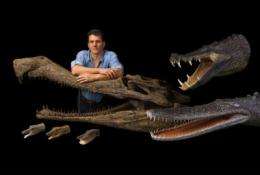
Paleontologist Paul Sereno with his Saharan discoveries -- SuperCroc, BoarCroc (upper right), PancakeCroc (lower right), RatCroc, DogCroc and DuckCroc. The fossil crocs were unearthed in a series of expeditions to the Sahara beginning in 2000, supported by the National Geographic Society. Credit: Photo by Mike Hettwer, courtesy National Geographic

Based on interpretation of the fossils, Sereno and Larsson hypothesize that these early crocs were small, upright gallopers. In the scientific paper, they suggest that the more agile of their new croc menagerie could not only gallop on land but also evolved a swimming tail for agility and speed in water, two modes of locomotion suggested to be evolutionary hallmarks for the past 200 million years.

"My African crocs appeared to have had both upright, agile legs for bounding overland and a versatile tail for paddling in water," Sereno writes in the National Geographic magazine article. "Their amphibious talents in the past may be the key to understanding how they flourished in, and ultimately survived, the dinosaur era."

To study the crocs' brains, Sereno CT-scanned the skulls of DuckCroc and DogCroc and then created digital and physical casts of the brains. The result: Both DogCroc and DuckCroc had broad, spade-shaped forebrains that look different from those of living crocs. "They may have had slightly more sophisticated brain function than living crocs," Larsson said, "because active hunting on land usually requires more brain power than merely waiting for prey to show up."

To collect the croc fossils, Sereno and his teams endured temperatures topping 125 degrees F, living for months on dehydrated food. Logistics were challenging: For the 2000 expedition, they transported trucks, tools, tents, five tons of plaster, 600 pounds of water and four months' worth of other supplies.

More information: The scientific paper can be access at: http://pensoftonli … ournal/index

Source: National Geographic Society (news : web)

4.9 /5 (9 votes)  

Filter


Move the slider to adjust rank threshold, so that you can hide some of the comments.


Display comments: newest first

nonoice
Nov 20, 2009

Rank: not rated yet
Aah reality is so much more fun than imagination.

Rarely seen except in the hands of certain fundamental evangelicals, the elusive "Crocoduck" has been fabled to be the theological deal-breaker Christians demand to prove evolution is legitimate.

http://freethough...rocoduck
fossilator
Nov 20, 2009

Rank: not rated yet
Sorry, my comment was meant to show that the naming could be unfortunate. Will someone now claim that evil evolutionists are trying to recover from the blows inflicted by "Banana Man" and company, by inventing transitional forms?
Rank 4.9 /5 (9 votes)
Related Stories
Relevant PhysicsForums posts

More news stories

US workers are 'giving away the store,' costing firms billions

Nearly 70 percent of the nation's service employees give away free goods and services – from hamburgers to cable TV – costing companies billions of dollars a year, according to a groundbreaking study.

Other Sciences / Economics & Business

created 11 hours ago | popularity not rated yet | comments 8

Storm warning: Financial tsunami heading this way

In today's global village, national coffers are more interconnected than ever before. And as the current economic crisis has proven, a downturn in one country can travel in a wave across the globe, like a financial tsunami. ...

Other Sciences / Economics & Business

created 12 hours ago | popularity 3 / 5 (2) | comments 6

Prague gets hold of modern genetics founder Mendel's papers

Germany has handed to the Czech Republic a manuscript of Johann Gregor Mendel, founder of modern genetics, on his plant hybridization experiments, the Czech foreign minister said Thursday.

Other Sciences / Other

created 8 hours ago | popularity 5 / 5 (1) | comments 1

Kids show cultural gender bias

(PhysOrg.com) -- Talk about gender confusion! A recent study by University of Alberta researchers Elena Nicoladis and Cassandra Foursha-Stevenson in the Journal of Cross-Cultural Psychology into whether speaki ...

Other Sciences / Social Sciences

created 17 hours ago | popularity 2 / 5 (1) | comments 2

'Flipped classroom' teaching model gains an online community

Researchers at Harvard University have launched the Peer Instruction (PI) Network, a new global social network for users of interactive teaching methods.

Other Sciences / Social Sciences

created 12 hours ago | popularity 5 / 5 (2) | comments 0


'Dark plasmons' transmit energy

Microscopic channels of gold nanoparticles have the ability to transmit electromagnetic energy that starts as light and propagates via "dark plasmons," according to researchers at Rice University.

FDA-approved drug rapidly clears amyloid from the brain, reverses Alzheimer's symptoms in mice

Neuroscientists at Case Western Reserve University School of Medicine have made a dramatic breakthrough in their efforts to find a cure for Alzheimer's disease. The researchers' findings, published in the journal Science, show t ...

Hydrogen from acidic water: Researchers develop potential low cost alternative to platinum for splitting water

A technique for creating a new molecule that structurally and chemically replicates the active part of the widely used industrial catalyst molybdenite has been developed by researchers with the Lawrence Berkeley ...

Ultraviolet protection molecule in plants yields its secrets

Lying around in the sun all day is hazardous not just for humans but also for plants, which have no means of escape. Ultraviolet (UV) radiation from the sun can damage proteins and DNA inside cells, leading ...

Anyone can learn to be more inventive, cognitive researcher says

There will always be a wild and unpredictable quality to creativity and invention, says Anthony McCaffrey, a cognitive psychology researcher at the University of Massachusetts Amherst, because an "Aha moment" is rare and ...

Soraa LED light may dim 50-watt halogen rivals

(PhysOrg.com) -- Soraa, a Fremont, California company founded in 2008, this week launched its first product, a light that uses LEDS (light emitting diodes). The "Soraa LED MR16 lamp" is the "perfect" replacement ...