Scientists find frog legs trade may facilitate spread of pathogens

November 19, 2009
These are frog legs for sale at a market in Indonesia. Credit: A. Roselli
Most countries throughout the world participate in the $40-million-per-year culinary trade of frog legs in some way, with 75 percent of frog legs consumed in France, Belgium and the United States. Scientists at the Smithsonian Institution and colleagues have found that this trade is a potential carrier of pathogens deadly to amphibians. The team's findings are published in the scientific journal Frontiers in Ecology, Thursday, Nov. 19.
Amphibians are rapidly declining worldwide. More than one-third of the nearly 6,000 amphibian species are threatened with extinction—disease is one of the main causes. Among the known amphibian pathogens, the parasitic fungus Batrachochytrium dendrobatidis, also known as amphibian chytrid (KI-trid), is a top concern. The fungus, which attacks keratin proteins in the skin of amphibians, including frogs, causes respiratory and neurological damage and eventually death.
"Amphibian chytrid is an unusual example of a disease that is a primary cause of extinction in amphibian species," said Brian Gratwicke, biologist at the Smithsonian's National Zoo and lead author of the team's paper. "In fact, amphibian chytrid has been listed as a likely threat in 94 cases out of the 159 extinct and potentially extinct amphibian species. There are several hypotheses about how amphibian chytrid has spread around the world, but the trade in amphibians for food, bait, pets and laboratory animals has been identified as the most likely mode of spread."

This chart illustrates global exporters and importers of frog legs (1996-2006). Credit: Data from the UN Commodity Trade Statistics Database
Although consuming amphibian legs is familiar to many people as a culinary curiosity, the global extent of the international trade is unknown. The team of scientists' research focused on 1996 through 2006, during which more than 100,000 metric tons of frog legs were imported from both wild and farmed sources, at a net value approaching half a billion dollars. One kilogram of frog legs averaged about $4 over this period—a kilogram of frog legs requires 10 to 40 individual animals translating to approximately 100 to 400 million animals per year.The scientists found no recorded cases of the extinction of a frog species caused by collection for food. However, given the growing importance of aquaculture to supply frog legs to global markets, the team stresses that the risk of disease spread through poorly regulated amphibian trade is probably an even greater risk to amphibian biodiversity than the direct population effects of overharvesting.
In countries such as Indonesia, which exports about 45 percent of all frog legs, the majority of animals are thought to be wild-caught and there is little to no effort to monitor this food source for disease pathogens. "Any trade in live frogs or fresh, un-skinned frog legs presents a substantial risk of the spread of amphibian chytrid," said Gratwicke. "The implementation and enforcement of some key amphibian trade policies could be a cost-effective conservation tool to mitigate disease risks associated with the trade."
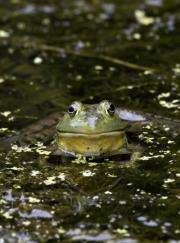
The American bullfrog is one of the many species used in the frog leg trade. Credit: Mehgan Murphy / Smithsonian's National Zoo
The exact origin of amphibian chytrid is unknown, but one theory is that it originated in Southern Africa and was distributed worldwide in the 1950s through the trade of the African clawed frog for pregnancy-testing and other amphibian trade. Amphibian chytrid has been detected in many parts of the United States, but some species are apparently resistant to the fungus, and it is not always associated with amphibian declines. The most dramatic declines have been observed in mountainous parts of Central and South America and Australia where it is responsible for the disappearance and probable extinction of many species.-
Project launched to fight frog-killing fungus
May 11, 2009 |
not rated yet |
0
-
Panamanian amphibians attacked by fungus
Feb 07, 2006 |
not rated yet |
0
-
Bullfrogs may be deadly fungus carriers
May 24, 2006 |
not rated yet |
0
-
Colombian frog believed extinct found alive
May 18, 2006 |
not rated yet |
0
-
Captive breeding introduced infectious disease to Mallorcan amphibians
Sep 22, 2008 |
not rated yet |
0
-
Engineers build first sub-10-nm carbon nanotube transistor
Feb 01, 2012 |
4.9 / 5 (30) |
30
-
Something old, something new: Evolution and the structural divergence of duplicate genes
Jan 31, 2012 |
4.6 / 5 (7) |
1
-
The hidden nanoworld of ice crystals: Revealing the dynamic behavior of quasi-liquid layers
Jan 30, 2012 |
5 / 5 (3) |
1
-
Stock market network reveals investor clustering
Jan 27, 2012 |
3.9 / 5 (23) |
8
-
Of microchemistry and molecules: Electronic microfluidic device synthesizes biocompatible probes
Jan 26, 2012 |
5 / 5 (1) |
0
-
Any books/articles for evolutionary stable strategy models in humans?
5 hours ago
-
Science behind the bore feeling?
11 hours ago
-
Homo Sapien vs. Chimpanzee - Divergence Timeline
16 hours ago
-
a single mRNA strand is attached to sevaral ribosomes?
Feb 08, 2012
-
Oestrogen and FSH
Feb 07, 2012
-
Linear Blood Vessel Network Examples in Animals or Plants
Feb 07, 2012
- More from Physics Forums - Biology
More news stories
Decoding the molecular machine behind E. coli and cholera
Scientists from Queen Mary, University of London have discovered the workings behind some of the bacteria that kill hundreds of thousands every year, possibly paving the way for new antibiotics that could treat infections ...
51 minutes ago |
not rated yet |
0
|
Deadly bird parasite evolves at exceptionally fast rate
A new study of a devastating bird disease that spread from poultry to house finches in the mid-1990s reveals that the bacteria responsible for the disease evolves at an exceptionally fast rate. What's more, ...
51 minutes ago |
not rated yet |
0
|
New research reveals why fishermen keep fishing despite dwindling catches
Half of fishermen would not give up their livelihood in the face of drastically declining catches according to research led by the University of East Anglia (UEA).
51 minutes ago |
not rated yet |
0
An economic analysis of Emerald Ash Borer management options
A new study in the Journal of Economic Entomology examines several options for managing the Emerald Ash Borer, an invasive insect that is destroying US ash trees.
29 minutes ago |
not rated yet |
0
Ultraviolet protection molecule in plants yields its secrets
Lying around in the sun all day is hazardous not just for humans but also for plants, which have no means of escape. Ultraviolet (UV) radiation from the sun can damage proteins and DNA inside cells, leading ...
2 hours ago |
5 / 5 (3) |
0
|
'Dark plasmons' transmit energy
Microscopic channels of gold nanoparticles have the ability to transmit electromagnetic energy that starts as light and propagates via "dark plasmons," according to researchers at Rice University.
Flexible paper robots
(PhysOrg.com) -- These inexpensive robots can stretch, bend and twist under control, and lift objects up to 120 times their own weight. Being soft, they can apply gentle and even pressure, and adapt to varied ...
Cell biologists describes mechanism by which some people may be more susceptible to colon cancer
An international research team led by cell biologists at the University of California, Riverside has uncovered a new insight into colon cancer, the third leading cause of cancer-related deaths in the United ...
New method makes culture of complex tissue possible in any lab
Scientists at the University of California, San Diego have developed a new method for making scaffolds for culturing tissue in three-dimensional arrangements that mimic those in the body. This advance, published online in ...
Tell me how you are -- and I know how long you will live
The way people rate their health determines their probability of survival in the following decades. Researchers from the Institute of Social and Preventive Medicine at the University of Zurich demonstrate that for ratings ...
Ultrasound study provides first direct evidence of effect of malaria on fetal growth
A study of almost 3,800 pregnancies has provided the most accurate and direct evidence to date that malaria infection reduces early foetal growth. Low birth weight is the most important risk factor for neonatal mortality ...

