Like humans, ants use bacteria to make their gardens grow
November 19, 2009 by Terry Devitt
Like humans, ants use bacteria to make their gardens grow

Enlarge

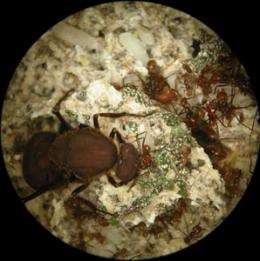
Pictured in October 2009, a leaf-cutter ant queen tends to a fungus garden in her colony, surrounded by her brood. These ants grow a fungus, which serves as the primary food source for the entire colony, using leaves the ants harvest from the rainforest. Recent research in the lab of Cameron Currie, associate professor of bacteriology at the University of Wisconsin-Madison, has revealed two symbiotic bacteria in the fungus garden that fix nitrogen for these ants. Nitrogen is a limiting nutrient in Neotropical ecosystems. Photo: Michael Poulsen

(PhysOrg.com) -- Leaf-cutter ants, which cultivate fungus for food, have many remarkable qualities.

Here's a new one to add to the list: the ant farmers, like their human counterparts, depend on nitrogen-fixing to make their gardens grow. The finding, reported this week (Nov. 20) in the journal Science, documents a previously unknown symbiosis between ants and bacteria and provides insight into how leaf-cutter ants have come to dominate the American tropics and subtropics.

What's more, the work, conducted by a team led by University of Wisconsin-Madison bacteriologist Cameron Currie, identifies what is likely the primary source of terrestrial nitrogen in the tropics, a setting where nutrients are otherwise scarce.

"Nitrogen is a limiting resource," says Garret Suen, a UW-Madison postdoctoral fellow and a co-author of the new study. "If you don't have it, you can't survive."

Indeed, the partnership between ant and microbe permits leaf-cutters to be amazingly successful. Their underground nests, some the size of small houses, can harbor millions of inhabitants. In the Amazon forest they comprise four times more biomass than do all land animals combined.

"This is the first indication of bacterial garden symbionts in the fungus-growing ant system," says Currie, a UW-Madison professor of .

A critical finding in the new study, according to the Wisconsin scientist, is that the nitrogen, which is extracted from the air by the bacteria, ends up in the ants themselves and, ultimately, benefits the nitrogen-poor ecosystems where the ants thrive.

The fungus-growing ants, Currie notes, are technically herbivores. They make their living by carving up foliage and carrying it back to their nests in endless columns to provide the raw material for the fungus they grow as food. "But plant-feeding insects are known to be nitrogen limited," explains Currie, "and the nitrogen is lower than what the insects need for survival."

Enter the nitrogen-fixing bacteria, two species of which were isolated in laboratory and field colonies of the ants. But merely finding the bacteria, Suen emphasizes, wasn't enough. It was necessary to prove that the ants were actually utilizing the nutrient to confirm a true mutualism.

"This is important because it could be that the bacteria are fixing nitrogen for themselves and not actually benefiting the ants," says Suen. "Showing that the nitrogen fixed by the bacteria is incorporated into the ants establishes that these bacteria aren't just transient visitors."

One other type of insect, the termite, has been previously shown to utilize nitrogen-fixing bacteria. And other bacteria-ant symbioses have been documented.

However, the discovery of the nitrogen-fixing mutualism in ants has significant ecological implications given the dominance of ants in virtually all of the word's terrestrial ecosystems. The new work suggests that an important source of nitrogen in the American tropics and is derived through the partnership of ant and bacteria.

Says Currie: "It is possible that this fixed nitrogen can have ecosystem scale impacts."

The partnership with bacteria, which Currie says could extend back to the origins of the gardening ants some 50 million years ago, confers a competitive edge that has permitted the leaf-cutters to prevail in their environments.

Says Suen: "Without nitrogen, there is no way these guys could achieve such large colony sizes. These ants are one of the most dominant insects in the Neotropics. The ability to have colonies with millions of is predicted to require a tremendous amount of ."

Source: University of Wisconsin-Madison (news : web)

4.7 /5 (3 votes)  

Filter


Move the slider to adjust rank threshold, so that you can hide some of the comments.


Display comments: newest first

frajo
Nov 19, 2009

Rank: 1 / 5 (1)
Now, where are the bacteria found? In the body of the ant? Attached to their body? In the leaves? In the fungus?
SGielis
Nov 23, 2009

Rank: 5 / 5 (1)
The bacteria are found in the fungus gardens:
http://www.scienc...956/1120
Rank 4.7 /5 (3 votes)
Relevant PhysicsForums posts
  • Mitosis
    created4 hours ago
  • Stem cell question.
    created5 hours ago
  • Protease cleavage
    created12 hours ago
  • Pertubance in a model
    created18 hours ago
  • Cancer drugs and Alzheimer's, Oh my!
    createdFeb 09, 2012
  • Squishing cells
    createdFeb 09, 2012
  • More from Physics Forums - Biology

More news stories

The power of estrogen -- male snakes attract other males

A new study has shown that boosting the estrogen levels of male garter snakes causes them to secrete the same pheromones that females use to attract suitors, and turned the males into just about the sexiest ...

Biology / Plants & Animals

created 16 hours ago | popularity 4.8 / 5 (6) | comments 1 | with audio podcast

Grass to gas: Researchers' genome map speeds biofuel development

Researchers at the University of Georgia have taken a major step in the ongoing effort to find sources of cleaner, renewable energy by mapping the genomes of two originator cells of Miscanthus x giganteus, a large perenn ...

Biology / Biotechnology

created 13 hours ago | popularity 3.8 / 5 (5) | comments 0 | with audio podcast

Miami battling invasion of giant African snails

No one knows how they got there. But an invasion of African giant snails has southern Florida in a panic over potential crop damage, disease and general yuckiness surrounding the slimy gastropods.

Biology / Ecology

created 20 hours ago | popularity 4 / 5 (1) | comments 4

Experts reveal how plants don't get sunburn

(PhysOrg.com) -- Experts at the University of Glasgow have discovered how plants survive the harmful rays of the sun.

Biology / Cell & Microbiology

created 16 hours ago | popularity 4.8 / 5 (5) | comments 0 | with audio podcast

Protein libraries in a snap

(PhysOrg.com) -- A Rice University undergraduate will depart with not only a degree but also a possible patent for his invention of an efficient way to create protein libraries, an important component of biomolecular ...

Biology / Cell & Microbiology

created 20 hours ago | popularity 4.8 / 5 (4) | comments 1 | with audio podcast


Anonymous knocks CIA website offline (Update)

The website of the Central Intelligence Agency was inaccessible on Friday after the hacker group Anonymous claimed to have knocked it offline.

Google users warned of threat to smartphone wallets

Users of Google smartphone wallets were being warned on Friday that there is a way to crack pass codes intended to thwart thieves from going on illicit shopping sprees.

New error-correcting codes guarantee the fastest possible rate of data transmission

Error-correcting codes are one of the triumphs of the digital age. They’re a way of encoding information so that it can be transmitted across a communication channel — such as an optical fiber o ...

Humans may have helped the decline of African rainforests 3000 years ago

(PhysOrg.com) -- Large areas of rainforests in Central Africa mysteriously disappeared over three thousand years ago, to be replaced by savannas. The prevailing theory has been that the cause was a change ...

New power source discovered

(PhysOrg.com) -- Researchers at the Massachusetts Institute of Technology (MIT) and RMIT University have made a breakthrough in energy storage and power generation.

Small modular reactor design could be a 'SUPERSTAR'

(PhysOrg.com) -- Though most of today's nuclear reactors are cooled by water, we've long known that there are alternatives; in fact, the world's first nuclear-powered electricity in 1951 came from a reactor ...