Nanotube defects equal better energy and storage systems
November 19, 2009
Nanotube defects equal better energy and storage systems

Enlarge

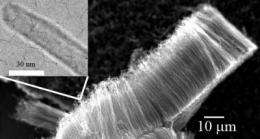
Carbon nanotubes could serve as supercapacitor electrodes with enhanced charge and energy storage capacity (inset: a magnified view of a single carbon nanotube). Credit: UC San Diego

(PhysOrg.com) -- Most people would like to be able to charge their cell phones and other personal electronics quickly and not too often. A recent discovery made by UC San Diego engineers could lead to carbon nanotube-based supercapacitors that could do just this.

In recent research, published in , Prabhakar Bandaru, a professor in the UCSD Department of Mechanical and Aerospace Engineering, along with graduate student Mark Hoefer, have found that artificially introduced defects in nanotubes can aid the development of supercapacitors.

"While batteries have large , they take a long time to charge; while electrostatic capacitors can charge quickly but typically have limited capacity. However, supercapacitors/electrochemical capacitors incorporate the advantages of both," Bandaru said.

Carbon nanotubes (CNTs) have been generally hailed as one of the wonder materials of the 21st century and have been widely recognized as ushering in the revolution. They are cylindrical structures, with diameters of 1 to 100 nanometers, that have been suggested to have outstanding structural, chemical, and electrical, characteristics based on their atomically perfect structures with a large surface area-to-volume ratio. However, defects are inevitable in such a practical structure, an aspect that was first investigated by UCSD engineering graduate student Jeff Nichols and then substantially extended by Hoefer in Bandaru's lab.

"We first realized that defective CNTs could be used for when we were investigating their use as electrodes for chemical sensors," Hoefer said. "During our initial tests we noticed that we were able to create charged defects that could be used to increase CNT charge storage capabilities."

Specifically, defects on nanotubes create additional charge sites enhancing the stored charge. The researchers have also discovered methods which could increase or decrease the charge associated with the defects by bombarding the CNTs with argon or hydrogen.

"It is important to control this process carefully as too many defects can deteriorate the electrical conductivity, which is the reason for the use of CNTs in the first place. Good conductivity helps in efficient charge transport and increases the power density of these devices," Bandaru added.

"At the very outset, it is interesting that CNTs, which are nominally considered perfect, could be useful with so many incorporated defects," he added.

The researchers think that the energy density and power density obtained through their work could be practically higher than existing capacitor configurations which suffer from problems associated with poor reliability, cost, and poor electrical characteristics.

Bandaru and Hoefer hope that their research could have major implications in the area of energy storage, a pertinent topic of today. "We hope that our research will spark future interest in utilizing CNTs as electrodes in charge storage devices with greater energy and power densities," Hoefer said.

While more research still needs to be done to figure out potential applications from this discovery, the engineers suggest that this research could lead to wide variety of commercial applications, and hope that more scientists and engineers will be compelled to work in this area, Bandaru said.

Meanwhile, Hoefer said this type of research will help fuel his future engineering career.

"It is remarkable how current tools and devices are becoming increasing more efficient and yet smaller due to discoveries made at the nanoscale," he said. "My time spent investigating CNTs and their potential uses at the Jacobs School will prepare me for my career, since future research will continue the trend of miniaturization while increasing efficiency."

More information: “Determination and enhancement of the capacitance contributions in carbon nanotube based electrode systems,” Applied Physics Letters. M. Hoefer and P.R. Bandaru.

Source: University of California - San Diego (news : web)

4.5 /5 (11 votes)  

Filter


Move the slider to adjust rank threshold, so that you can hide some of the comments.


Display comments: newest first

dirk_bruere
Nov 19, 2009

Rank: not rated yet
Numbers?
sender
Nov 20, 2009

Rank: not rated yet
i think nanowool suspended in electrolytes encased in closed cells will be the future of 'air' batteries, just waiting on the statistics
Rank 4.5 /5 (11 votes)
Relevant PhysicsForums posts
  • polymer nanocomposites
    createdFeb 10, 2012
  • Corrosion Tests on Magnesium
    createdFeb 09, 2012
  • polyethylene copper nanocomposite
    createdFeb 09, 2012
  • Output of xrd analysis
    createdFeb 08, 2012
  • Transport phenomena problem based on problems 18.B11 and 19B.6 from Bird, stewart, lw
    createdFeb 06, 2012
  • Help with material selection - Car Piston
    createdFeb 05, 2012
  • More from Physics Forums - Materials & Chemical Engineering

More news stories

What lies beneath: Mapping hidden nanostructures

The ability to diagnose and predict the properties of materials is vital, particularly in the expanding field of nanotechnology. Electron and atom-probe microscopy can categorize atoms in thin sheets of material, ...

Nanotechnology / Nanophysics

created 19 hours ago | popularity 5 / 5 (3) | comments 1

New kind of solar cell could capture significantly more energy than current cells

New solar cells could increase the maximum efficiency of solar panels by over 25%, according to scientists from the University of Cambridge.

Nanotechnology / Nanophysics

created Feb 08, 2012 | popularity 4.5 / 5 (12) | comments 14 | with audio podcast

Nanoshell whispering galleries improve thin solar panels

Visitors to Statuary Hall in the U.S. Capitol Building may have experienced a curious acoustic feature that allows a person to whisper softly at one side of the cavernous, half-domed room and for another on ...

Nanotechnology / Nanomaterials

created Feb 07, 2012 | popularity 4.3 / 5 (6) | comments 6 | with audio podcast

'Dark plasmons' transmit energy

Microscopic channels of gold nanoparticles have the ability to transmit electromagnetic energy that starts as light and propagates via "dark plasmons," according to researchers at Rice University.

Nanotechnology / Nanophysics

created Feb 09, 2012 | popularity 4.8 / 5 (9) | comments 1 | with audio podcast

Revealing how a battery material works

Since its discovery 15 years ago, lithium iron phosphate (LiFePO4) has become one of the most promising materials for rechargeable batteries because of its stability, durability, safety and ability to deliver ...

Nanotechnology / Nanomaterials

created Feb 08, 2012 | popularity 5 / 5 (5) | comments 0 | with audio podcast


Anonymous knocks CIA website offline (Update)

The website of the Central Intelligence Agency was inaccessible on Friday after the hacker group Anonymous claimed to have knocked it offline.

Humans may have helped the decline of African rainforests 3000 years ago

(PhysOrg.com) -- Large areas of rainforests in Central Africa mysteriously disappeared over three thousand years ago, to be replaced by savannas. The prevailing theory has been that the cause was a change ...

New error-correcting codes guarantee the fastest possible rate of data transmission

Error-correcting codes are one of the triumphs of the digital age. They’re a way of encoding information so that it can be transmitted across a communication channel — such as an optical fiber o ...

Small modular reactor design could be a 'SUPERSTAR'

(PhysOrg.com) -- Though most of today's nuclear reactors are cooled by water, we've long known that there are alternatives; in fact, the world's first nuclear-powered electricity in 1951 came from a reactor ...

New power source discovered

(PhysOrg.com) -- Researchers at the Massachusetts Institute of Technology (MIT) and RMIT University have made a breakthrough in energy storage and power generation.

The power of estrogen -- male snakes attract other males

A new study has shown that boosting the estrogen levels of male garter snakes causes them to secrete the same pheromones that females use to attract suitors, and turned the males into just about the sexiest ...