Scientists synthesize graphene-like material: Polymer with honeycomb structure
November 19, 2009
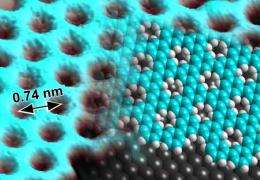
Scanning tunneling microscope image of the two-dimensional porous polymer (left side of image) with a model of the material structure superposed (right side: blue-green - carbon; white - hydrogen; gray - silver surface).
Two-dimensional carbon layers, so-called graphenes, are regarded as a possible substitute for silicon in the semiconductor industry. The electronic properties of these layers can be varied by "building in" specific arrays of holes in their structure. Physicists at Empa, Switzerland, together with chemists from the Max Planck Institute for Polymer Research in Mainz, Germany, have, for the first time, succeeded in synthesizing a graphene-like porous polymer with atomic accuracy.
Graphene consists of a two-dimensional carbon layer in which the carbon atoms are arranged on a hexagonal lattice, resembling a honeycomb. Carbon nanotubes are rolled-up sheets of graphene, and thick piles of graphene sheets form graphite.
Graphene boasts some very special characteristics - it is extremely tear-resistant, an excellent thermal conductor, and reconciles such conflicting qualities as brittleness and ductility. In addition, graphene is impermeable to gases, which makes it interesting for applications involving air-tight membranes. Because of its unusual electronic properties graphene is viewed as a possible substitute material for silicon in semiconductor technologies.
By inserting holes of a specific size and distribution into graphene sheets, it should be possible to impart the material particular electronic characteristics. For these reasons intensive research is being conducted worldwide into the synthesis and characterization of two-dimensional graphene-like polymers. Graphene and graphene-like polymers are currently hot research topics in materials science, with this year’s Körber European Science Award being awarded to the Dutch physicist Andre Geim for his pioneering studies in the field of two-dimensional carbon crystals.
New manufacturing method: “bottom-up” synthesis on metal surfaces
Together with colleagues from the Max Planck Institute for Polymer Research in Mainz, scientists from Empa’s "nanotech@surfaces" laboratory have for the first time succeeded in synthesizing a graphene-like polymer with well defined pores. To achieve this feat the researchers allowed chemical building blocks of functionalized phenyl rings to “grow” spontaneously into a two-dimensional structure on a silver substrate. This created a porous form of graphene with pore diameters of a single atom and pore-to-pore spacings of less than a nanometer.
Until now, porous graphene has been manufactured using lithographic processes during which the holes are subsequently etched into the layer of material. These holes are, however, much larger than just a few atoms in diameter. They are also not as near to each other and significantly less precisely shaped as with the "bottom-up" technique based on molecular self-assembly developed by the Empa and Max Planck group. In this process the molecular building blocks join together spontaneously at chemically defined linking points to form a regular, two-dimensional network. This allows graphene-like polymers to be synthesized with pores which are finer than is possible by any other technique.
More information:
• "Porous graphenes: two-dimensional polymer synthesis with atomic precision", Marco Bieri, Matthias Treier, Jinming Cai, Kamel Aďt-Mansour, Pascal Ruffieux, Oliver Gröning, Pierangelo Gröning, Marcel Kastler, Ralph Rieger, Xinliang Feng, Klaus Müllen, and Roman Fasel, Chem. Commun., 2009, 6919-6921
http://www.rsc.org … doi=b915190g
• "Highlights in Chemical Science" by «RSC (Royal Society of Chemistry) Publishing»: http://www.rsc.org … networks.asp
• "Research Highlight" in Nature Chemistry: http://www.nature. … hem.415.html
Provided by EMPA
-
A Smarter Way to Grow Graphene
May 14, 2008 |
not rated yet |
0
-
By adding graphene, researchers create superior polymer
May 19, 2008 |
not rated yet |
0
-
Unzipping Carbon Nanotubes Can Make Graphene Ribbons
Apr 20, 2009 |
not rated yet |
0
-
Nano World: Composites with nano-graphite
Jul 24, 2006 |
not rated yet |
0
-
Scientists discover ground-breaking material: Graphane
Jan 30, 2009 |
not rated yet |
0
-
Engineers build first sub-10-nm carbon nanotube transistor
Feb 01, 2012 |
4.9 / 5 (30) |
30
-
Something old, something new: Evolution and the structural divergence of duplicate genes
Jan 31, 2012 |
4.6 / 5 (7) |
1
-
The hidden nanoworld of ice crystals: Revealing the dynamic behavior of quasi-liquid layers
Jan 30, 2012 |
5 / 5 (3) |
1
-
Stock market network reveals investor clustering
Jan 27, 2012 |
3.9 / 5 (23) |
8
-
Of microchemistry and molecules: Electronic microfluidic device synthesizes biocompatible probes
Jan 26, 2012 |
5 / 5 (1) |
0
-
polymer nanocomposites
11 hours ago
-
Corrosion Tests on Magnesium
Feb 09, 2012
-
polyethylene copper nanocomposite
Feb 09, 2012
-
Output of xrd analysis
Feb 08, 2012
-
Transport phenomena problem based on problems 18.B11 and 19B.6 from Bird, stewart, lw
Feb 06, 2012
-
Help with material selection - Car Piston
Feb 05, 2012
- More from Physics Forums - Materials & Chemical Engineering
More news stories
What lies beneath: Mapping hidden nanostructures
The ability to diagnose and predict the properties of materials is vital, particularly in the expanding field of nanotechnology. Electron and atom-probe microscopy can categorize atoms in thin sheets of material, ...
3 hours ago |
5 / 5 (1) |
1
'Dark plasmons' transmit energy
Microscopic channels of gold nanoparticles have the ability to transmit electromagnetic energy that starts as light and propagates via "dark plasmons," according to researchers at Rice University.
20 hours ago |
5 / 5 (6) |
1
|
New kind of solar cell could capture significantly more energy than current cells
New solar cells could increase the maximum efficiency of solar panels by over 25%, according to scientists from the University of Cambridge.
Feb 08, 2012 |
4.5 / 5 (12) |
14
|
Nanoshell whispering galleries improve thin solar panels
Visitors to Statuary Hall in the U.S. Capitol Building may have experienced a curious acoustic feature that allows a person to whisper softly at one side of the cavernous, half-domed room and for another on ...
Nanotechnology / Nanomaterials
Feb 07, 2012 |
4.3 / 5 (6) |
6
|
Nanotube therapy takes aim at breast cancer stem cells
Wake Forest Baptist Medical Center researchers have again proven that injecting multiwalled carbon nanotubes (MWCNTs) into tumors and heating them with a quick, 30-second laser treatment can kill them.
Nanotechnology / Bio & Medicine
Feb 09, 2012 |
5 / 5 (1) |
0
|
Hovering not hard if you're top-heavy, researchers find
Top-heavy structures are more likely to maintain their balance while hovering in the air than are those that bear a lower center of gravity, researchers at New York University's Courant Institute of Mathematical Sciences ...
Grass to gas: Researchers' genome map speeds biofuel development
Researchers at the University of Georgia have taken a major step in the ongoing effort to find sources of cleaner, renewable energy by mapping the genomes of two originator cells of Miscanthus x giganteus, a large perenn ...
Drug halts organ damage in inflammatory genetic disorder
A new study shows that Kineret (anakinra), a medication approved for the treatment of rheumatoid arthritis, is effective in stopping the progression of organ damage in people with neonatal-onset multisystem inflammatory disease ...
Cochlear implants may be safe, effective for organ transplant patients
Cochlear implants may be a safe, effective option for some organ transplant patients who've lost their hearing as an unfortunate consequence of their transplant-related drug regime, researchers report.
Researchers develop new method for creating tissue engineering scaffolds
Researchers at Northwestern University have developed a new method for creating scaffolds for tissue engineering applications, providing an alternative that is more flexible and less time-intensive than current technology.
Molecular profiling reveals differences between primary and recurrent ovarian cancers
There is a need to analyze tumor specimens at the time of ovarian cancer recurrence, according to a new study published in Molecular Cancer Therapeutics. Researchers used a diagnostic technology called molecular profiling to examine ...
Nov 19, 2009
Rank: not rated yet
How about He?