Mystery of the Solar Tsunami -- Solved (w/ Video)
November 19, 2009 Mystery of the Solar Tsunami -- Solved

Enlarge

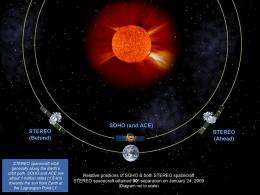
The unique orbit of STEREO's twin spacecraft allowed scientists to confirm the existence of solar tsunamis. Credit: NASA

(PhysOrg.com) -- Sometimes you really can believe your eyes. That's what NASA's Solar Terrestrial Relations Observatory (STEREO) is telling researchers about a controversial phenomenon on the sun known as the "solar tsunami."

Years ago, when solar physicists first witnessed a towering wave of hot plasma racing across the sun's surface, they doubted their senses. The scale of the wave was staggering: It rose up higher than Earth itself and rippled out from a central point in a circular pattern millions of kilometers in circumference. Skeptical observers suggested it might be a shadow of some kind—a trick of the satellite's eye—but surely not a real wave.

"Now we know," says Joe Gurman of the Laboratory at NASA's Goddard Space Flight Center. "Solar tsunamis are real."

You need Flash installed to watch this ideo

Violent events on the Sun can trigger waves much the same as earthquakes can trigger tsunamis on the Earth, as shown in this computer simulation. Credit: NASA/Walt Feimer, GSFC Conceptual Image Lab

The twin confirmed their reality in February 2009 when sunspot 11012 unexpectedly erupted. The blast hurled a billion-ton cloud of gas (a coronal mass ejection, or CME) into space and sent a tsunami racing along the sun's surface. STEREO recorded the wave from two positions separated by 90 degrees, giving researchers an unprecedented view of the event.

"It was definitely a wave," says Spiros Patsourakos of George Mason University, lead author of a paper reporting the finding in Astrophysical Journal Letters. "Not a wave of water, but a giant wave of hot plasma and magnetism."

The technical name is "fast-mode magnetohydrodynamical wave," or "MHD wave" for short. The one STEREO saw reared up about 100,000 kilometers high, raced outward at 250 km/second (560,000 mph), and packed as much energy as 2400 megatons of TNT (1029 ergs).

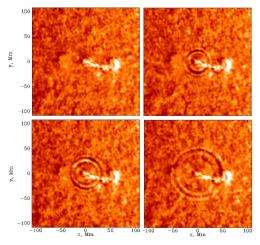
Solar tsunamis were discovered in 1997 by the Solar and Heliospheric Observatory (SOHO). In May of that year, a CME came blasting up from an active region on the sun's surface, and SOHO recorded a tsunami rippling away from the blast site.

"We wondered," recalls Gurman, "is that a wave, or just a shadow of the CME overhead?"

SOHO's single point of view was not enough to answer the question—neither for that first wave nor for many similar events recorded by SOHO in years that followed.

The question remained open until after the launch of STEREO. At the time of the February 2009 eruption, STEREO-B was directly over the blast site, while STEREO-A was stationed at a right angle —"perfect geometry for cracking the mystery," says co-author Angelos Vourlidas of the Naval Research Laboratory in Washington, D.C.

The physical reality of the waves has been further confirmed by movies of the waves crashing into things. "We've seen the waves reflected by sunspots," says Vourlidas. "And there is a wonderful movie of a solar prominence oscillating after it gets hit by a wave. We call it the 'dancing prominence.'"
Mystery of the Solar Tsunami -- Solved
Enlarge

Scientists first spied tsunami-like waves on the surface of the sun in July 1996 with SOHO. Credit: SOHO (ESA & NASA)

Solar tsunamis pose no direct threat to Earth, but they are important to study. "We can use them to diagnose conditions on the ," notes Gurman. "By watching how the waves propagate and bounce off things, we can gather information about the sun's lower atmosphere available in no other way."

"Tsunami waves can also improve our forecasting of space weather," adds Vourlidas, "Like a bull-eye, they 'mark the spot' where an eruption takes place. Pinpointing the blast site can help us anticipate when a CME or radiation storm will reach Earth."

And they're pretty entertaining, too. "The movies," he says, "are out of this world."

More information: : "'Extreme Ultraviolet Waves' are Waves: First Quadrature Observations of an Extreme Ultraviolet Wave from STEREO" http://www.iop.org/EJ/abstract/1538-4357/700/2/L182/

Provided by JPL/NASA (news : web)


Rate this story - 4.8 /5 (30 votes)

Rank Filter

Move the slider to adjust rank threshold, so that you can hide some of the comments.


Display comments: newest first

  • CWFlink - Nov 19, 2009
    • Rank: 5 / 5 (2)
    What we don't know could fill black holes! Amazing! ...stereo makes a big difference, again!

    Perspective is everything! :)
  • omatumr - Nov 19, 2009
    • Rank: 2.8 / 5 (6)
    We Know So Little About The Sun

    For decades - at least since the 1969 Apollo Mission returned lunar samples to Earth whose surfaces were filled with elements implanted by the solar wind - NASA insisted that experimental data fit the Standard Solar Model of a giant ball of hydrogen heated by a steady H-fusion reactor.

    The very first analysis revealed evidence of mass-dependent fractionation enriching lightweight isotopes at the surface of the Sun and in the solar wind.

    Those data suggested that simple mass-dependent fractionation might also explain the high abundance of lightweight elements at the solar surface, where the lightest element, H = 91% and the next lightest element, He = 9%.

    Now four decades later, red-faced NASA officials try to convince the public that Earth's climate is immune to changes in the Sun, a variable star, without explaining why NASA ignored experimental data in favor of the Standard Solar Model of a giant ball of hydrogen (H) heated by H-fusion.
  • antialias - Nov 20, 2009
    • Rank: not rated yet
    and packed as much energy as 2400 megatons of TNT (1029 ergs).


    Umm... I thought an erg was 10^-7 Joules (which is not a lot). So something doesn't seem right here (or did they mean 10-to-the-power-of-29 ergs?)
  • frajo - Nov 20, 2009
    • Rank: 3 / 5 (2)
    or did they mean 10-to-the-power-of-29 ergs?

    Certainly. This kind of typo happens quite often.
  • RayCherry - Nov 20, 2009
    • Rank: 5 / 5 (2)
    No kind regards? Tut-tut! ;-)

    Are all such eruptions, and associated surface waves, caused by internal disruptions only? Or has there been any recordings of comets or meteors making it through the corona to the solar surface, causing this wave phenomena?
  • Nik_2213 - Nov 20, 2009
    • Rank: 4.5 / 5 (2)
    IIRC, SOHO has logged a bunch of sun-grazing comets being 'eaten' without obvious effect. There may be fractional enrichment of solar wind from those impacts, but nothing spectacular. I reckon you'd have to toss in a minor planet to be noticed...

    FWIW, I remember reports of a small Lunar impact during a meteorite shower. Is there any recent evidence of big Mars or Venus impacts ??
  • nkalanaga - Nov 20, 2009
    • Rank: 5 / 5 (1)
    One of the Mars orbiters sent back a pair of pictures, taken some time apart, which showed that a crater appeared during the interval. It wasn't a big crater, but it did show that rocks do hit Mars.

    As for Venus, as dense as its atmosphere is, it would take a fair sized object to reach the surface. I doubt that anything smaller than a hundred meters would survive to leave a crater, but don't know what the actual size is, if anyone has published the results.
  • RayCherry - Nov 21, 2009
    • Rank: not rated yet
    I have read reports of the dedicated solar telescopes, terrestrial and satellite recording sun grazers, but have seen nothing about impactors. Just curious, because all the literature indicates that objects that are pulled toward the inner solar system on trajectories that provide minimal possibilities for achieving any stable orbit should either get a gravity assisted boot back out of the area, or 'fall into the sun'. The latter, in conjunction with the phenomena reported above piqued my curiousity. Obviously there is enough energy radiating outward to destablise most matter and turn most objects to gas before reaching the solar surface, but what about the occassionally wandering asteroid or planetesimal? How big, dense, (and not talking about being stupid here) and how fast would you have to be to cause wrinkles in the skin of the sun?
  • omatumr - Nov 22, 2009
    • Rank: 1 / 5 (1)
    No kind regards? Tut-tut! ;-)

    Are all such eruptions, and associated surface waves, caused by internal disruptions only?


    Sunspots themselves arise from deep-seated magnetic fields of ancient origin, perhaps coming the Sun's compact energetic neutron core or from Bose-Einstein condensation of iron-rich, zero-spin material surrounding the solar core into a rotating, superfluid, superconductor. This is probably the energy source for sunspot 11012, the one that unexpectedly erupted in February and hurled a billion-ton cloud of gas into space and sent a tsunami racing along the sun's surface.

    With kind regards,
    Oliver K. Manuel
    Former NASA PI for Apollo

November 19, 2009 all stories

Comments: 9

4.8 /5 (30 votes)

  • hide
  • Related Stories

  • The Surprising Shape of Solar Storms (w/Video)
    created Apr 14, 2009 | popularity not rated yet | comments 0
  • The Sun's X-file under the Spotlight
    created Sep 03, 2004 | popularity not rated yet | comments 0
  • STEREO Reveals the Anatomy of a Solar Storm in 3D
    created Apr 28, 2009 | popularity not rated yet | comments 0
  • NASA releases first 3-D images of the sun from STEREO
    created Apr 23, 2007 | popularity not rated yet | comments 0
  • NASA satellite sees solar hurricane detach comet tail
    created Oct 01, 2007 | popularity not rated yet | comments 0


  • hide
  • Relevant PhysicsForums posts

  • Why Don't Sunrise and Sunset Times Change Symmetrically?
    created 16 hours ago
  • Where in the sky do meteors come from at any arbitrary point in the year?
    created Sep 04, 2010
  • Name of asteroid that'll pass very close
    created Sep 02, 2010
  • What gas giant, what moon(s) are split in half and.
    created Sep 02, 2010
  • Total speed of Earths movement
    created Sep 01, 2010
  • expanding universe
    created Aug 30, 2010
  • More from Physics Forums - General Astronomy

Other News

The rocket is named after the famous Danish astronaut Tycho Brahe

Technical glitch grounds homemade Danish rocket

Space & Earth / Space Exploration

created 14 hours ago | popularity 3.7 / 5 (3) | comments 0

The first launch attempt of a homemade rocket built by two Danes failed on Sunday because of a technical glitch, according to Danish media.


Dramatic climate change is unpredictable

Dramatic climate change is unpredictable

Space & Earth / Earth Sciences

created Aug 30, 2010 | popularity 3.7 / 5 (22) | comments 33 | with audio podcast

The fear that global temperature can change very quickly and cause dramatic climate changes that may have a disastrous impact on many countries and populations is great around the world. But what causes climate ...


asteroid impact

Study suggests dinosaurs killed off by more than one asteroid

Space & Earth / Earth Sciences

created Aug 31, 2010 | popularity 4.2 / 5 (19) | comments 24 | with audio podcast report

(PhysOrg.com) -- Dinosaurs, along with over half of other species, became extinct at the end of the Cretaceous period about 65.5 million years ago, and many scientists believe this was due to a single impact ...


Impact hypothesis loses its sparkle

Impact hypothesis loses its sparkle

Space & Earth / Earth Sciences

created Aug 30, 2010 | popularity 4.3 / 5 (13) | comments 22 | with audio podcast

Shock-synthesized diamonds said to prove a catastrophic impact killed off North American megafauna can't be found.


Hubble observations of supernova reveal composition of 'star guts' pouring out

Hubble observations of supernova reveal composition of 'star guts' pouring out

Space & Earth / Astronomy

created Sep 02, 2010 | popularity 4.9 / 5 (15) | comments 10 | with audio podcast

Observations made with NASA's newly refurbished Hubble Space Telescope of a nearby supernova are allowing astronomers to measure the velocity and composition of "star guts" being ejected into space following ...