NASA Provides Venerable Hubble Hardware to Smithsonian
November 19, 2009
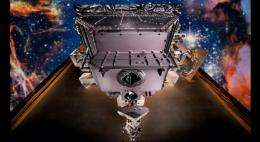
NASA's Wide Field and Planetary 2 camera on display in the National Air and Space Museum's Space Hall. Courtesy: Smithsonian
(PhysOrg.com) -- Two key instruments from NASA's Hubble Space Telescope have a new home in the Smithsonian's National Air and Space Museum in Washington after being returned to Earth aboard space shuttle Atlantis last May.
Astronauts brought back the Wide Field and Planetary Camera 2, or WFPC-2, and the Corrective Optics Space Telescope Axial Replacement, or COSTAR, after more than 15 years in space. The camera returned the iconic images that now adorn posters, album covers, the Internet, classrooms and science text books worldwide.
"This was the camera that saved Hubble," said Ed Weiler, associate administrator for the Science Mission Directorate at NASA Headquarters in Washington. "I have looked forward for a long time to stand in front of this very instrument while on display to the public."
After Hubble's launch and deployment aboard the shuttle in 1990, scientists realized the telescope's primary mirror had a flaw, known as a spherical aberration. The outer edge of the mirror was ground too flat by a depth of 2.2 microns, roughly equal to one-fiftieth the thickness of a human hair. This tiny flaw resulted in fuzzy images because some of the light from the objects being studied was scattered.
Hubble's first servicing mission provided the telescope with hardware that basically acted as eye glasses. Launched in December 1993 aboard space shuttle Endeavour, the mission added the WFPC-2, about the size of a baby grand piano, and COSTAR, about the size of a telephone booth. The WFPC-2 had the optical fix built in, while the COSTAR provided the optical correction for other Hubble instruments.
The WFPC-2 made more than 135,000 observations of celestial objects from 1993 to 2009. The camera was the longest serving and most prolific instrument aboard Hubble.
"For years the Wide Field and Planetary Camera 2 has been taking pictures of the universe," said John Trauger of NASA's Jet Propulsion Laboratory in Pasadena, Calif. "Today, we are taking pictures of the WFPC-2 and I guess if there was ever a camera that deserves to have its picture taken, this is it."
The Hubble instruments will be on display in the National Air and Space Museum's Space Hall through mid-December. They then will travel to Southern California to go on temporary display at several venues. In March 2010, the instruments will return to the Smithsonian Air and Space Museum, where they will take up permanent residency.
JPL designed and built the WFPC-2. The COSTAR instrument was built by Ball Aerospace in Boulder, Colo. The Hubble Space Telescope is a project of international cooperation between NASA and the European Space Agency. The project is managed by NASA's Goddard Space Flight Center in Greenbelt, Md. The Space Telescope Science Institute in Baltimore conducts Hubble science operations. The institute is operated for NASA by the Association of Universities for Research in Astronomy Inc., in Washington.
-
New Science Instruments for Hubble
Oct 16, 2007 |
not rated yet |
0
-
Engineers Restart Hubble Camera
Jul 03, 2006 |
not rated yet |
0
-
NASA Invites Public to Choose Hubble's Next Discovery
Jan 28, 2009 |
not rated yet |
0
-
Engineers Investigate Issue on One of Hubble's Science Instruments
Jan 29, 2007 |
not rated yet |
0
-
NASA announces details of Hubble servicing mission
Jan 08, 2008 |
not rated yet |
0
-
Engineers build first sub-10-nm carbon nanotube transistor
Feb 01, 2012 |
4.9 / 5 (31) |
30
-
Something old, something new: Evolution and the structural divergence of duplicate genes
Jan 31, 2012 |
4.6 / 5 (7) |
1
-
The hidden nanoworld of ice crystals: Revealing the dynamic behavior of quasi-liquid layers
Jan 30, 2012 |
5 / 5 (3) |
1
-
Stock market network reveals investor clustering
Jan 27, 2012 |
3.9 / 5 (23) |
8
-
Of microchemistry and molecules: Electronic microfluidic device synthesizes biocompatible probes
Jan 26, 2012 |
5 / 5 (1) |
0
-
Titan's lack of impact craters
Feb 09, 2012
-
Real pictures of black hole eating a star?
Feb 08, 2012
-
Hypothetical way to travel faster than light, but not technically exceed lightspeed
Feb 06, 2012
-
How do scientists monitor the Sun's activity?
Feb 05, 2012
-
Search patterns in observational studies
Feb 05, 2012
-
Derivation of Pogson's law
Feb 03, 2012
- More from Physics Forums - General Astronomy
More news stories
NASA sees wide-eyed cyclone Jasmine
Cyclone Jasmine's eye has opened wider on NASA satellite imagery, as it moves through the Southern Pacific Ocean.
Space & Earth / Earth Sciences
20 minutes ago |
not rated yet |
0
NASA sees Giovanna reach cyclone strength, threaten Madagascar
Tropical Storm 12S built up steam and became a cyclone on February 10, 2012 as NASA's Terra satellite passed overhead. Residents of east-central Madagascar should prepare for this cyclone to make landfall ...
Space & Earth / Earth Sciences
19 minutes ago |
not rated yet |
0
Humans may have helped the decline of African rainforests 3000 years ago
(PhysOrg.com) -- Large areas of rainforests in Central Africa mysteriously disappeared over three thousand years ago, to be replaced by savannas. The prevailing theory has been that the cause was a change ...
Could Venus be shifting gear?
(PhysOrg.com) -- ESAs Venus Express spacecraft has discovered that our cloud-covered neighbour spins a little slower than previously measured. Peering through the dense atmosphere in the infrared, the ...
Space & Earth / Space Exploration
8 hours ago |
5 / 5 (5) |
7
|
Mars Science Laboratory computer issue resolved
(PhysOrg.com) -- Engineers have found the root cause of a computer reset that occurred two months ago on NASA's Mars Science Laboratory and have determined how to correct it.
Space & Earth / Space Exploration
9 hours ago |
5 / 5 (5) |
3
|
CIA website offline, Anonymous takes credit
The website of the Central Intelligence Agency was unresponsive on Friday after the hacker group Anonymous claimed to have knocked it offline.
Complex wiring of the nervous system may rely on a just a handful of genes and proteins
Researchers at the Salk Institute have discovered a startling feature of early brain development that helps to explain how complex neuron wiring patterns are programmed using just a handful of critical genes. ...
The power of estrogen -- male snakes attract other males
A new study has shown that boosting the estrogen levels of male garter snakes causes them to secrete the same pheromones that females use to attract suitors, and turned the males into just about the sexiest ...
New error-correcting codes guarantee the fastest possible rate of data transmission
Error-correcting codes are one of the triumphs of the digital age. Theyre a way of encoding information so that it can be transmitted across a communication channel such as an optical fiber o ...
Small modular reactor design could be a 'SUPERSTAR'
(PhysOrg.com) -- Though most of today's nuclear reactors are cooled by water, we've long known that there are alternatives; in fact, the world's first nuclear-powered electricity in 1951 came from a reactor ...
Curry spice component may help slow prostate tumor growth
Curcumin, an active component of the Indian curry spice turmeric, may help slow down tumor growth in castration-resistant prostate cancer patients on androgen deprivation therapy (ADT), a study from researchers ...