Hunting for Planets in the Dark
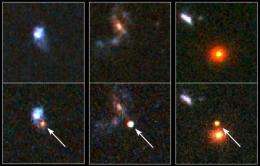
A proposed space mission that aims to measure dark energy could also detect planets that current surveys are unable to find.
Dark energy isn't good for life in the universe. This mysterious substance, which cosmologists believe makes up around 70 percent of the universe, may eventually pull apart galaxies, then stars and planets, and finally atoms and molecules, in what some call the Big Rip.
It’s ironic, then, that the search for dark energy might help in the search for life in the universe. That's because planet hunting through a technique called microlensing requires a similar sort of instrument as a dark energy mission.
"Both dark energy and microlensing planet studies are best done with a wide-field telescope optimized for infrared observing," says Peter Garnavich a cosmologist from the University of Notre Dame.
In Europe, the Euclid mission is a proposed space telescope for characterizing dark energy, but some believe that it might be more attractive to funding agencies if it included an exoplanet survey. A similar collaboration is being considered in the United States.
"There is less money for research, so it is important to have robust, low-risk missions that maximize the scientific return," says Euclid-team-member Jean-Philippe Beaulieu of the Institut d'Astrophysique de Paris (IAP).
Converging technology
The first evidence of dark energy came from supernova observations made a decade ago. The data showed that the farthest supernovae were fainter than expected, which meant that the expansion of the universe is accelerating. No known force can do that, so it was theorized that some unknown energy must be pulling everything apart.
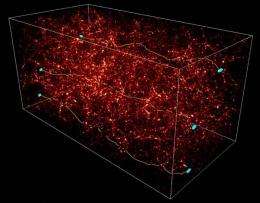
To get a better understanding of dark energy, cosmologists want to measure how the acceleration has changed over time. This could be done in one of three ways: (1) with more supernova observations, (2) by mapping out the way galaxies cluster together, or (3) by observing the apparent distortion in the shapes of distant galaxies caused by matter along the line of sight.
All of these techniques require a large space telescope that can stare at a big piece of the sky, but this fits the bill of another astronomical enterprise.
"The microlensing planet search will also need a large detector and big sky footprint, so it is natural to think that these two seemingly different programs could work with the same space telescope," Garnavich says.
Originally, the marriage of planet hunting and dark energy was part of the DUNE mission that was proposed to the European Space Agency (ESA) as part of its Cosmic Vision 2007.
However, ESA decided that DUNE should be merged with another dark energy project called SPACE. The resulting mission, Euclid, is still under review.
The Euclid design is still being hammered out, but the main instrument is a 1.2-meter diameter telescope for high-resolution optical imaging. It would map the distribution of galaxies across the sky, as well as measure the amount of distortion (so-called weak lensing) caused by the bending of light as it travels through regions of dense matter on its way to us.
Without any design changes, this dark-energy telescope could also search for microlensing events, which are caused by a similar light-bending effect involving stars and planets rather than galaxies.
Massive lenses
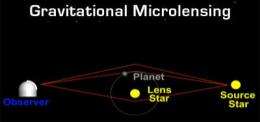
A microlensing surveys detects planets by looking at a large number of target stars and waiting for another star to pass near the line of sight. The mass of the foreground star will bend light around it, causing the background star to suddenly brighten. The increase in flux can be anywhere from a factor of a few to a factor of a thousand.
If there is a planet around the foreground star, it may invoke an additional blip in the observed light. In the typical microlensing event, the planet causes the background star to brighten (or sometimes darken) by 20 to 30 percent, Beaulieu says.
The data from a microlensing event tells astronomers the mass of the star and planet and the orbital separation between them, and also the distance to the system. But because microlensing systems are typically very far away, there is little chance to learn more. A microlensing planet is only observed once.
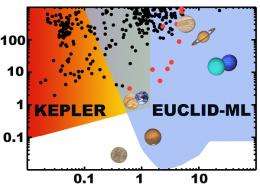
Despite this limitation, important statistical information can be collected, says Beaulieu. Microlensing is more sensitive to planets at orbital radii larger than an astronomical unit, or AU, which is the Earth-Sun separation.
That means microlensing searches complement other planet-hunting techniques, like radial velocity and transiting, that are more sensitive to planets that orbit very close to their star.
"We are arriving at one AU from both ends," Beaulieu says. "Transiting searches like Kepler are moving out from the hot part. Microlensing surveys are coming in from the cold part."
Filling in the cold part of the planet census - beyond the "snow line" where surface water is frozen rather than liquid - is important in modeling how planetary systems form.
"Without any understanding of low-mass planets in more distant orbits, it will be difficult to understand how the different regions of the proto-planetary disk interact during the planet formation process." says David Bennett from the University of Notre Dame. Bennett is the principal investigator of the Microlensing Planet Finder (MPF), a dedicated planet-hunting spacecraft that NASA is considering.
Aiming higher
There are a number of ground-based telescopes that are watching the skies for microlensing events. So far they have netted 9 planets, with 6 or 7 more candidates for which the data has not yet been published, Beaulieu says.
Moving a telescope from the ground into space will increase angular resolution and allow more small stars to be observed. Since there's only about a one-in-a-million chance that a background star will be microlensed, observing more stars means better odds of finding planets, especially those that are Earth-like.
Beaulieu and his colleagues have determined that - with 3 months of observations from Euclid - they could survey 200 million stars and possibly detect 10 Earth-like planets.
ESA is currently reviewing Euclid and 5 other similar-sized missions, in order to select which 2 will be selected for launch in the coming decade as part of Cosmic Vision 2015-2025.
"I think that a microlensing planet search would significantly improve Euclid's chances of being funded," says Bennett, whose MPF project might also be coupled to a dark energy mission.
The main drawback of these joint ventures is that planet-hunters and cosmologists would have to share observing time, which would also mean sharing financial support.
"Space agencies often divide up their funding into areas based on broad topics like cosmology or solar system," Garnavich says. "When a project comes along that can produce good science across these divisions, often the territorial imperative kicks in and the bureaucrats are unwilling to share funding or work with another group even in their own organization."
Source: Astrobio.net, by Michael Schirber


