Study uses brain scans to discover how children 'read' faces
November 20, 2009 Study uses brain scans to discover how children 'read' faces

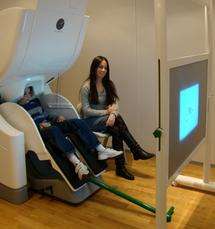
Researcher Banu Ahtam guides 9 year old Oscar Nathan through the study.

(PhysOrg.com) -- Oxford University scientists are using brain-scanning technology to understand how we learn to recognise and 'read' faces as children.

The research will also investigate whether there are any differences in the way people with autism spectrum disorders respond to seeing faces.

‘Faces are really very similar in their basic features, but we are very good at recognising different faces instantly. The brain has to be very specialised to be able to do this quickly and accurately,’ says Dr Jennifer Swettenham, who is leading the study.

The ability to recognise faces is very important for communication and socialising. We need to be able to recognise people’s , and also understand their emotions, respond to where they are looking, and many other signs and indications.

‘If there’s a problem with the way the brain processes faces then this can have profound impact on people’s ability to understand social situations,’ says Dr Swettenham. ‘There is a lot of evidence to suggest that people with have difficulty with processing faces.’

Psychologists in the Oxford Autism Research Group are using a technique called magnetoencephalography (MEG) to map in children of different ages when they are shown photos of different things. The researchers aim to discover when our brains become specialised to ‘see’ faces. They will also compare children with and without autism spectrum disorder (ASD) to see if the development of these brain responses is affected by ASD.

Magnetoencephalography (MEG) is a non-invasive technique that uses sensors to record magnetic activity produced by active , or neurons, in the brain. Children sit on a chair with their head surrounded by the sensors, but they are not in an enclosed space like MRI scans and MEG does not make a noise, unlike MRI.

‘We hope this research will help us understand more about autism spectrum disorder and about ,’ says Dr Swettenham.

The researchers aim to involve 96 children aged between 5 and 16, with and without autism spectrum disorder, in the study.

Provided by Oxford University (news : web)


Rate this story - not rated yet

Rank Filter

Move the slider to adjust rank threshold, so that you can hide some of the comments.


Display comments: newest first

  • Super_Ego - Nov 21, 2009
    • Rank: not rated yet
    Have they investigated this in light of mirror neurons?

November 20, 2009 all stories

Comments: 1

not rated yet

  • hide
  • Related Stories


  • hide
  • Relevant PhysicsForums posts

Other News

Depression and lack of concentration do not necessarily go together

Medicine & Health / Psychology & Psychiatry

created 3 hours ago | popularity 5 / 5 (1) | comments 0

Many clinicians believe that depression goes hand in hand with cognitive difficulties such as memory problems or difficulties concentrating and paying attention, but a recent review of nearly 20 years of literature conducted ...


boredom

Bored to death? It's possible

Medicine & Health / Psychology & Psychiatry

created 18 hours ago | popularity 3.9 / 5 (15) | comments 7 | with audio podcast report

(PhysOrg.com) -- Scientists from the University College London in the U.K. have found that living a life of boredom can kill you.


Feeling blue? You'll shun the new

Feeling blue? You'll shun the new

Medicine & Health / Psychology & Psychiatry

created 7 hours ago | popularity 5 / 5 (3) | comments 0 | with audio podcast

A sick or sad child might cling to mom's leg. But that same child - fed, rested and generally content - will happily toddle off to explore every nook and cranny of the known world. Or: You're chipper and you ...


Babies wise to what we really mean: Researchers find first evidence that six-month-olds comprehend adults' intentions

Medicine & Health / Psychology & Psychiatry

created 8 hours ago | popularity 5 / 5 (1) | comments 0 | with audio podcast

A study by York University researchers reveals that infants as young as six months old know when we're "playing" them - and they don't like it.


Early life stress may predict cardiovascular disease

Early life stress may predict cardiovascular disease

Medicine & Health / Health

created 8 hours ago | popularity not rated yet | comments 0 | with audio podcast

Early life stress could be a risk factor for cardiovascular disease in adulthood, researchers report.