Dutch build more dunes against rising seas
November 20, 2009 by Alix Rijckaert More than 18 million cubic metres of sand are set to be poured onto the new coastal band of dunes until 2011

Enlarge

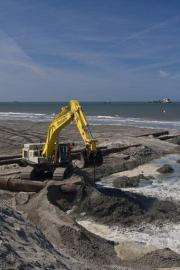
Handout photo shows a bulldozer clearing sand on the beach in Monster in the Netherlands. Sand is being dredged from the bottom of the North Sea off the coast of the country to build dunes as part of an ambitious effort to safeguard the country from flooding.

On the beach at Monster, bulldozers painstakingly turn sand dredged from the bottom of the North Sea bed into dunes in an ambitious effort to safeguard the Netherlands from flooding.

Stretching more than 20 kilometres (15 miles) southwards from The Hague, the project is one of many in a never-ending battle against rising sea levels attributed to global warming.

"Because it is a low-lying delta, the Netherlands is very sensitive to ," Water Management Deputy Minister Tineke Huizinga told AFP on a recent visit to the bustling work site.

"If sea and river levels rise, the Netherlands will be under threat," Huizinga said, walking in yellow boots along a pipeline of several hundred metres (yards) spewing out dredged sand.

"Fortunately, the coast is safe today, but we are investing in the security of people who will live here in 50 years."

More than 18 million cubic metres of sand -- enough to fill 7,200 Olympic-sized swimming pools -- are set to be poured onto the new coastal band of dunes until 2011.

The project got underway last year at a total cost of 130 million euros (about 200 million dollars) to the Dutch state.

Sand is dredged from the bottom of the , about 15 kilometres from shore, by two specialised vessels that work in turns, day and night, before being relayed to the beach via the pipeline.

Bulldozers then amass the sand to create the dunes, broaden the beach and gain territory from the sea, metre by metre.

"We had no choice but to extend the coast towards the sea," the area's flood prevention chief Michiel van Haersma Buma told AFP.

"Our coast is relatively narrow. Houses and greenhouses lie just beyond the dunes. This area is so densely populated that we had no space to construct more dunes and dykes further inland."

The new dunes -- 30 to 60 metres wide, and rising up to 10 metres above -- are going up next to an existing band of dunes. Covering them is a special type of grass with long roots to keep the sand intact.

"The more dunes there are, the less sea water can infiltrate," thus reducing the danger of contamination of fresh water inland, Haersma Buma explained.

When completed, the project would have made the 20-kilometre stretch of dune-lined beach up to 200 metres wide at low tide, compared to 180 metres at present.

The economic stakes are high: Up to 65 percent of the Netherlands' gross domestic product comes from areas that are located below sea level.

"We want to to be able to live and work in security," Huizinga said.

"It is a big investment. But the cost of protecting this area is a fraction of the cost that a would cause to the economy -- and that does not even take into account the social disruption and loss of life."

The government is due to unveil a new programme next year for protecting the nation from water-related consequences of global warming, at a cost to the state of around one billion euros (1.5 billion dollars) per year from 2020, water ministry spokeswoman Marie-Christine Lanser-Reusken told AFP.

In September last year, a government-appointed commission warned that the Netherlands must spend more than 100 billion euros over the next century on dike upgrades and coastal expansion.

The Delta commission predicted a sea level rise of between 0.65 and 1.3 metres (2.15 and 4.3 feet) by 2100, and said about nine million of the country's 16 million inhabitants already lived in areas directly shielded from the sea and rivers by dikes and dunes.

Floods in 1953 killed 1,835 people and left 72,000 homeless when a total 200,000 hectares of land in the southern provinces of Zeeland, Noord Brabant and Zuid-Holland were inundated.

(c) 2009 AFP


Rate this story - 4.3 /5 (6 votes)


November 20, 2009 all stories

Comments: 0

4.3 /5 (6 votes)

  • hide
  • Related Stories

  • Dutch, making peace with water, tackle overcrowding
    created Oct 18, 2009 | popularity not rated yet | comments 0
  • Squeezing out dune plants
    created Sep 26, 2005 | popularity not rated yet | comments 0
  • Town beach between canal and a hard place
    created Mar 30, 2008 | popularity not rated yet | comments 0
  • English Coast Stays Abreast of Possible Perils of Global Warming
    created May 15, 2006 | popularity not rated yet | comments 0
  • Dune and Dirty: Hurricane Teaches Lessons Through Ecosystem Research
    created Dec 08, 2008 | popularity not rated yet | comments 0


  • hide
  • Relevant PhysicsForums posts

  • Carbon Dioxide emissions question
    created Feb 08, 2010
  • Photosynthesis vs. carbonization
    created Feb 07, 2010
  • Sheep's footprints
    created Feb 05, 2010
  • How did Victorians estimate the ages of fossils?
    created Feb 03, 2010
  • How can we defeat pollution as individuals?
    created Jan 29, 2010
  • Formation of lava fields on Lanzarote
    created Jan 27, 2010
  • More from Physics Forums - Earth

Other News

A new 3-D map of the interstellar gas within 300 parsecs from the sun

A new 3D map of the interstellar gas within 300 parsecs from the Sun

Space & Earth / Astronomy

created 1hour ago | popularity 5 / 5 (3) | comments 0 | with audio podcast

(PhysOrg.com) -- Astronomy & Astrophysics is publishing new 3D maps of the interstellar gas in the local area around our Sun. A French-American team of astronomers presents new absorption measurements toward ...


Rho Ophiuchus cloud

Professor: We have a 'moral obligation' to seed universe with life

Space & Earth / Astronomy

created 9 hours ago | popularity 3.6 / 5 (18) | comments 29 | with audio podcast report

(PhysOrg.com) -- Eventually, the day will come when life on Earth ends. Whether that’s tomorrow or five billion years from now, whether by nuclear war, climate change, or the Sun burning up its fuel, the last ...


New international satellite observations help assess future earthquake risk in Haiti

New international satellite observations help assess future earthquake risk in Haiti

Space & Earth / Earth Sciences

created 1hour ago | popularity not rated yet | comments 0

Virginia Key, Florida--Scientists at the University of Miami have analyzed images based on Synthetic Aperture Radar (SAR) observations taken before and just after Haiti's earthquake, on January 12. The images ...


Russian Soyuz TMA-17 rocket blasts off to the International Space Station

Russia wants to charge more for rides to space: report

Space & Earth / Space Exploration

created 12 hours ago | popularity 5 / 5 (1) | comments 2

Russia, which is set to hold a monopoly on flights to the international space station (ISS), wants to charge more for rides on its Soyuz rocket, the space agency head said Tuesday.


UB geographers help map devastation in Haiti

Space & Earth / Earth Sciences

created 5 hours ago | popularity not rated yet | comments 0

In the wake of the earthquake in Haiti, University at Buffalo geography students are participating in a global effort to enhance the international response and recovery effort by helping to assess damage, using images hosted ...