International expedition investigates climate change, alternative fuels in Arctic
November 20, 2009 International expedition investigates climate change, alternative fuels in Arctic

Enlarge

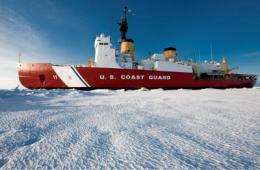
NRL's Marine Biogeochemistry section organized and led an international research expedition aboard the USCG Polar Sea in the Beaufort Sea during September 15-26, 2009. Credit: U.S. Coast Guard

Scientists from the Marine Biogeochemistry and Geology and Geophysics sections of the Naval Research Laboratory (NRL) organized and led a team of university and government scientists on an Arctic expedition to initiate methane hydrate exploration in the Beaufort Sea and determine the spatial variation of sediment contribution to Arctic climate change.

Utilizing the U.S. Coast Guard Cutter Polar Sea as a research platform, three cross-shelf transects were surveyed and sampled off Alaska's North Slope at Hammerhead, Thetis Island and Halkett representing three regions of the Alaskan shelf. The expedition integrated expertise in coastal geophysics, , dissolved and free fluxes through the water column and into the atmosphere, sediment and water column microbiology and biogeochemistry and detailed characterization of the sub-seafloor geology.

"The objective of the sampling is to help determine variations in the shallow sediment and water column methane sources, methane cycling and the subsequent flux to the atmosphere," said Richard Coffin, chief scientist, NRL Chemistry Division.

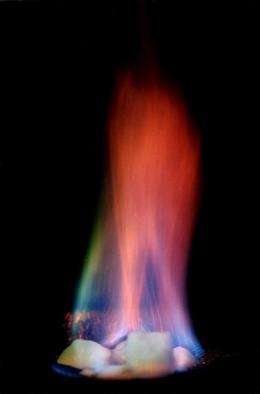
The content, location and distribution of methane in hydrate is variable and controlled by geothermal gradients and biological and thermal methane production. Large deposits of methane hydrates, frozen mixtures of hydrocarbon gas (mostly methane) and water, occur over large areas of the ocean floor. International research has begun with a primary goal of obtaining the methane in these hydrates as an energy source.

During the 12-day expedition, Methane In The Shelf and Slope (MITAS-1), the crew conducted 34 conductivity-temperature-depth (CTD) water column casts using a rosette of Niskin bottles and collected sediment samples from 14 piston cores, three vibrocores and 20 multicores. Regions selected for this study were based on the review of Minerals Management Service and U.S. Geologic Survey (USGS) seismic data with specific sample locations decided onboard through review of the 3.5 Kilohertz (kHz) sub-bottom profiler data.

The MITAS-1 crew focused on six primary goals to include:

  • Acquire and integrate seismic, acoustic, temperature, geochemical, and lithostratigraphic data for evaluation of deep sediment hydrate distributions.
  • Estimate spatial variation and controls on the vertical methane flux as it relates to variations in lithostratigraphy, geologic structures, water column temperatures, heat flow, seismic and acoustic profiles, and water depth.
  • Develop and calibrate models to evaluate sediment hydrate loading, hydrate destabilization through warming, and the fate of methane after destabilization.
  • Determine and model the transport of methane from the sediment through the water column into the atmosphere.
  • Study the control of total methane emissions by microbial methane consumption in the sediment and in the water column.
  • Study the contribution of methane to the benthic and pelagic carbon cycling.
The expedition was supported by NRL, Office of Naval Research (ONR), Department of Energy (DoE), Royal Netherlands Institute for Sea Research (NIOZ), French Research Institute for Exploitation of the Sea (IFREMER) and the German Leibniz Institute of Marine Sciences (IFM-Geomar). Future expeditions will also include scientists from Scotland's Herriot-Watt University, Norway's University of Bergen and GNS Science of New Zealand.

"Our project is intended to initiate a long-term collaboration in future expeditions in the Beaufort Sea and other regions of the Arctic Ocean," said Coffin.
International expedition investigates climate change, alternative fuels in Arctic
Enlarge

Having the potential to provide a clean and abundant fuel alternative, deposits of methane hydrates -- frozen mixtures of hydrocarbon gas (mostly methane) and water -- occur over large areas of the ocean floor. Credit: US Geological Society

Source: Naval Research Laboratory (news : web)


Rate this story - 3 /5 (1 vote)

Rank Filter

Move the slider to adjust rank threshold, so that you can hide some of the comments.


Display comments: newest first

  • GrayMouser - Nov 26, 2009
    • Rank: not rated yet
    Given the reductions in personnel in the 4 services and the cutting on budgets for their primary mission, you have to wonder why the US Navy and DOD are spending chunks of their limited budgets on non-defense related research. Unless this is pork-barrel funded research.

November 20, 2009 all stories

Comments: 1

3 /5 (1 vote)

  • hide
  • Related Stories

  • Methane gas likely spewing into the oceans through vents in sea floor (w/ Video)
    created Sep 02, 2009 | popularity not rated yet | comments 0
  • Warming ocean contributes to global warming
    created Aug 14, 2009 | popularity not rated yet | comments 0
  • Scientists Gain New Insights Into 'Frozen' Methane Beneath Ocean Floor
    created Nov 10, 2005 | popularity not rated yet | comments 0
  • Greenhouse gases from the deep sea
    created Mar 02, 2006 | popularity not rated yet | comments 0
  • Alaskan drilling will assess gas hydrate
    created Feb 20, 2007 | popularity not rated yet | comments 0


  • hide
  • Relevant PhysicsForums posts

  • Carbon Dioxide emissions question
    created Feb 08, 2010
  • Photosynthesis vs. carbonization
    created Feb 07, 2010
  • Sheep's footprints
    created Feb 05, 2010
  • How did Victorians estimate the ages of fossils?
    created Feb 03, 2010
  • How can we defeat pollution as individuals?
    created Jan 29, 2010
  • Formation of lava fields on Lanzarote
    created Jan 27, 2010
  • More from Physics Forums - Earth

Other News

Rho Ophiuchus cloud

Professor: We have a 'moral obligation' to seed universe with life

Space & Earth / Astronomy

created 19 hours ago | popularity 3.1 / 5 (24) | comments 49 | with audio podcast report

(PhysOrg.com) -- Eventually, the day will come when life on Earth ends. Whether that’s tomorrow or five billion years from now, whether by nuclear war, climate change, or the Sun burning up its fuel, the last ...


Climate 'Tipping Points' May Arrive Without Warning, Says Top Forecaster

Space & Earth / Environment

created 7 hours ago | popularity 3.7 / 5 (6) | comments 5 | with audio podcast

(PhysOrg.com) -- A new University of California, Davis, study by a top ecological forecaster says it is harder than experts thought to predict when sudden shifts in Earth's natural systems will occur -- a worrisome finding ...


A new 3-D map of the interstellar gas within 300 parsecs from the sun

A new 3D map of the interstellar gas within 300 parsecs from the Sun

Space & Earth / Astronomy

created 10 hours ago | popularity 5 / 5 (4) | comments 0 | with audio podcast

(PhysOrg.com) -- Astronomy & Astrophysics is publishing new 3D maps of the interstellar gas in the local area around our Sun. A French-American team of astronomers presents new absorption measurements toward ...


38 percent of world's surface in danger of desertification

38 percent of world's surface in danger of desertification

Space & Earth / Environment

created 4 hours ago | popularity 2.3 / 5 (3) | comments 4

A team of Spanish researchers has measured the degradation of the planet's soil using the Life Cycle Assessment (LCA), a scientific methodology that analyses the environmental impact of human activities, and ...


Russian Soyuz TMA-17 rocket blasts off to the International Space Station

Russia wants to charge more for rides to space: report

Space & Earth / Space Exploration

created 21 hours ago | popularity 5 / 5 (3) | comments 5

Russia, which is set to hold a monopoly on flights to the international space station (ISS), wants to charge more for rides on its Soyuz rocket, the space agency head said Tuesday.