CERN atom-smasher restarts after 14-month hiatus: official
November 20, 2009
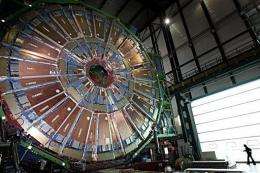
A view of a superconducting solenoid magnet at the European Organization for Nuclear Research (CERN) near Geneva

Enlarge

A view of a superconducting solenoid magnet at the European Organization for Nuclear Research (CERN) near Geneva. The world's biggest atom-smasher, shut down after its inauguration in September 2008 amid technical faults, restarted on Friday, a spokesman for the European Organisation for Nuclear Research said.

The world's biggest atom-smasher, shut down after its inauguration in September 2008 amid technical faults, restarted on Friday, a spokesman for the European Organisation for Nuclear Research said.

Particle beams are once again zooming around the world’s most powerful particle accelerator—the Large Hadron Collider—located at the CERN laboratory near Geneva, Switzerland. On November 20 at 4:00 p.m. EST, a clockwise circulating beam was established in the LHC’s 17-mile ring.

After more than one year of repairs, the LHC is now back on track to create high-energy particle collisions that may yield extraordinary insights into the nature of the physical universe.

“The LHC is a machine unprecedented in size, in complexity, and in the scope of the international collaboration that has built it over the last 15 years,” said Dennis Kovar, U.S. Department of Energy Associate Director of Science for High Energy Physics. “I congratulate the scientists and engineers that have worked to get the LHC back up and running, and look forward to the discoveries to come.”

American scientists have played an important role in the construction of the LHC. About 150 scientists, engineers and technicians from three DOE national laboratories—Brookhaven Lab, Fermilab and Berkeley Lab—built critical accelerator components. They are joined by colleagues from DOE’s SLAC National Accelerator Laboratory and the University of Texas at Austin in ongoing LHC accelerator R&D. The work has been supported by the DOE Office of Science.

Circulating beams are a major milestone on the way to the ultimate goal: data from high-energy particle collisions in each of the LHC’s four major particle detectors. Over the next few months, scientists will create collisions between two beams of protons. These very first LHC collisions will take place at the relatively low energy of 900 GeV. They will then raise the beam energy, aiming for collisions at the world-record energy of 7 TeV in early 2010. With these high-energy collisions, the hunt for discoveries at the LHC will begin.

“It’s great to see beam circulating in the LHC again,” said CERN Director General Rolf Heuer. “We’ve still got some way to go before physics can begin, but with this milestone we’re well on the way.”

In all, an estimated 10,000 people from 60 countries have helped design and build the LHC accelerator and its four massive particle detectors, including more than 1,700 scientists, engineers, students and technicians from 97 U.S. universities and laboratories in 32 states and Puerto Rico supported by the DOE Office of Science and the National Science Foundation.

4.2 /5 (26 votes)  

Rank 4.2 /5 (26 votes)
Related Stories
Relevant PhysicsForums posts

More news stories

Physicists build highly efficient 'no-waste' laser

A team of University of California, San Diego researchers has built the smallest room-temperature nanolaser to date, as well as an even more startling device: a highly efficient, "thresholdless" laser that ...

Physics / General Physics

created 1 hour ago | popularity 5 / 5 (5) | comments 1 | with audio podcast

Transparent iron? For the first time, an experiment shows that atomic nuclei can become transparent

At the high-brilliance synchrotron light source PETRA III, a team of DESY scientists headed by Dr. Ralf Röhlsberger has succeeded in making atomic nuclei transparent with the help of X-ray light. At the ...

Physics / General Physics

created 1 hour ago | popularity 5 / 5 (2) | comments 1 | with audio podcast

Quantum physicist explains $100K offer for proof scaled-up quantum computing is impossible

(PhysOrg.com) -- MIT researcher Scott Aaronson has certainly riled the physics community with his offer this past Friday, of $100,000 to anyone who can prove that scaled-up quantum computing is impossible. ...

Physics / Quantum Physics

created 6 hours ago | popularity 4.4 / 5 (7) | comments 10 | with audio podcast weblog

Flipping a light switch in the cell: Quantum dots used for targeted neural activation

By harnessing quantum dots—tiny light-emitting semiconductor particles a few billionths of a meter across—researchers at the University of Washington (UW) have developed a new and vastly more targeted ...

Physics / Optics & Photonics

created 3 hours ago | popularity 5 / 5 (2) | comments 0 | with audio podcast

Unusual 'collapsing' iron superconductor sets record for its class

(PhysOrg.com) -- A team from the National Institute of Standards and Technology and the University of Maryland has found an iron-based superconductor that operates at the highest known temperature for a material ...

Physics / Superconductivity

created 6 hours ago | popularity 4 / 5 (2) | comments 0 | with audio podcast


Short fasting cycles work as well as chemotherapy in mice

Man may not live by bread alone, but cancer in animals appears less resilient, judging by a study that found chemotherapy drugs work better when combined with cycles of short, severe fasting.

Gene therapy for inherited blindness succeeds in patients' other eye

Gene therapy for congenital blindness has taken another step forward, as researchers further improved vision in three adult patients previously treated in one eye. After receiving the same treatment in their ...

Study shows how DNA finds its match

It's been more than 50 years since James Watson and Francis Crick showed that DNA is a double helix of two strands that complement each other. But how does a short piece of DNA find its match, out of the millions ...

'Explorers,' who embrace the uncertainty of choices, use specific part of cortex

Life shrouds most choices in mystery. Some people inch toward a comfortable enough spot and stick close to that rewarding status quo. Out to dinner, they order the usual. Others consider their options systematically ...

Scientists delve into the brain roots of hunger and eating

Synaptic plasticity – the ability of the synaptic connections between the brain's neurons to change and modify over time -- has been shown to be a key to memory formation and the acquisition of new learning behaviors. ...

Obstacles no barrier to higher speeds for worms, researchers find

Obstacles in an organism's path can help it to move faster, not slower, researchers from New York University's Applied Math Lab at the Courant Institute of Mathematical Sciences have found through a series ...