Tapering a Free-Electron Laser to Extract More Juice
(PhysOrg.com) -- Researchers from the NSLS and Science Applications International Corporation (SAIC) have demonstrated a technique that could be used to significantly improve the quantity and quality of light produced from a free-electron laser (FEL) - a source that provides pulses of light that can be 1,000 times shorter than those at conventional storage ring light sources.
The research, conducted at the NSLS Source Development Laboratory (SDL), is the first to show an efficiency and spectrum enhancement in the FEL by tapering the device's undulator, the array of magnets that induces the electron beam to generate radiation. The results are published in the October 7, 2009, edition of Physical Review Letters.
All light sources based on electron storage rings, including those at the NSLS, produce a broad range of wavelengths, or colors of light. This is ideal for hosting a wide variety of experiments, but to understand how molecules change their structure in chemical and biological systems, scientists need extremely short pulses of light (less than one trillionth of a second) with short wavelengths. This is where FELs shine. Like a stroboscopic flash, the ultra-short bursts of light produced from an FEL allows scientists to take time-resolved images of biological and chemical processes and various other atomic-scale events.
"An FEL is complementary to a storage ring light source," said NSLS accelerator physicist Xijie Wang. "FELs can provide pulses of light that are a thousand times shorter than those produced at existing light sources and contain a million more photons per pulse. That makes them extremely valuable tools for exploring the dynamics of biological or chemical processes as they evolve."
FELs work by shooting a series of ultra-short bunches of electrons through an undulator, which causes them to oscillate back and forth as though they're zigzagging through a tight slalom course. This oscillatory motion causes the electrons to emit an intense beam of photons (i.e. light) that travels in the same direction as the electron beam. The prolonged interaction between the emitted light and the electron beam along the length of undulator is termed "lasing," which produces ultra-short light pulses of unprecedented brightness. FELs are tunable, spanning the electromagnetic spectrum from the terahertz to the x-ray regime. The FEL at the SDL is "seeded" with an input laser pulse of a chosen wavelength and the kinetic energy extracted from the electron beam is transformed into light that amplifies the input pulse.
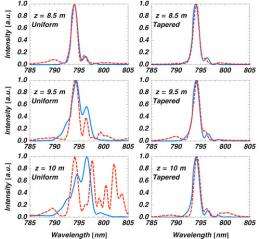
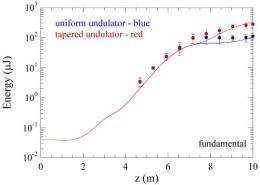
During the recent novel experiment at the SDL, the researchers tapered the undulator - slowly increasing the vertical gap in the last few meters of the device. This reduces the magnetic field, which results in an enhanced conversion efficiency of electron energy to FEL light.
In comparison with the results for a uniform undulator, the tapered undulator produced a far-improved FEL beam: the light intensity was increased by 300 percent for the fundamental wavelength and 50 percent for the third harmonic. Harmonics are multiples of the seed laser frequency that are emitted when the seeded electron beam passes through the undulator. The wavelength of the third harmonic, for example, is three times shorter than the fundamental.
"In addition to tripling the intensity of the light, we were able to preserve the quality of the spectral bandwidth," said NSLS physicist Jim Murphy.
This is the first experiment to measure these characteristics in a tapered undulator.
In the future, this technique will be used to produce high intensity ultraviolet light at the SDL that will be ideal for exploring chemical processes.
Others involved in this research include David Harder, Houjun Qian, Yuzhen Shen, and Xi Yang (NSLS), and Henry Freund and W. Miner (Science Applications International Corporation). This work was funded by the Office of Naval Research, the U.S. Department of Defense Joint Technology Office, and the U.S. Department of Energy Office of Basic Energy Science.
More information: X.J. Wang, H.P. Freund, D. Harder, W.H. Miner, Jr., J.B. Murphy, H. Qian, Y. Shen, and X. Yang, "Efficiency and Spectrum Enhancement in a Tapered Free-Electron Laser Amplifier," Phys. Rev. Lett., 103, 154801 (2009).
Provided by Brookhaven National Laboratory (news : web)


