Museum: Galileo's fingers, tooth are found
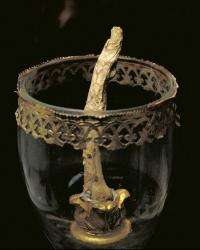
(AP) -- Two fingers and a tooth removed from Galileo Galilei's corpse in a Florentine basilica in the 18th century and given up for lost have been found again and will soon be put on display, an Italian museum director said Friday.
Three fingers, a vertebra and a tooth were removed from the astronomer's body by admirers in 1737, 95 years after his death, as his corpse was being moved from a storage place to a monumental tomb - opposite that of Michelangelo, in Santa Croce Basilica in Florence.
One of the fingers was recovered soon afterward and is now part of the collection of the Museum of the History of Science, in Florence. The vertebra has been kept at the University of Padua, where Galileo taught for years.
But the tooth and two fingers from the scientist's right hand - the thumb and middle finger - were kept by one of the admirers, an Italian marquis, and later enclosed in a container that was passed on from generation to generation in the same family, Paolo Galluzzi, the museum's director, told The Associated Press in a telephone interview.
"But with time, the generations lost knowledge of what was actually inside the container," and the family sold it, Galluzzi said. By 1905, all traces of the relics had disappeared, "leading scholars to hypothesize that these singular specimens had been definitely lost," the museum said in a statement.
The container recently turned up at auction and was purchased by a private collector, intrigued by the contents but not sure they were Galileo's relics.
The buyer eventually contacted Galluzzi and other Florence culture officials, who used detailed historical documents, as well as documentation from the family that had owned it for so long, to conclude that the fingers and tooth were Galileo's, the museum director said.
The relics were inside an 18th-century blown-glass vase, which in turn was inside a wooden case topped with a wooden bust of Galileo, the museum said.
Galileo, who died in 1642, was condemned by the Vatican for saying the Earth revolved around the Sun. Church teaching at the time held that the Earth was the center of the universe. In the early 1990s, Pope John Paul II rehabilitated him, saying the church had erred.
The museum will put the fingers and tooth on display next spring.
©2009 The Associated Press. All rights reserved. This material may not be published, broadcast, rewritten or redistributed.


