China harnesses mountain wind power
November 22, 2009 by Jerome Cartillier
China is the world's largest emitter of the greenhouse gases blamed for global warming

Enlarge

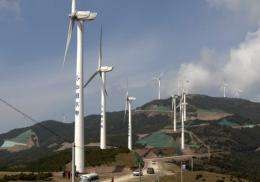
Cars and people are seen passing near wind power turbines in Dali, in the China's southwestern Yunnan province. In energy-hungry Yunnan, power is being produced at wind farms, dams and garbage dumps as the Asian giant adopts more "green" technology thanks to carbon trading.

In the mountains above the southwestern Chinese town of Dali, dozens of new wind turbines dot the landscape -- a symbol of the country's sky-high ambitions for clean, green energy.

At an altitude of 3,000 metres (9,800 feet), Dali Zhemoshan is the highest wind farm in China, where renewable has become a priority for a government keen to reduce its carbon emissions and which has taken full advantage of the global trade in carbon credits.

"Wind resources in Yunnan province are not the best in the country," says Zhai Cheng, a project manager at the farm for the Chinese group Sinohydro.

"But at altitude, it becomes more interesting," he adds, gesturing at the line of 48 metre-high turbines.

China, which relies on coal for more than 70 percent of its energy, is the world's largest emitter of the greenhouse gases blamed for global warming.

But it has set a target of generating 15 percent of its energy from renewable sources -- mainly wind and water -- by 2020.

In Yunnan, the -- which operate at full tilt between October and April -- are there to boost the region's enormous hydroelectric power resources when productivity falls during the winter months.

"China is redoubling its efforts, with the 2020 target for wind power generation rising from 30 to 100 gigawatts," said Zhai.

The rapid boom in wind farming in China -- where installed capacity doubled in 2008 for the fourth year running to sit at 12.2 gigawatts -- places it behind only the United States, Germany and Spain.

"In terms of the scale and the pace of the build-up of the Chinese wind industry, it's without parallel anywhere in the world ever," said Steve Sawyer, secretary general of the Global Council (GWEC).

"They went from very little installed capacity and almost no industry five years ago to the point where they will be the number one market in the world this year" in terms of new capacity, he said.

"At the current rate, they will be the number one in the world in cumulative capacity by the end of 2011, early 2012," Sawyer predicted.

As well as major wind farms in the north of China, such as those in Gansu province, smaller projects -- like the one in Dali -- are multiplying, almost always relying on the Clean Development Mechanism (CDM).

The CDM, which was created as part of the Kyoto Protocol, allows industrialised countries to fulfil part of their greenhouse gas reduction commitments by investing in clean energy technology in developing countries.

With a generating capacity of 30.75 megawatts, the 41 turbines in Dali produce the same amount of energy as the burning of 20,000 tonnes of coal -- thereby preventing the emission of 50,000 tonnes of carbon dioxide per year.

The produced by the Dali pilot project, funded with a 30-million-euro (45-million-dollar) loan from the French Development Agency, will be purchased by Dutch bank Rabobank, Zhai said.

Those credits should amount to between seven and eight percent of annual income, he added, predicting that the project should pay for itself in 10 to 15 years.

"The wind industry in China and India is one of the biggest success stories of the CDM," said GWEC's Sawyer.

"The Chinese example is a very good example: the only way you can make use of the market mechanism is if you have very clear and effective policies and measures to support the industry at the same time."

The challenge for now, he says, is one of quality.

"They have had this rapid build-up and now they have to focus on the quality rather than just the quantity. Grid extension and connection is one issue, the performance of the turbines themselves is another."

(c) 2009 AFP

4.4 /5 (12 votes)  

Filter


Move the slider to adjust rank threshold, so that you can hide some of the comments.


Display comments: newest first

dirk_bruere
Nov 23, 2009

Rank: 1 / 5 (1)
So we are giving the Chinese money to screw our own industries. They must be laughing.
Landrew
Nov 23, 2009

Rank: not rated yet
When China was burning fossil fuels at a record rate, the air pollution and CO2 emissions were also escalating. China should be applauded for taking this direction.
frajo
Nov 23, 2009

Rank: 1 / 5 (1)
So we are giving the Chinese money to screw our own industries.
Some people seem to be convinced they'd screw your industry a lot harder if they'd not lend them some bucks. Call it investment; call it participation.
Rank 4.4 /5 (12 votes)
Related Stories
Relevant PhysicsForums posts
  • dynamics 2/32
    created1 hour ago
  • dynamics
    created1 hour ago
  • Vibration Absorbtion Problem
    created6 hours ago
  • Does anyone make a small high temperature and high pressure pump?
    created12 hours ago
  • Strange indexing in Fortran Code
    created23 hours ago
  • Car Port post load calculation
    createdFeb 07, 2012
  • More from Physics Forums - General Engineering

More news stories

Windows 8 preview set for February 29

Microsoft on Wednesday revealed plans to unveil a test version of its latest Windows computer operating software later this month.

Technology / Software

created 6 hours ago | popularity 3.8 / 5 (4) | comments 5

Solar start-ups set new efficiency records

(PhysOrg.com) -- Although Alta Devices and Semprius make different types of solar panels, both start-ups have been breaking records in the past few days. Santa Clara, Calif.-based Alta Devices announced that ...

Technology / Energy & Green Tech

created 16 hours ago | popularity 4.9 / 5 (11) | comments 11 | with audio podcast report

Groupon fails to turn profit as revenue grows

Daily deals site Groupon on Wednesday issued its first earnings report as a publicly traded company, saying it failed to turn a profit despite revenue nearly tripling from a year earlier.

Technology / Business

created 4 hours ago | popularity not rated yet | comments 0

Lawsuit seeks to block Google's privacy changes

(AP) -- A consumer watchdog group is suing the Federal Trade Commission in an attempt to prevent Google from making sweeping changes to its privacy policies next month.

Technology / Internet

created 4 hours ago | popularity not rated yet | comments 0

Romanian accused of hacking NASA-JPL computers

(AP) -- The Los Angeles U.S. attorney's office says a federal grand jury has indicted a Romanian citizen on charges he hacked into 25 climate-research computers at NASA's Jet Propulsion Laboratory in Pasadena.

Technology / Internet

created 4 hours ago | popularity not rated yet | comments 0


Astronomy team discovers nearby dwarf galaxy

(PhysOrg.com) -- A team led by UCLA research astronomer Michael Rich has used a unique telescope to discover a previously unknown companion to the nearby galaxy NGC 4449, which is some 12.5 million light years ...

Amasia: As next supercontinent forms, Arctic Ocean, Caribbean will vanish first

(PhysOrg.com) -- Geologists at Yale University have proposed a new theory to describe the formation of supercontinents, the epic process by which Earth’s major continental blocks combine into a single ...

Why are there so few fish in the Earth's oceans?

(PhysOrg.com) -- A Stony Brook University researcher has found that, contrary to popular belief, there are not plenty of fish in the sea.

Scientists strengthen memory by stimulating key site in brain

Ever gone to the movies and forgotten where you parked the car? New UCLA research may one day help you improve your memory.

Transparent iron? For the first time, an experiment shows that atomic nuclei can become transparent

At the high-brilliance synchrotron light source PETRA III, a team of DESY scientists headed by Dr. Ralf Röhlsberger has succeeded in making atomic nuclei transparent with the help of X-ray light. At the ...

Physicists build highly efficient 'no-waste' laser

A team of University of California, San Diego researchers has built the smallest room-temperature nanolaser to date, as well as an even more startling device: a highly efficient, "thresholdless" laser that ...