Harnessing the power of salt, Norway tries osmotic power
November 23, 2009 by Pierre-Henry Deshayes
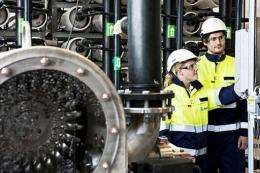
Handout picture shows workers at the Statkraft Osmotic power plant prototype in Tofte, south of Oslo, in October 2009. After wind, sun, currents and tides, a company is preparing to make clean electricity by harnessing another natural phenomenon, the energy-unleashing encounter of freshwater and seawater.
After wind, sun, currents and tides, a company is preparing to make clean electricity by harnessing another natural phenomenon, the energy-unleashing encounter of freshwater and seawater.
Taking a step further in the planet's hunt for clean power, Norway is to unveil on Tuesday the world's first prototype of an osmotic power plant on the banks of the Oslo fjord.
The project is small-scale but could prove the great potential of osmotic energy.
"It is a form of renewable energy which, unlike solar or wind power, produces a predictable and stable amount of energy regardless of the weather," explained Stein Erik Skilhagen, in charge of the project at state-owned Statkraft, which specialises in renewable energies.
Osmotic energy is based on the principle that nature is constantly seeking balance, and plays on the different concentration levels of liquids.
When freshwater and seawater meet on either side of a membrane -- a thin layer that retains salt but lets water pass -- freshwater is drawn towards the seawater side. The flow puts pressure on the seawater side, and that pressure can be used to drive a turbine, producing electricity.
The phenomenon of osmosis is widespread in nature, permitting plants to drink through their leaves, and is used by industry to desalinate seawater. But the Norwegian experiment, a prototype that will produce just enough electricity to power a coffee-maker, will be the first time osmosis is used to make power.
"What's important for now is to test and validate the technology, not to produce a lot" of electricity, Skilhagen said of the two to four kilowatts (KW) the plant will likely produce at first.
And Statkraft's aspirations for osmotic power go far beyond the prototype, set up in a former chlorine factory in Hurum, about 60 kilometers (37 miles) south of Oslo.
The company hopes to have a commercial-size plant up and running by 2015, producing about 25 megawatts (MW) of electricity, or enough for 10,000 homes.
And it says osmotic power has a global potential of 1,700 terawatt hour (TWh) annually, equivalent to half the current power production in Europe or China's total energy consumption for 2002.
Statkraft itself admits there is still a long way to go, starting with finding how to make more energy-efficient membranes.
The ones tested at the Hurum plant will have an efficiency level of less than 1 watt per square metre. The company says it plans to install membranes that can deliver 2-3 watts per square meter after some time, but an efficiency level of 5 watts per square meter is needed to make osmotic power profitable.
"It is definitely a point to work on," said Gerald Pourcelly of the European Membrane Institute, adding that time could bring the efficiency level of membranes to 5 or 6 watts per square meter.
Nevertheless, "everything that contributes to the development of renewable energy sources is positive," the scientist stressed, "considering the progression of carbon dioxide emissions and dwindling fossil fuel reserves."
(c) 2009 AFP
-
Dutch University Tests Windmill for Seawater Desalination
Feb 29, 2008 |
not rated yet |
0
-
Energy-efficient water purification
Jan 14, 2009 |
not rated yet |
0
-
Renewable energy wrecks environment, scientist claims
Jul 24, 2007 |
not rated yet |
0
-
Tide machines may be major power sources
Jun 01, 2006 |
not rated yet |
0
-
Nuclear desalination
Nov 20, 2007 |
not rated yet |
0
-
Engineers build first sub-10-nm carbon nanotube transistor
Feb 01, 2012 |
4.9 / 5 (31) |
30
-
Something old, something new: Evolution and the structural divergence of duplicate genes
Jan 31, 2012 |
4.6 / 5 (7) |
1
-
The hidden nanoworld of ice crystals: Revealing the dynamic behavior of quasi-liquid layers
Jan 30, 2012 |
5 / 5 (3) |
1
-
Stock market network reveals investor clustering
Jan 27, 2012 |
3.9 / 5 (23) |
8
-
Of microchemistry and molecules: Electronic microfluidic device synthesizes biocompatible probes
Jan 26, 2012 |
5 / 5 (1) |
0
-
Calling function with no input argument
15 hours ago
-
Force free body diagram problem on gym equipment
16 hours ago
-
Empirical data regarding shower heads and water
Feb 10, 2012
-
feed hold button on CNC lathe
Feb 09, 2012
-
RFAC in Fortran
Feb 09, 2012
-
dynamics 2/32
Feb 08, 2012
- More from Physics Forums - General Engineering
More news stories
Anonymous knocks CIA website offline (Update)
The website of the Central Intelligence Agency was inaccessible on Friday after the hacker group Anonymous claimed to have knocked it offline.
10 hours ago |
5 / 5 (9) |
16
Google users warned of threat to smartphone wallets
Users of Google smartphone wallets were being warned on Friday that there is a way to crack pass codes intended to thwart thieves from going on illicit shopping sprees.
8 hours ago |
5 / 5 (2) |
0
New error-correcting codes guarantee the fastest possible rate of data transmission
Error-correcting codes are one of the triumphs of the digital age. Theyre a way of encoding information so that it can be transmitted across a communication channel such as an optical fiber o ...
Technology / Computer Sciences
18 hours ago |
4.9 / 5 (8) |
6
|
New power source discovered
(PhysOrg.com) -- Researchers at the Massachusetts Institute of Technology (MIT) and RMIT University have made a breakthrough in energy storage and power generation.
Technology / Energy & Green Tech
17 hours ago |
4.7 / 5 (30) |
8
|
Small modular reactor design could be a 'SUPERSTAR'
(PhysOrg.com) -- Though most of today's nuclear reactors are cooled by water, we've long known that there are alternatives; in fact, the world's first nuclear-powered electricity in 1951 came from a reactor ...
Technology / Energy & Green Tech
18 hours ago |
4.4 / 5 (13) |
23
|
Humans may have helped the decline of African rainforests 3000 years ago
(PhysOrg.com) -- Large areas of rainforests in Central Africa mysteriously disappeared over three thousand years ago, to be replaced by savannas. The prevailing theory has been that the cause was a change ...
The power of estrogen -- male snakes attract other males
A new study has shown that boosting the estrogen levels of male garter snakes causes them to secrete the same pheromones that females use to attract suitors, and turned the males into just about the sexiest ...
Complex wiring of the nervous system may rely on a just a handful of genes and proteins
Researchers at the Salk Institute have discovered a startling feature of early brain development that helps to explain how complex neuron wiring patterns are programmed using just a handful of critical genes. ...
Could Venus be shifting gear?
(PhysOrg.com) -- ESAs Venus Express spacecraft has discovered that our cloud-covered neighbour spins a little slower than previously measured. Peering through the dense atmosphere in the infrared, the ...
Advanced power-grid model finds low-cost, low-carbon future in West
(PhysOrg.com) -- The least expensive way for the Western U.S. to reduce greenhouse gas emissions enough to help prevent the worst consequences of global warming is to replace coal with renewable and other ...
Fool's gold may prove an unlikely alternative to overexploited catalytic materials
Catalytic materials, which lower the energy barriers for chemical reactions, are used in everything from the commercial production of chemicals to catalytic converters in car engines. However, with current catalytic materials ...
Nov 23, 2009
Rank: 5 / 5 (2)
Nov 23, 2009
Rank: 5 / 5 (1)
I think this is called blue energy.
It is actual the sun energy that evaporated the water from the sea, rendering the sea salter.
Nov 24, 2009
Rank: 3 / 5 (1)
http://www.physor...117.html
Nov 24, 2009
Rank: 5 / 5 (1)
This is entirely different aspect of energy. Blue energy compares to wind or solar power. Making hydrogen as transport fuel is just a carrier of energy, and it's having bad efficiency too.