Large Hadron Collider sends beams in 2 directions
November 23, 2009 By ALEXANDER G. HIGGINS , Associated Press Writer
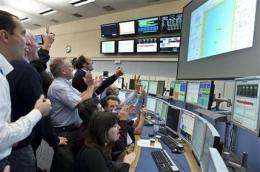
In this photo released by the European Organization for Nuclear Research (CERN) on Saturday, Nov. 21, 2009, scientists react in the CERN Control Center after successfully restarting the Large Hadron Collider, in Geneva, Switzerland, Friday, Nov. 20, 2009. Scientists moved Saturday to prepare the world's largest atom smasher for exploring the depths of matter after successfully restarting the $10 billion machine following more than a year of repairs. (AP Photo/Keystone, Brice, CERN)
(AP) -- The world's largest atom smasher made another leap forward Monday by circulating beams of protons in opposite directions at the same time in the $10 billion machine after more than a year of repairs, organizers said.
New discoveries on the makeup of universe and its tiniest particles are unlikely before next year, but the Large Hadron Collider has been advancing faster than expected in its startup phase that began Friday night, said Rolf Heuer, director-general of the European Organization for Nuclear Research.
Proton collisions could possibly begin within the next 10 days, officials said Monday.
"It went much faster than foreseen," said Fabiola Gianotti, who speaks for the Atlas experiment, one of four major detectors in rooms the size of cathedrals about 100 meters (300 feet) underground. "We're all very happy."
Ultimately, the collider aims to create conditions like they were 1 trillionth to 2 trillionths of a second after the Big Bang - which scientists think marked the creation of the universe billions of years ago. Physicists also hope the collider will help them see and understand other suspected phenomena, such as dark matter, antimatter and supersymmetry.
The collider was started with great fanfare Sept. 10, 2008, only to be heavily damaged by an electrical fault nine days later. It has taken 14 months to repair and add protection systems to the machine before it was restarted.
The protons on Monday were traveling at almost the speed of light - 11,000 times a second in each direction around the 27-kilometer (17-mile) tunnel under the Swiss-French border at Geneva. The scientists are still testing the machine before causing proton collisions, the heart of the research at the organization, known as CERN.
So far the machine is operating at 450 billion electron volts of energy, which is relatively low compared with its design capability of 14 times that. It soon will overtake the world's current most powerful accelerator, the Tevatron at Fermilab outside Chicago, which operates at 1 trillion electron volts, or TeV.
Steve Myers, the director for accelerators, said the CERN collider should be ramped up to 1.2 TeV by Christmas. CERN might decide to make the first collisions at the current low energy or at 1.2 TeV, but that will be more for calibration purposes than for making scientific discoveries.
Physicists said the discoveries could begin in the first half of next year when the collider reaches 3.5 TeV.
Myers said the collider may even go up to 5 TeV before the end of the year.
Tejinder S. Virdee, a physicist from London's Imperial College who represents more than 2,000 scientists on the experiment at CERN, said it could take several years before the collider discovers the elusive Higgs boson, a particle that theoretically gives mass to other subatomic particles, and thus everything in the universe.
That is because the Higgs boson is believed to be hard to see and needs powerful energy to be revealed, Virdee said.
"This is going to take a few years," he said.
The collider will eventually create conditions many millionths of a second closer than the previous closest to the Big Bang, at which matter is believed to have changed very quickly as the universe cooled rapidly and expanded.
"Nature is always more," said Gianotti. "There would be no charm if we knew now."
©2009 The Associated Press. All rights reserved. This material may not be published, broadcast, rewritten or redistributed.
-
Restored machine to explore mysteries of Big Bang
Nov 21, 2009 |
not rated yet |
0
-
Particle collider: Black hole or crucial machine?
Aug 07, 2009 |
not rated yet |
0
-
Physics world shifts focus to Switzerland
Sep 06, 2007 |
not rated yet |
0
-
Large Hadron Collider restart delayed till October
Jun 20, 2009 |
not rated yet |
0
-
CERN atom-smasher restarts after 14-month hiatus: official
Nov 20, 2009 |
not rated yet |
0
-
Engineers build first sub-10-nm carbon nanotube transistor
Feb 01, 2012 |
4.9 / 5 (30) |
30
-
Something old, something new: Evolution and the structural divergence of duplicate genes
Jan 31, 2012 |
4.6 / 5 (7) |
1
-
The hidden nanoworld of ice crystals: Revealing the dynamic behavior of quasi-liquid layers
Jan 30, 2012 |
5 / 5 (3) |
1
-
Stock market network reveals investor clustering
Jan 27, 2012 |
3.9 / 5 (23) |
8
-
Of microchemistry and molecules: Electronic microfluidic device synthesizes biocompatible probes
Jan 26, 2012 |
5 / 5 (1) |
0
-
Question on Kirchoff's Laws
1 hour ago
-
Changes in Water Weight
2 hours ago
-
Some superconductor help
2 hours ago
-
perturbance in a model
3 hours ago
-
Combustion: where does the heat come from?
4 hours ago
-
How does dynamic pressure affect static pressure?
4 hours ago
- More from Physics Forums - General Physics
More news stories
Borexino Collaboration succeeds in spotting pep neutrinos emitted from the sun
(PhysOrg.com) -- To learn more about how the sun works, scientists study particles that are emitted from it into space due to thermonuclear reactions that occur inside; by applying known physics principles, ...
Explained: Sigma
It's a question that arises with virtually every major new finding in science or medicine: What makes a result reliable enough to be taken seriously? The answer has to do with statistical significance -- but ...
10 hours ago |
5 / 5 (6) |
13
Physics research suggests new pathways for cancer progression
Observing that certain cancer cells may exhibit greater flexibility than normal cells, some scientists believe that this capability promotes rapid tumor growth. Now computer simulations developed by Boston University Biomedical ...
7 hours ago |
5 / 5 (1) |
0
Quantum physicist explains $100K offer for proof scaled-up quantum computing is impossible
(PhysOrg.com) -- MIT researcher Scott Aaronson has certainly riled the physics community with his offer this past Friday, of $100,000 to anyone who can prove that scaled-up quantum computing is impossible. ...
Physicists build highly efficient 'no-waste' laser
A team of University of California, San Diego researchers has built the smallest room-temperature nanolaser to date, as well as an even more startling device: a highly efficient, "thresholdless" laser that ...
Feb 08, 2012 |
5 / 5 (18) |
5
|
'Dark plasmons' transmit energy
Microscopic channels of gold nanoparticles have the ability to transmit electromagnetic energy that starts as light and propagates via "dark plasmons," according to researchers at Rice University.
Decoding the molecular machine behind E. coli and cholera
Scientists from Queen Mary, University of London have discovered the workings behind some of the bacteria that kill hundreds of thousands every year, possibly paving the way for new antibiotics that could treat infections ...
Deadly bird parasite evolves at exceptionally fast rate
A new study of a devastating bird disease that spread from poultry to house finches in the mid-1990s reveals that the bacteria responsible for the disease evolves at an exceptionally fast rate. What's more, ...
Flexible paper robots
(PhysOrg.com) -- These inexpensive robots can stretch, bend and twist under control, and lift objects up to 120 times their own weight. Being soft, they can apply gentle and even pressure, and adapt to varied ...
Cell biologists describes mechanism by which some people may be more susceptible to colon cancer
An international research team led by cell biologists at the University of California, Riverside has uncovered a new insight into colon cancer, the third leading cause of cancer-related deaths in the United ...
New method makes culture of complex tissue possible in any lab
Scientists at the University of California, San Diego have developed a new method for making scaffolds for culturing tissue in three-dimensional arrangements that mimic those in the body. This advance, published online in ...