Machine Converts CO2 into Gasoline, Diesel, and Jet Fuel
November 23, 2009 by Lisa Zyga weblog
Sandia CR5

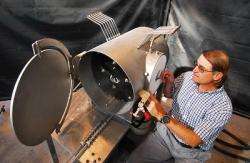
Sandia researcher Rich Diver assembles a prototype device intended to chemically reenergize carbon dioxide into carbon monoxide, which ultimately could become the building block to synthesize a liquid combustible fuel. Photo by Randy Montoya.

(PhysOrg.com) -- Researchers at Sandia National Laboratories have built a machine that uses the sun's energy to convert carbon dioxide waste from power plants into transportation fuels such as gasoline, diesel, and jet fuel. The system could provide an alternative to carbon sequestration; instead of permanently storing CO2 underground, the CO2 could be recycled and put to use.

A prototype of the machine, which was invented by Sandia researcher Rich Diver, was tested recently for the first time.

Called the Counter-Rotating-Ring Receiver Reactor Recuperator (CR5), the cylindrical machine consists of two chambers on the sides and 14 rotating rings in the center. The outer edges of the rings are made of iron oxide. When the scientists heat the inside of one chamber to 1,500C with a solar concentrator, the iron oxide undergoes a thermo-chemical reaction where it gives up oxygen molecules. As the rings rotate (at one revolution per minute), the hot side approaches the opposite chamber and begins to cool down. When carbon dioxide is pumped into this chamber, the retrieves oxygen molecules from the carbon dioxide, transforming it into carbon monoxide. The carbon monoxide could then serve as a building block to create a liquid combustible fuel.

Diver originally designed the machine to generate hydrogen without using electrolysis. By substituting water for the in the second chamber, the researchers can make the machine produce hydrogen. Also, by mixing the resulting hydrogen with , they can produce syngas.

It will probably take 15-20 years before the technology is ready for the market, with the biggest challenge being to increase the system's efficiency. The researchers' goal is to achieve an efficiency of a few percent, which is about twice as efficient as photosynthesis' real-world efficiency of 1%. One way to increase efficiency is to develop new ceramic composites that release at lower temperatures.

"Ultimately, we believe we have to get in the range of 10% sunlight-to-fuels, and we're a long way from doing that," said James Miller, a chemical engineer with Sandia's advanced materials laboratory.

via: Technology Review

© 2009 PhysOrg.com

4.4 /5 (46 votes)  

Filter


Move the slider to adjust rank threshold, so that you can hide some of the comments.


Display comments: newest first

LariAnn
Nov 23, 2009

Rank: 2.7 / 5 (9)
IMHO, if this technology will take 15-20 years to bring to market, it is a nonviable technology for practical purposes. Research energy and effort should go into technologies that can be put into use much sooner than 15-20 years!
El_Nose
Nov 23, 2009

Rank: 4.8 / 5 (6)
nothing my friend that is a 'viable technology' that has the potential to be its own industy comes to market in under 20 years except microprocessor improvements. You need a sack of money and a few scientists and engineers to give over their lives to the project.
defunctdiety
Nov 23, 2009

Rank: 3.5 / 5 (4)
nothing my friend that is a 'viable technology' that has the potential to be its own industy comes to market in under 20 years

I may be wrong here, but I think LariAnn's point was that by that time, we are either going to have renewables to the point where they are 100% economically viable and supplanting fossils and/or the myth that we need to do anything about CO2 will be fully and forever debunked and no one will want their technology, both very very likely, IMO.

One way or another, everything will have changed by then. They needed to have started this 15 years ago if they wanted to have a market.
kshultz222_yahoo_com
Nov 23, 2009

Rank: 4.8 / 5 (6)
"One way or another, everything will have changed by then. They needed to have started this 15 years ago if they wanted to have a market."

I am sure that is what they would be saying 15 to 20 years from now if we don't explore it now... I say we keep working in every promising area. That way, if the oil gets too expensive or scarce or otherwise unpalatable, we will have a good fallback option.
antialias_physorg
Nov 23, 2009

Rank: 4.5 / 5 (8)
The energy need for this method is rather prohibitive.

Remember that a lot of energy is released when fuels are converted to (mostly) CO2 and water. . When you turn the CO2 back into fuels you need to put all that energy back in order to reform those bonds.

It's much more economical to directly use that energy in some form instead of creating CO2 (at a loss) and then burning that (at a loss again because of the Carnot limit).
nkalanaga
Nov 23, 2009

Rank: 5 / 5 (6)
The advantage of this method is that you use sunlight to directly produce transportable fuels. It would be inefficient for electricity production, but if you want hydrocarbons or hydrogen for vehicles it would be more efficient than growing plants.
david_42
Nov 23, 2009

Rank: 4.5 / 5 (6)
Unfortunately, people learn things when they learn them, not "15 years ago". Developing a product to commercial scale takes time, money and engineering. It's very easy to sit at your computer (which you had absolutely nothing to do with developing) connected to an Internet (ditto) and be critical of people who are doing the research, finding the money and scaling a process.

And after all that, this process may not scale and may not be commercially viable, even if it does. I've seen hundreds of research breakthroughs over the decades that proved to be unworkable outside the lab.
GaryB
Nov 23, 2009

Rank: 4.5 / 5 (6)
We are always going to need jet fuel, so there will always be a need for something to make that fuel. By 15-20 years, we should have viable electric cars, but you can't run a jet with electricity.
PPihkala
Nov 23, 2009

Rank: 2.7 / 5 (6)
but you can't run a jet with electricity.

No, we can't, with current battery tech. But with even todays battery tech has shown that model planes can be flown with LiIon batteries, so if battery tech get's better, it's more feasible to fly by electric power.
droom
Nov 24, 2009

Rank: 5 / 5 (3)
No, we can't, with current battery tech. But with even todays battery tech has shown that model planes can be flown with LiIon batteries, so if battery tech get's better, it's more feasible to fly by electric power.


I dont think you understand how a jet engine works. Electricity cant replace the combustible, its the energy from the burn that actually propels the jet. A car or propeller plane uses the burn to fire pistons to crank a shaft...etc, which electricity can replace as the energy source.
ormondotvos
Nov 24, 2009

Rank: 1 / 5 (1)
Actually, real planes are flying with batteries now, fully enclosed. Check YouTube for "electric airplane"
droom
Nov 24, 2009

Rank: 5 / 5 (1)
Yes, propeller based electric planes, we were talking about jets though.
ShotmanMaslo
Nov 24, 2009

Rank: 4 / 5 (4)
Important thing about this development is that it could lead to GREEN carbon based economy. Imagine the countless billions that would be needed to convert all devices now using carbon based fuel to hydrogen or electricity. If this proves to be viable, theres no need to!
sender
Nov 24, 2009

Rank: 2 / 5 (2)
5 year solution:
Maybe we should pump it underground to utilize the pressure and power of geothermal energy for CO2 reformation?

ISEEE
Nov 24, 2009

Rank: 1.3 / 5 (4)
This laboratory is essentially trying to create perpetual energy. Drop it on the market to soon and you have a real economic crisis on your hand from elevated oil prices. My theory is that they have the means to bring it to market within a year but must say 15 years to keep current gasoline prices low.
Going
Nov 24, 2009

Rank: 5 / 5 (1)
The amazing thing about this is that it uses cheap old iron as the medium and not some expensive rare earth. In war time development cycles can be reduced to a matter of a few years or less. The current situation on climate is as critical as any war. Given the political will this could be working in a few years.
DozerIAm
Nov 24, 2009

Rank: not rated yet
I am sure that is what they would be saying 15 to 20 years from now if we don't explore it now... I say we keep working in every promising area. That way, if the oil gets too expensive or scarce or otherwise unpalatable, we will have a good fallback option.


That right there is rational thinking. We should explore all options, regardless of their present day utility. Who knows what we may learn along the way!
rippeyb
Nov 24, 2009

Rank: not rated yet
The work that SWAPSOL is doing with CO2 is much more promising. They discovered a reaction between H2S and CO2, which transforms these gases into water, sulfur and carbon-sulfur polymers.
www.SWAPSOL.com
nkalanaga
Nov 24, 2009

Rank: not rated yet
ISEEE: No, this isn't "perpetual energy", it's "artificial photosynthesis", in that it uses sunlight to power the process. All they're doing is turning sunlight into liquid fuels without going through the electric or steam stages.
DerekD
Nov 27, 2009

Rank: 1 / 5 (2)
Ummm...what's the point of this???...don't we already have a system in place (or in the process of being put into place) that utilizes the CO2 from power plants? That system being photosynthesis? Why take CO2 away from plants? Kinda selfish and anti green ain't it?

Here's the idea. Grow Grass...cut and then burn the grass for power in power plants. Resulting CO2 release is utilized by new batches of grass to grow. New grass gets burned in power plant...and resulting CO2 release is utilized by yet another new batch of growing grass.

Carbon neutral...don't steal CO2 from the plants with this CR5 device!!!!
ShotmanMaslo
Nov 28, 2009

Rank: 5 / 5 (2)
DerekD: Agriculture is one of the most polluting ways to get fuel, and the amount of soil needed for biofuels would be prohibitive.
This process could be much more environmentaly friendly and effective. Altough I doubt it will get efficient enough to completely replace fossil fuels.

Your comparison is funny. Instead of "stealing" CO2 from plants, you are suggesting to "massacre them and then burn their dead bodies"! Kinda selfish and anit-green! :D
Husky
Nov 28, 2009

Rank: 1 / 5 (1)
Conversion of Co2 into fossile fuel would only be interesting if the required energy comes from green renewables, otherwise you'd be burning fuel to create some fuel in an inefficient way. But then again if all the green renewables were there, who would longer need liquid fuel? So, maybe viable if they could use low quality waste heat for the conversion, or very high quality heat from a high temperature gas cooled nuclear reactor and a catalyctic process to drive the costs of a barrel under that of the costs of pumping oil from the earth and storing the co2, so, at present the market is not ready, but maybe the balance will shift in the future
antialias_physorg
Nov 28, 2009

Rank: not rated yet
But then again if all the green renewables were there, who would longer need liquid fuel?


I think someone already mentioned one use: jet fuel (although I can't really think of anything else). Jet fuel is not something that can be replaced by 'green' energy sources since you need the explosive/combustible aspect of fuel in order to get those speeds.
DerekD
Nov 29, 2009

Rank: 1 / 5 (1)
Shotmanmaslo: Very funny personification of my point. I did lol. However, here are some quick points that show how this CO2 conversion device is of no future use and how all can be accomplished in the mid term with grass (not food crops like corn, just certain types of fast growing grasses).

Coal is the most polluting power generating resources. As of 2006, 41% of world electricity generation came from coal. To replace all of this coal, we'd only need to add 3-6% more new crop land. That amount is most likely available.

Grow grass...emit the same amount of CO2 as coal, but new grass absorbs the release of CO2 by the burning. Carbon neutral. Fuel can also be extracted from grass through other process in the near future. It's a renewable, carbon neutral alternative to coal. You can also extract oil from the grass, which is expensive now, but won't be in the near future.
aswicks
Dec 11, 2009

Rank: not rated yet
Hey DerekD,
Please supply the reference for the grass as fuel numbers. I am an agricultural consultant and would like to see those papers.

Could these fast growing grasses be grown in the temperate regions where most of the coal fired plants exist or are these tropical grasses? How about storage during the winter when electricity demand increases?
Rank 4.4 /5 (46 votes)
Related Stories
Relevant PhysicsForums posts
  • Cooking Tomato Juice
    created1 hour ago
  • mols
    created20 hours ago
  • Need help, Activation energy determination from this reaction. Is this possible??
    createdFeb 02, 2012
  • A question on Molecular Orbital theory
    createdFeb 02, 2012
  • Finding Magnetic Moment of N-Propylamine adduct of VO(pd)2
    createdFeb 02, 2012
  • Surface area of a beaker of water w/ surface tension?
    createdFeb 01, 2012
  • More from Physics Forums - Chemistry

More news stories

As strong as an insect's shell

Harvard researchers at the Wyss Institute for Biologically Inspired Engineering have come up with a tough, low-cost, biodegradable material inspired by insects’ hard outer shells. The material’s ...

Chemistry / Materials Science

created 14 hours ago | popularity 5 / 5 (4) | comments 0

Economizing chemistry, atom by atom

In chemistry, downsizing can have positive attributes. Reducing the number of steps and reagents in synthetic reactions, for example, enables chemists to boost their productivity while reducing their environmental ...

Chemistry / Materials Science

created 13 hours ago | popularity not rated yet | comments 0

Scientists rediscover self-healing silicone mechanism from the 1950s

(PhysOrg.com) -- Research in self-healing organic polymers has grown recently, but one simple self-healing mechanism from more than 60 years ago has been nearly forgotten until now. Using this mechanism, which ...

Chemistry / Polymers

created Jan 30, 2012 | popularity 4.4 / 5 (21) | comments 10 | with audio podcast report

Study proves plausibility of new pathway to life's chemical building blocks

For decades, chemists considered a chemical pathway known as the formose reaction the only route for producing sugars essential for life to begin, but more recent research has called into question the plausibility of such ...

Chemistry / Biochemistry

created Jan 31, 2012 | popularity 5 / 5 (5) | comments 6 | with audio podcast

Plant power: The ultimate way to 'go green'?

Researchers are turning to plants and solar power in the search for new sources of renewable and sustainable energy that can support the transition from rapidly depleting fossil fuels to a bio-based society. An article published ...

Chemistry / Biochemistry

created Feb 02, 2012 | popularity 3.5 / 5 (2) | comments 0 | with audio podcast


Amazon fungi found that eat polyurethane, even without oxygen

(PhysOrg.com) -- Until now polyurethane has been considered non-biodegradable, but a group of students from Yale University in the US has found fungi that will not only eat and digest it, they will do so even in the absence ...

Scientists chart high-precision map of Milky Way's magnetic fields

(PhysOrg.com) -- Scientists at the Naval Research Laboratory (NRL) are part of an international team that has pooled their radio observations into a database, producing the highest precision map to date of ...

Whole exome sequencing identifies cause of metabolic disease

Sequencing a patient's entire genome to discover the source of his or her disease is not routine – yet. But geneticists are getting close.

Hearing metaphors activates brain regions involved in sensory experience

When a friend tells you she had a rough day, do you feel sandpaper under your fingers? The brain may be replaying sensory experiences to help understand common metaphors, new research suggests.

Renowned physicist invents microscope that can peer at living brain cells

(PhysOrg.com) -- Ever since scientists began studying the brain, they’ve wanted to get a better look at what was going on. Researchers have poked and prodded and looked at dead cells under electron microscopes, ...

New kind of high-temperature photonic crystal could someday power everything from smartphones to spacecraft

A team of MIT researchers has developed a way of making a high-temperature version of a kind of materials called photonic crystals, using metals such as tungsten or tantalum. The new materials — which ...