Visual assistance for cosmic blind spots
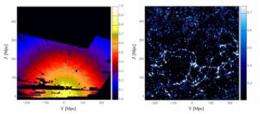
A bit of imagination on the part of a measuring instrument wouldn't be a bad thing. It could help to add data from areas where the instrument is unable to measure. However, it must do so constructively. In order to infer missing data in an astronomical measurement with more than just imagination, physicists at the Max Planck Institute for Astrophysics have formulated a theory of spatial perception called information field theory.
The scientists have developed a series of rules for reconstituting incomplete and noisy image data. Furthermore, they have established the various conditions under which the rules should be applied. They draw on a mathematical algorithm that particle physicists use in quantum field theory. The theory could also help to create images in the areas of medicine, geology and materials sciences. (Phys. Rev. D, online publication, 9 November 2009)
Sometimes we hear or see what we think makes sense: we can recognise a cup even if we only see a single detail. And we understand someone mumbling on the phone more clearly if we are already familiar with their voice. It's the expectation of a sensory impression that makes life easier for magicians, too, when they make a ball disappear by throwing it up in the air: our eyes follow the ball that we think should be flying through the air, but the conjurer only pretended to throw the ball and actually hid it instead.
A measuring instrument should be safe from such illusions - on the one hand. But on the other hand, it would certainly be helpful if scientists could add data in places where it cannot be measured: for instance, when they want to take a picture of the universe behind the Milky Way, which telescopes are unable to penetrate. To enable them to draw conclusions about astronomical blind spots, Torsten Enßlin and his team at the Max Planck Institute for Astrophysics in Garching have developed a clever system, which they call information field theory (IFT).
"We add the missing data on the basis of the existing measuring points around the edge of the blind spot," says Torsten Enßlin, who heads a research group at the Garching-based Institute on the cosmic microwave background, the relic radiation from the Big Bang: "These conclusions are more or less uncertain, of course." Yet adding data in a way that appears to make sense is not enough to avoid reaching a wrong conclusion: "Our theory also calculates precisely how uncertain the statements are," says Enßlin. Using this method, the scientists partially completed measurements of the cosmic microwave background, a radiation echo of the Big Bang, behind the Milky Way, where even the most clear-sighted telescope is blind.
IFT is based on the responses to two questions, which the system must answer for each unknown point. If the researchers want to reconstruct the microwave background on the basis of measuring data, for example, they first ask: How probable are the measured data? Then they ask: How probable are our assumptions on the microwave background? These two probabilities determine how plausible the respective images of the microwave background are in light of the data and prior knowledge. An optimal reconstruction lies in the middle of the probable images.
The relationship between the signal sensitivity and the noise of the measuring instrument plays a decisive role in answering the first question. The noise disturbs the measurement, and at worst a physical measuring signal can get lost in the noise - like the static that distorts an analogue radio transmission with poor reception.
"The answer to the second question comes from the previous question; in other words, my expectation of a signal resulting from my prior knowledge," explains Torsten Enßlin. The signal corresponds to the reality of the data that the measuring instrument may only be able to reproduce with distortion. Correctly applying the expectation of a signal is a tricky business. "If I really want to see something, I choose a strong prior - but then I'm blind to everything else," says Enßlin. Up to now, scientists often constructed their expectations of measuring data more or less randomly and equally randomly decided how strongly they should be incorporated into a data point. Information theory, on the other hand, precisely regulates how expectations should be formulated and also what weighting they should carry. "What's new about our theory is that we can apply information theory to spatially distributed parameters - we call them fields - when we broaden them for the purposes of information field theory," says Enßlin.
There is already a rule for supplementing incomplete spatially distributed data: the Wiener filter. Torsten Enßlin compares another scenario to explain how it works: "If you can see a lot of trees, you're probably standing in a forest," he says: "Even if your sight is impaired, you can conclude that there is another tree standing next to all the trees you can see." The Wiener filter applies only under a number of conditions: the noise of the instrument must be independent of the signal's strength, and the measuring instrument's response to the signal must increase in a linear fashion, in other words, evenly in line with the increase in strength. And finally, the noise and the signal must follow Gaussian statistics, which are easy to apply mathematically. Information field theory incorporates the Wiener filter - as a simple special case.
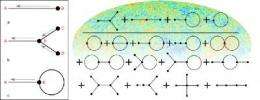
Often, at least one of these conditions is not met. "But because there was no theory for this case, physicists also applied the Wiener filter when they really shouldn't have," says Torsten Enßlin. He and his colleagues have now created this theory. They formulated a description of how to proceed in individual cases in the form of Feynman diagrams - schematic drawings consisting of dots, lines and circles, which, if you know how to read them, reveal what mathematical operations need to be carried out.
The physicist Richard Feynman developed this schematic code to record the goings-on in the world of the tiniest elements - such as what happens when two electrodes collide. Feynman thereby put his quantum field theory, which described such processes, into practice more or less clearly. And this was the inspiration behind information field theory. "At some point I had the feeling that I had to refresh my knowledge of quantum field theory," says Torsten Enßlin. So he waded through a textbook on the subject and came across a footnote explaining how human visual perception can be described as statistical field theory. "This gave me the idea to formulate information field theory, because we have measuring problems especially when researching cosmic microwave radiation and the distribution of matter in the universe. These can be very well described by statistical field theories," he says. "Someone could have come up with the idea earlier, but quantum physicists do not usually concern themselves with signal recognition and electrical engineers do not read books about quantum field theory".
Since Torsten Enßlin's work as a physicist was concerned with signal recognition, he developed a mathematical algorithm that can be of great help to many - and not only to astrophysicists. Medical practitioners would, in numerous cases, be able to make more precise diagnoses if the imaging procedures took a less limited perspective. And IFT could also help geologists locate mineral resources where measurements provide an incomplete picture.
More information: Torsten A. Ensslin, Mona Frommert, Francisco S. Kitaura, Information field theory for cosmological perturbation reconstruction and non-linear signal analysis, Physical Review D, online publication, November 9, 2009
Source: Max-Planck-Gesellschaft (news : web)


