Peptides control crystal growth with 'switches, throttles and brakes'
November 23, 2009
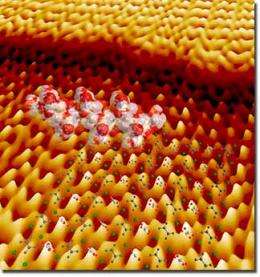
Aspartic acid-rich peptides adsorbed on a calcium oxalate monohydrate (COM) crystal surface. Models of a peptide and COM crystal structure are overlain on an AFM image collected during growth of the [010] face of COM. The rendered AFM image reveals the molecular structure of the crystal surface including individual kink-sites along a single atomic step. The high peaks show the individual oxalate groups and the dimension along the bottom edge of the image is 60 angstroms.
(PhysOrg.com) -- By producing some of the highest resolution images of peptides attaching to mineral surfaces, scientists have a deeper understanding how biomolecules manipulate the growth crystals. This research may lead to a new treatment for kidney stones using biomolecules.
The research, which appears in the Nov. 23 online edition of the journal Proceedings of the National Academy of Sciences, explores how peptides interact with mineral surfaces by accelerating, switching and inhibiting their growth.
The team, made up of researchers from Lawrence Livermore National Laboratory, the Molecular Foundry at Lawrence Berkeley, the University of California, Davis and the University of Alabama, for the first time produced single-molecule resolution images of this peptide-mineral interaction.
Inorganic minerals play an important role in most biological organisms. Bone, teeth, protective shells or the intricate cell walls of marine diatoms are some displays of biomineralization, where living organisms form structures using inorganic material. Some minerals also can have negative effects on an organism such as in kidney and gallstones, which lead to severe suffering and internal damage in humans and other mammals.
Understanding how organisms limit the growth of pathological inorganic minerals is important in developing new treatment strategies. But deciphering the complex pathways that organisms use to create strong and versatile structures from relatively simple materials is no easy feat. To better understand the process, scientists attempt to mimic them in the laboratory.
By improving the resolution power of an Atomic Force Microscope (AFM), the PNAS authors were able to image individual atomic layers of the crystal interacting with small protein fragments, or peptides, as they fell on the surface of the crystal.
"Imaging biomolecules that are weakly attached to a surface, while simultaneously achieving single-molecule resolution, is normally difficult to do without knocking the molecules off," said Raymond Friddle, an LLNL postdoctoral fellow. But the team improved upon previous methods and achieved unprecedented resolution of the molecular structure of the crystal surface during the dynamic interaction of each growing layer with peptides. "We were able to watch peptides adhere to the surface, temporarily slow down a layer of the growing crystal, and surprisingly 'hop' to the next level of the crystal surface."
The images also revealed a mechanism that molecules can use to bind to surfaces that would normally repel them. The high resolution images showed that peptides will cluster together on crystal faces that present the same electronic charge. Under certain conditions the peptides would slow down growth, while under other conditions the peptides could speed up growth.
On another face of the crystal, where the peptides were expected to bind strongly, the researchers found instead that the peptides did not attach to the surface unless the crystal growth slowed. The peptides needed to bind in a specific way to the face, which takes more time than a non-specific attachment. As a result, the growing layers of the crystal were able to shed off the peptides as they attempted to bind.
But when the researchers slowed down the crystal growth rate, the peptides collapsed onto the surface so strongly that they completely stopped growth. The researchers proposed that the phenomenon is due to the unique properties of bio-polymers, such as peptides or polyelectrolytes, which fluctuate in solution before resting in a stable configuration on a surface.
"The results of the catastrophic drop in growth by peptides suggest ways that organisms achieve protection against pathological mineralization," said Jim De Yoreo, the project lead and deputy director of research at LBNL's Molecular Foundry. "Once growth is halted, a very high concentration of the mineral will be needed before growth can again reach significant levels."
He said designing polyelectrolyte modifiers in which the charge, size and ability to repel water can be systematically varied would allow researchers to create the equivalent of "switches, throttles and brakes" for directing crystallization.
Source: Lawrence Livermore National Laboratory
-
Bare bones of crystal growth: Biomolecules enhance metal contents in calcite
Oct 31, 2008 |
not rated yet |
0
-
Discovery of natural compounds that could slow blood vessel growth
Oct 04, 2008 |
not rated yet |
0
-
Scientists uncover speedometer for crystal growth controlled by biomolecule properties
Dec 04, 2006 |
not rated yet |
0
-
Toothpick: New molecular tag IDs bone and tooth minerals
Jul 10, 2008 |
not rated yet |
0
-
Surgical Implants Coated with One of "Nature's Antibiotics" Could Prevent Infection
Jan 29, 2009 |
not rated yet |
0
-
Engineers build first sub-10-nm carbon nanotube transistor
Feb 01, 2012 |
4.9 / 5 (30) |
30
-
Something old, something new: Evolution and the structural divergence of duplicate genes
Jan 31, 2012 |
4.6 / 5 (7) |
1
-
The hidden nanoworld of ice crystals: Revealing the dynamic behavior of quasi-liquid layers
Jan 30, 2012 |
5 / 5 (3) |
1
-
Stock market network reveals investor clustering
Jan 27, 2012 |
3.9 / 5 (23) |
8
-
Of microchemistry and molecules: Electronic microfluidic device synthesizes biocompatible probes
Jan 26, 2012 |
5 / 5 (1) |
0
-
Cancer drugs and Alzheimer's, Oh my!
8 hours ago
-
Squishing cells
8 hours ago
-
Any books/articles for evolutionary stable strategy models in humans?
20 hours ago
-
Science behind the bore feeling?
Feb 09, 2012
-
Homo Sapien vs. Chimpanzee - Divergence Timeline
Feb 09, 2012
-
a single mRNA strand is attached to sevaral ribosomes?
Feb 08, 2012
- More from Physics Forums - Biology
More news stories
'Dark plasmons' transmit energy
Microscopic channels of gold nanoparticles have the ability to transmit electromagnetic energy that starts as light and propagates via "dark plasmons," according to researchers at Rice University.
14 hours ago |
5 / 5 (5) |
0
|
Nanotube therapy takes aim at breast cancer stem cells
Wake Forest Baptist Medical Center researchers have again proven that injecting multiwalled carbon nanotubes (MWCNTs) into tumors and heating them with a quick, 30-second laser treatment can kill them.
Nanotechnology / Bio & Medicine
19 hours ago |
5 / 5 (1) |
0
|
New kind of solar cell could capture significantly more energy than current cells
New solar cells could increase the maximum efficiency of solar panels by over 25%, according to scientists from the University of Cambridge.
Feb 08, 2012 |
4.5 / 5 (11) |
14
|
New technology platform for molecule-based electronics
Researchers at the Nano-Science Center at the University of Copenhagen have developed a new nano-technology platform for the development of molecule-based electronic components using the wonder material graphene. At the same ...
Nanotechnology / Nanomaterials
21 hours ago |
5 / 5 (2) |
0
Nanoshell whispering galleries improve thin solar panels
Visitors to Statuary Hall in the U.S. Capitol Building may have experienced a curious acoustic feature that allows a person to whisper softly at one side of the cavernous, half-domed room and for another on ...
Nanotechnology / Nanomaterials
Feb 07, 2012 |
4.3 / 5 (6) |
6
|
New error-correcting codes guarantee the fastest possible rate of data transmission
Error-correcting codes are one of the triumphs of the digital age. Theyre a way of encoding information so that it can be transmitted across a communication channel such as an optical fiber o ...
High school students test best with 7 hours' rest
(Medical Xpress) -- Whether or not you know any high school students that actually get nine hours of sleep each night, thats what federal guidelines currently prescribe.
Soccer -- the link between managers and captains
Soccer managers regard their captains as an extension of themselves, according to new research from Northumbria University, which could explain why Fabio Capello quit as England manager following the FA row ...
Using economic evaluations for drug reimbursement decisions - what have we achieved?
Researchers at the University of York perform evaluations of the clinical and cost-effectiveness of drugs for the National Institute for Health and Clinical Excellence (NICE).
Increasing healthy food options makes economic sense
If there is an obvious truth one can learn from perusing the various dining options on Lehighs sprawling Asa Packer campusfrom the University Center and Rathbone Hall to the sorority and fraternity houses on the ...
Humans may have helped the decline of African rainforests 3000 years ago
(PhysOrg.com) -- Large areas of rainforests in Central Africa mysteriously disappeared over three thousand years ago, to be replaced by savannas. The prevailing theory has been that the cause was a change ...