A year after discovery, Congo's 'mother lode' of gorillas remains vulnerable
November 23, 2009 A year after discovery, Congo's 'mother lode' of gorillas remains vulnerable

Enlarge

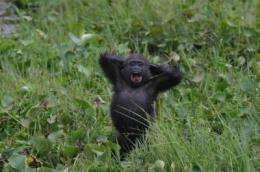
Western lowland gorillas recently surveyed in forest swamps (and part of last year's discovery of more than 125,000 gorillas in the Republic of Congo) are now in need of protection from human activities. Credit: Thomas Breuer/Wildlife Conservation Society—Max Planck Institute for Evolutionary Anthropology

A new study by the Wildlife Conservation Society says that western lowland gorillas living in a large swamp in the Republic of Congo—part of the "mother lode" of more than 125,000 gorillas discovered last year—are becoming increasingly threatened by growing humans activity in the region.

The study recommends protection of the swamp forests adjacent to the southwest border of Lac Télé Community Reserve after recent surveys confirmed that high densities of the great apes still exist in the remote location.

The findings and recommendations appear in the November issue of the journal Oryx. The study's authors include: Hugo Rainey, Emma Stokes, Fiona Maisels, Samantha Strindberg, Fortuné Iyenguet, Guy-Aimé Malanda, and Bola Madzoké from the Wildlife Conservation Society: and Domingos Dos Santos from the Republic of Congo Minstčre de l'Economie Forestičre.

The swamp also supports large numbers of chimpanzees, red colobus monkeys, elephants, and other rain forest species. According to the study, imminent threats to the swamp include new logging operations, oil exploration, an influx of refugees from neighboring Democratic Republic of Congo, and, resulting from these developments, an increase in the human population, construction of roads and other infrastructure, and the escalation of the illegal bushmeat trade.

"We implore both the Government of the Republic of Congo and the international community to begin the groundwork for the creation of a new protected area to safeguard these and their unique environment for the benefit of future generations," said Dr. James Deutsch, WCS Director for Africa Programs. "Losing gorillas in this region after all the attention from their discovery would be a sad coda on an otherwise great story."
A year after discovery, Congo's 'mother lode' of gorillas remains vulnerable
Enlarge

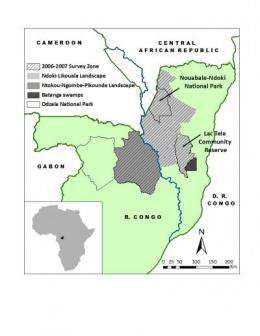
WCS researchers recently surveyed the Raphia swamp forests in the Republic of Congo and found higher gorilla densities than expected. The study site is the dark polygon to the southeast of Lac Télé Community Reserve. Credit: Courtesy of the Wildlife Conservation Society

"The world was electrified at the discovery of more than 125,000 western lowland gorillas still in existence in the heart of Africa's rain forests, which include the recently surveyed gorillas just outside of Lac Télé," said WCS researcher Dr. Hugo Rainey, the paper's lead author. "Now that the thrill is gone, we can't forget about the most important part of wildlife surveys: protecting what we find."

Using methodologies based on counting the nests constructed by gorillas and the decay rates of these temporary structures, the researchers calculated that the study area (measuring 1,029 square kilometers, or 379 square miles, in size) contained an estimated population of 5,042 gorillas, more in fact than previous estimates for the site. The result is one of the highest density estimates ever calculated for gorillas—more than five gorillas per square kilometer (more than 13 gorillas per square mile).

The study site was the easternmost part of the gorilla census announced last year that produced a jaw-dropping estimate of more than 125,000 western lowland gorillas for the region.

Source: Wildlife Conservation Society (news : web)


Rate this story - 5 /5 (1 vote)


November 23, 2009 all stories

Comments: 0

5 /5 (1 vote)

  • hide
  • Related Stories

  • Scientists discover 'Planet of the Apes'
    created Aug 05, 2008 | popularity not rated yet | comments 0
  • Mountain gorillas in danger in the Congo
    created Aug 21, 2007 | popularity not rated yet | comments 0
  • Uganda's gorilla population growing
    created Apr 21, 2007 | popularity not rated yet | comments 0
  • New national park protects world's rarest gorilla
    created Nov 26, 2008 | popularity not rated yet | comments 0
  • World's most endangered gorilla fights back
    created Dec 05, 2007 | popularity not rated yet | comments 0


  • hide
  • Relevant PhysicsForums posts

  • Sleeping habits and the risk of cancer
    created Feb 08, 2010
  • Pressure in chambers of the heart
    created Feb 07, 2010
  • Primordial soup canned?
    created Feb 07, 2010
  • Where on the r/K selection theory scale do social insects like ants and bees fall?
    created Feb 06, 2010
  • Testosterone levels and Fighting
    created Feb 05, 2010
  • Evolution Simulator
    created Feb 04, 2010
  • More from Physics Forums - Biology

Other News

Researchers find genes that 'tune' flower fragrances

Biology / Biotechnology

created 20 minutes ago | popularity not rated yet | comments 0 | with audio podcast

(PhysOrg.com) -- Shakespeare famously wrote, "That which we call a rose by any other name would smell as sweet." With all due respect to the Bard, University of Florida researchers may have to disagree: no matter what you ...


Researchers map all the fragile sites of the yeast Saccharomyces cerevisiae's genome

Biology / Cell & Microbiology

created 11 minutes ago | popularity not rated yet | comments 0 | with audio podcast

The research group of Dr. François Robert, a researcher at the Institut de recherches cliniques de Montréal (IRCM), in collaboration with the team of Dr. Daniel Durocher (Samuel Lunenfeld Research Institute and University ...


Mescal worm test shows DNA leaks into preservative liquids

Biology / Biotechnology

created 21 minutes ago | popularity not rated yet | comments 0

Just because you don't swallow the worm at the bottom of a bottle of mescal doesn't mean you have avoided the essential worminess of the potent Mexican liquor, according to scientists from the Biodiversity Institute of Ontario ...


Animals cope with climate change at the dinner table

Biology / Ecology

created 1 seconds ago | popularity not rated yet | comments 0

Some animals, it seems, are going on a diet, while others have expanding waistlines.


Researchers reveal 3-D structure of bullet-shaped virus with potential to fight cancer, HIV

Researchers reveal 3-D structure of bullet-shaped virus with potential to fight cancer, HIV

Biology / Cell & Microbiology

created 6 hours ago | popularity 5 / 5 (6) | comments 0 | with audio podcast

(PhysOrg.com) -- Using cryo-electron microscopy and advanced image-processing methods, UCLA researchers have developed a model of how the potentially therapeutic vesicular stomatitis virus assembles.