Cassini Sends Back Images of Enceladus as Winter Nears
November 23, 2009 Cassini Sends Back Images of Enceladus as Winter Nears

Enlarge

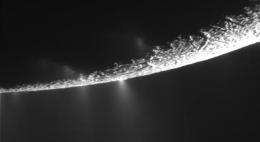
This unprocessed image was captured by NASA's Cassini spacecraft during its Nov. 21, 2009 flyby of Saturn's moon Enceladus. It shows the moon's south polar region, where jets of water vapor and other particles spew from fissures on the surface. Image credit: NASA/JPL/Space Science Institute

(PhysOrg.com) -- NASA's Cassini spacecraft has sailed seamlessly through the Nov. 21 flyby of Saturn's moon Enceladus and started transmitting uncalibrated temperature data and images of the rippling terrain. These data and images will be processed and analyzed in the coming weeks. They will help scientists create the most-detailed-yet mosaic image of the southern part of the moon's Saturn-facing hemisphere and a contiguous thermal map of one of the intriguing "tiger stripe" features, with the highest resolution to date.

"These first raw images are spectacular, and paint an even more fascinating picture of Enceladus," said Bob Pappalardo, Cassini project scientist at NASA's Jet Propulsion Laboratory in Pasadena, Calif. "The Cassini teams will be delving into the data to better understand the workings of this bizarre, active moon."

Scientists are particularly interested in the tiger stripes, which are fissures in the south polar region, because they spew jets of and other particles hundreds of kilometers, or miles, from the surface. This flyby was scientists' last peek at the tiger stripes before the south pole fades into the darkness of winter for several years. The work focused on the tiger stripe known as Baghdad Sulcus.

The Nov. 21 encounter, which is sometimes called "E8" because it is the eighth targeted flyby of Enceladus, brought Cassini to within about 1,600 kilometers (1,000 miles) of the moon's surface, at around 82 degrees south latitude. Cassini is now cruising toward Rhea, another one of Saturn's moons, for more imaging and mapping work.

To see a full gallery of raw images, click here.

Provided by JPL/NASA (news : web)


Rate this story - 4.4 /5 (7 votes)


November 23, 2009 all stories

Comments: 0

4.4 /5 (7 votes)

  • hide
  • Related Stories


  • hide
  • Relevant PhysicsForums posts

  • Spreading Life in the Universe
    created 1hour ago
  • Force of Gravity in terms of Density
    created Feb 08, 2010
  • what is the relation between gravity and light?
    created Feb 08, 2010
  • Does the Thermoelectric effect apply in sun?
    created Feb 07, 2010
  • More from Physics Forums - General Astronomy

Other News

Climate 'Tipping Points' May Arrive Without Warning, Says Top Forecaster

Space & Earth / Environment

created 4 minutes ago | popularity not rated yet | comments 0 | with audio podcast

(PhysOrg.com) -- A new University of California, Davis, study by a top ecological forecaster says it is harder than experts thought to predict when sudden shifts in Earth's natural systems will occur -- a worrisome finding ...


URI researcher calls for global effort to monitor marine pollutants

Space & Earth / Environment

created 1hour ago | popularity 5 / 5 (1) | comments 1

A University of Rhode Island researcher who studies chemical pollutants in the marine environment has called on colleagues around the world to establish a global monitoring network to verify that the chemicals banned by the ...


A new 3-D map of the interstellar gas within 300 parsecs from the sun

A new 3D map of the interstellar gas within 300 parsecs from the Sun

Space & Earth / Astronomy

created 2 hours ago | popularity 5 / 5 (3) | comments 0 | with audio podcast

(PhysOrg.com) -- Astronomy & Astrophysics is publishing new 3D maps of the interstellar gas in the local area around our Sun. A French-American team of astronomers presents new absorption measurements toward ...


Rho Ophiuchus cloud

Professor: We have a 'moral obligation' to seed universe with life

Space & Earth / Astronomy

created 11 hours ago | popularity 3.7 / 5 (19) | comments 32 | with audio podcast report

(PhysOrg.com) -- Eventually, the day will come when life on Earth ends. Whether that’s tomorrow or five billion years from now, whether by nuclear war, climate change, or the Sun burning up its fuel, the last ...


New international satellite observations help assess future earthquake risk in Haiti

New international satellite observations help assess future earthquake risk in Haiti

Space & Earth / Earth Sciences

created 3 hours ago | popularity not rated yet | comments 0

Virginia Key, Florida--Scientists at the University of Miami have analyzed images based on Synthetic Aperture Radar (SAR) observations taken before and just after Haiti's earthquake, on January 12. The images ...