'Cosmic fruit machine' matches collisions
November 24, 2009 'Cosmic fruit machine' matches collisions

Enlarge

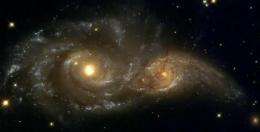
Two galaxies (NGC 2207 & IC 2163) merging. Image: NASA/Hubble Heritage

(PhysOrg.com) -- A new website will give everyone the chance to contribute to science by playing a 'cosmic fruit machine' and compare images of colliding galaxies with millions of simulated images of galactic pile-ups.

These collisions, which astronomers call ‘galactic mergers’, could be the key to finding out why the Universe contains the mix of galaxies it does - some with trailing spiral arms, others more like compact ‘balls’ of stars.

Surprisingly, humans are much better than computers at spotting the best match between a real galactic merger image and a random selection of simulated merger images. Because the simulated images reflect the different variables involved in the data from people using the site, Galaxy Zoo Mergers, promise to revolutionise our understanding of these collisions.

Galaxy Zoo Mergers, which goes live today at http://mergers.galaxyzoo.org is an international project led by scientists from Oxford University in the UK and George Mason University in the US.

‘Visitors to the Galaxy Zoo Mergers site use what’s rather like a giant fruit machine, with a real image of a galactic merger in the centre and eight randomly selected simulated merger images filling the other eight ‘slots’ around it,’ said Dr Chris Lintott of Oxford University’s Department of Physics, galaxyzoo.org team member. ‘By randomly cycling through the millions of simulated possibilities and selecting only the very best matches they are helping to build up a profile of what kind of factors are necessary to create the galaxies we see in the Universe around us - and, hopefully, having fun too!’

Users do more than simply select images, they can also take direct control of the simulations - choosing ‘more’ or ‘fewer stars’ or ‘flipping’ galaxies - in order to provide an exact match to what we see in the Universe.

‘Whilst we’re challenging the 250,000 existing users of the original Galaxy Zoo site to take part in this new project, anyone is welcome to join in - you don’t have to be an expert, in fact our evidence shows that not being an expert actually makes you better at this sort of task,’ said Dr John Wallin, an Astronomer in George Mason University’s Department of Computational and Data Sciences, galaxyzoo.org team member. ‘By reconstructing these collisions, our users will help us understand how galaxies have changed over the history of the universe.’

The project will focus on around 3,000 images of real galactic mergers identified through the Galaxy Zoo project - it also features some new images of these mergers taken by the Hubble Space Telescope. The next stage will be to investigate the ‘before’ and ‘after’ of these colliding galaxies to work out what caused them and what will happen next - rather like trying to capture the slow motion detail of the moments before a car crash and predict the aftermath.

‘These collisions take millions of years to unfold and so all we get from the Universe is a single snapshot of each one. By producing simulations, we will be able to watch each cosmic car crash unfold in the computer,’ said Anthony Holincheck, a graduate student at George Mason University and galaxyzoo.org team member.

The collisions examined in the project are a foretaste of what will happen when our own galaxy, the Milky Way, eventually merges with our galactic neighbour Andromeda in the distant future.

Provided by Oxford University (news : web)


Rate this story - 4.5 /5 (6 votes)

Rank Filter

Move the slider to adjust rank threshold, so that you can hide some of the comments.


Display comments: newest first

  • Going - Nov 24, 2009
    • Rank: not rated yet
    I tried this out and it requires a lot of patience together with a lot of trial and error. It's interesting to see how much galactic mass and speeds produce widely different outcomes.
  • brant - Nov 24, 2009
    • Rank: 1 / 5 (1)
    "The collisions examined in the project are a foretaste of what will happen when our own galaxy, the Milky Way, eventually merges with our galactic neighbour Andromeda in the distant future."

    Forecasting the future these days?

    The approach they are trying is like throwing a bunch of mud at the wall to see what sticks.

    Their theory doesnt predict anything because its wrong so they try a bunch of parameteres and then cherry pick the data. Hey wait a minute... Isnt there a problem with this modus operandi in another scientific institution right now??.

November 24, 2009 all stories

Comments: 2

4.5 /5 (6 votes)

  • hide
  • Related Stories

  • Web users to write ‘Hitchhiker’s Guide to the Galaxies’
    created Feb 17, 2009 | popularity not rated yet | comments 0
  • Astronomer Triggers Public’s Online Search for Overlapping Galaxies
    created Dec 20, 2007 | popularity not rated yet | comments 0
  • Galaxy collisions dominate the local universe
    created Dec 06, 2005 | popularity not rated yet | comments 0
  • Spitzer Spies Monster Galaxy Pileup
    created Aug 06, 2007 | popularity not rated yet | comments 0
  • The Universe: It's not as violent as we think
    created Sep 17, 2004 | popularity not rated yet | comments 0


  • hide
  • Relevant PhysicsForums posts

  • Spreading Life in the Universe
    created 17 hours ago
  • Force of Gravity in terms of Density
    created Feb 08, 2010
  • what is the relation between gravity and light?
    created Feb 08, 2010
  • Does the Thermoelectric effect apply in sun?
    created Feb 07, 2010
  • More from Physics Forums - General Astronomy

Other News

India announces long-range nuclear-capable missile test

Space & Earth / Space Exploration

created 37 minutes ago | popularity 5 / 5 (1) | comments 0

India will test a nuclear-capable missile with a range of over 5,000 kilometres (3,000 miles) within a year, its top military scientist said Wednesday, risking a rise in regional tensions.


Space shuttle Endeavour pulls in at space station (AP)

Space shuttle Endeavour pulls in at space station

Space & Earth / Space Exploration

created 6 hours ago | popularity 5 / 5 (1) | comments 0

(AP) -- Shuttle Endeavour arrived to a warm welcome at the International Space Station early Wednesday, delivering a new room and observation deck that will come close to completing construction 200 miles ...


Climate 'Tipping Points' May Arrive Without Warning, Says Top Forecaster

Space & Earth / Environment

created 16 hours ago | popularity 3.5 / 5 (11) | comments 11 | with audio podcast

(PhysOrg.com) -- A new University of California, Davis, study by a top ecological forecaster says it is harder than experts thought to predict when sudden shifts in Earth's natural systems will occur -- a worrisome finding ...


38 percent of world's surface in danger of desertification

38 percent of world's surface in danger of desertification

Space & Earth / Environment

created 12 hours ago | popularity 2 / 5 (4) | comments 6

A team of Spanish researchers has measured the degradation of the planet's soil using the Life Cycle Assessment (LCA), a scientific methodology that analyses the environmental impact of human activities, and ...


A new 3-D map of the interstellar gas within 300 parsecs from the sun

A new 3D map of the interstellar gas within 300 parsecs from the Sun

Space & Earth / Astronomy

created 18 hours ago | popularity 5 / 5 (6) | comments 0 | with audio podcast

(PhysOrg.com) -- Astronomy & Astrophysics is publishing new 3D maps of the interstellar gas in the local area around our Sun. A French-American team of astronomers presents new absorption measurements toward ...