Gene increases effectiveness of drugs used to fight cancer and allows reduction in dosage
November 24, 2009
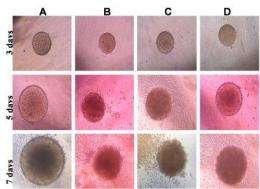
This image shows the effect of gene therapy combined with cytotoxic agents in E spheroids derived from breast cancer cell line MCF-7. A. Control; B. Doxorubicin 10nm, C. Paclitaxel 10nm, D. Docetaxel 10nm, combined with gene E. Credit: University of Granada
Researchers at the University of Granada, Spain, have found a suicide gene, called 'gene E', which leads to the death of tumour cells derived from breast, lung and colon cancer, and prevents their growth. The importance of this new gene is that its use to fight cancer can reduce the potent drugs that are currently used, so that could mean more effective treatment for cancer.
This research was conducted by Ana Rosa Rama Ballesteros, from the Department of Anatomy and Human Embryology at the University of Granada, and directed by professors Antonia Aránega Jimenez, José Carlos Prados Salazar and Consolación Melguizo Alonso. Its aim was to study the possibility of reducing the dosage of drugs currently administered to cancer patients using combination therapy with suicide gene E.
Scientists from the UGR have shown that the bacteriophage phiX174 killer gene called E, can be used to induce death in tumour cells. So far, attempts to use many chemotherapeutic (cytotoxic) agents similar to the E gene have shown severe limitations resulting from their toxicity and their poor affinity with the tumour.
Advantages of gene therapy
As Ana Rosa Rama explains, chemotherapy, radiotherapy and surgery show at present "limited" results in advanced stages of cancer. "That is why it is urgent to find new therapies, and gene therapy has emerged as a potentially powerful therapeutic platform." Her work has shown that "it is possible to use gene therapy as an aid to chemotherapy, improving its results when it comes to attacking cancer, thus allowing the dosage of agents to be reduced and contributing to a reduction in side effects for the patient."
In order to understand how the E gene works, the researchers conducted studies using various techniques. The results indicate that the E gene's mechanism of action is to induce apoptosis (cell death), possibly through mitochondrial injury.
Therefore, they stress that "this new E gene appears as an ideal candidate to be transfected into tumour cells in order to induce apoptosis, possibly through mitochondrial activation, and to increase the sensitivity of these cells to the action of the drug developed specifically to act on them."
The results of this research suggest the possibility of reducing the concentration of chemotherapeutic agents in current use with cancer patients. Thus, in lung cancer cell line A-549, scientists from the UGR achieved a 14% inhibition of tumour growth and reduced by 100 times the dose of Paclitaxel agent when it was combined with gene E. In the case of colon cancer, the results were similar. However, the most relevant fact was found in the breast cancer cell line MCF-7, in which the dose of the chemotherapeutic agent, doxorubicin, was reduced by 100 times, reaching up to a 21% greater inhibition of tumour proliferation when combined with gene E. Currently, researchers from the UGR are in the process of obtaining a patent for gene E.
Source: University of Granada
-
Maslinic acid provides a natural defense against colon cancer
Jan 08, 2009 |
not rated yet |
0
-
New type of drug shrinks primary breast cancer tumors significantly in just 6 weeks
Apr 17, 2008 |
not rated yet |
0
-
Scientists discover new gene responsible for spread of cancer
Mar 29, 2006 |
not rated yet |
0
-
Guardian of genome predicts treatment outcomes for childhood cancer
Nov 05, 2007 |
not rated yet |
0
-
Pro-vitamin E shown to be active against breast cancer cells
Dec 08, 2006 |
not rated yet |
0
-
Engineers build first sub-10-nm carbon nanotube transistor
Feb 01, 2012 |
4.9 / 5 (31) |
30
-
Something old, something new: Evolution and the structural divergence of duplicate genes
Jan 31, 2012 |
4.6 / 5 (7) |
1
-
The hidden nanoworld of ice crystals: Revealing the dynamic behavior of quasi-liquid layers
Jan 30, 2012 |
5 / 5 (3) |
1
-
Stock market network reveals investor clustering
Jan 27, 2012 |
3.9 / 5 (23) |
8
-
Of microchemistry and molecules: Electronic microfluidic device synthesizes biocompatible probes
Jan 26, 2012 |
5 / 5 (1) |
0
-
Is Everyday Technology Killing Us?
Feb 08, 2012
-
Exercise and weight loss
Feb 08, 2012
-
Why do we have head aches? Our brains can't feel anything.
Feb 07, 2012
-
"The end of diseases" by David Agus, interview from Daily Show with Jon Stewart
Feb 04, 2012
-
Oncolytic adenovirus
Feb 04, 2012
-
Nutrition label stuffs and diets
Feb 02, 2012
- More from Physics Forums - Medical Sciences
More news stories
Complex wiring of the nervous system may rely on a just a handful of genes and proteins
Researchers at the Salk Institute have discovered a startling feature of early brain development that helps to explain how complex neuron wiring patterns are programmed using just a handful of critical genes. ...
6 hours ago |
4.9 / 5 (9) |
0
|
Both maternal and paternal age linked to autism
Older maternal and paternal age are jointly associated with having a child with autism, according to a recently published study led by researchers at The University of Texas Health Science Center at Houston (UTHealth).
Medicine & Health / Psychology & Psychiatry
10 hours ago |
4 / 5 (2) |
0
|
New understanding of DNA repair could eventually lead to cancer therapy
A research group in the Faculty of Medicine & Dentistry at the University of Alberta is hoping its latest discovery could one day be used to develop new therapies that target certain types of cancers.
10 hours ago |
4.8 / 5 (4) |
0
|
Curry spice component may help slow prostate tumor growth
Curcumin, an active component of the Indian curry spice turmeric, may help slow down tumor growth in castration-resistant prostate cancer patients on androgen deprivation therapy (ADT), a study from researchers ...
11 hours ago |
4.4 / 5 (8) |
0
|
Human cognitive performance suffers following natural disasters, researchers find
Not surprisingly, victims of a natural disaster can experience stress and anxiety, but a new study indicates that it might also cause them to make more errors - some serious - in their daily lives. In their upcoming Human Fa ...
Medicine & Health / Psychology & Psychiatry
7 hours ago |
4 / 5 (1) |
0
Google users warned of threat to smartphone wallets
Users of Google smartphone wallets were being warned on Friday that there is a way to crack pass codes intended to thwart thieves from going on illicit shopping sprees.
Anonymous knocks CIA website offline (Update)
The website of the Central Intelligence Agency was inaccessible on Friday after the hacker group Anonymous claimed to have knocked it offline.
New error-correcting codes guarantee the fastest possible rate of data transmission
Error-correcting codes are one of the triumphs of the digital age. Theyre a way of encoding information so that it can be transmitted across a communication channel such as an optical fiber o ...
The power of estrogen -- male snakes attract other males
A new study has shown that boosting the estrogen levels of male garter snakes causes them to secrete the same pheromones that females use to attract suitors, and turned the males into just about the sexiest ...
Humans may have helped the decline of African rainforests 3000 years ago
(PhysOrg.com) -- Large areas of rainforests in Central Africa mysteriously disappeared over three thousand years ago, to be replaced by savannas. The prevailing theory has been that the cause was a change ...
New power source discovered
(PhysOrg.com) -- Researchers at the Massachusetts Institute of Technology (MIT) and RMIT University have made a breakthrough in energy storage and power generation.