Fish food fight: Fish don't eat trees after all, says new study
(PhysOrg.com) -- What constitutes fish food is a matter of debate. A high-profile study a few years ago suggested that fish get almost 50 percent of their carbon from trees and leaves, evidence for a very close link between the terrestrial and aquatic ecosystems.
But new research from the University of Washington shows this is not likely to be true. Algae provide a much richer diet for fish and other aquatic life, according to research published this week in the Proceedings of the National Academy of Sciences.
"Are the fish made of maple? Our argument would be no, they're not, they're made of algae," says Michael Brett, a UW professor of civil and environmental engineering. "Other scientists have said that up to 50 percent of the carbon was coming from this terrestrial source. We're saying that's very unlikely."
The results could be important not just to fish but to people seeking to boost fish populations.
"In terms of fishery production this means you've really got to focus on the algae," Brett said. "The terrestrial environment is still important, but for other reasons such as habitat."
The new paper shows that algae are necessary ingredients for healthy zooplankton, the animals at the base of the aquatic food web. Brett's lab studies omega-3 fatty acids, the same ones touted in health studies. Fish can't produce the heart-healthy lipids, they just accumulate them from their diet. Brett's group looks at where exactly the omega-3's are coming from, largely from several groups of phytoplankton that can make these fats.
After reading the fish food study published in 2004 in the journal Nature, "we were furrowing our brows and saying 'This doesn't make sense,'" Brett said, "because the terrestrial plants aren't producing these omega-3 molecules. Those results completely conflicted with the perspective that was coming out of our own area of research."
The earlier study by the Institute for Ecosystem Studies in Millbrook, N.Y., was a large-scale experiment on three lakes in Michigan. Researchers fertilized these lakes with a labeled form of carbon dioxide sprinkled on the lakes' surfaces over more than a month. They then analyzed how much of that labeled carbon showed up in animals at each position in the aquatic food web. Even when terrestrial plant matter was only about 20 percent of the available food, they found, the animals appeared to be composed of about 50 percent land-based carbon.
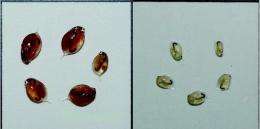
The UW study took a different approach. Brett and colleagues raised zooplankton in the lab, feeding them a diet of either pure algae, pure land-based carbon, or various mixtures of the two. They found that zooplankton fed a purely land-based diet survived and reproduced but were small and produced relatively few offspring. Zooplankton fed a diet of pure algae were 10 times bigger than their tree-fed twins and produced 20 times more offspring. Zooplankton fed a mixed diet were larger and produced more offspring as the proportion of algae in their diet went up. Even when zooplankton ate almost nothing but land-based carbon, nearly all their lipids came from algae.
"I think we were able to show that the terrestrial source is such low quality that it's inconceivable that it could be nearly as important as what that study suggested," Brett said.
This research was funded by the National Science Foundation. Co-authors are Sami Taipale and Hari Seshan of the UW and Martin Kainz of the Danube University Krems in Austria.
So why did the earlier study suggest that fish were eating land-based food? Brett believes the reason is those researchers discounted the idea of zooplankton migration, the daily movement down to deeper waters during the daytime to hide from predatory fish. Researchers sprinkled tagged food in the upper waters and assumed that any other food source must be land-based.
"The flaw was that there was an alternative source. They could have been getting half of their carbon from the lower depths in the lakes," Brett said.
In recent years the earlier study has had a profound impact on the field of aquatic ecology but few scientists have critically assessed its results, Brett says. "What I would hope our paper would do is to really get people to open their eyes and say 'Does this really add up, and is there a simpler way to look at what is supporting fisheries production?'"
Source: University of Washington (news : web)


