Researchers Establish Common Seasonal Patterns Among Bacterial Communities in Arctic Rivers
November 24, 2009 Researchers Establish Common Seasonal Patterns Among Bacterial Communities in Arctic Rivers

Enlarge

Courtesy Proceedings of the National Academy of Sciences, USA

(PhysOrg.com) -- New research on bacterial communities throughout six large Arctic river ecosystems reveals predictable temporal patterns, suggesting that scientists could use these communities as markers for monitoring climate change in the polar regions. The study, published this week in the Proceedings of the National Academy of Sciences Early Edition, shows that bacterial communities in the six rivers shifted synchronously over time, correlating with seasonal shifts in hydrology and biogeochemistry.

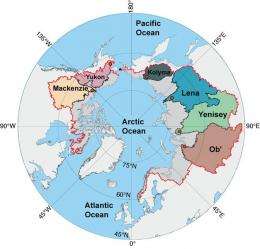
The research team documents these patterns through a three-year, circumpolar study of planktonic bacterial communities in the six largest rivers of the pan-arctic watershed: the Ob', Yenisey, Lena, Kolyma, Yukon, and Mackenzie Rivers.

"Our results demonstrate that synchrony, seasonality and annual reassembly in planktonic bacterial communities occur on global scales," said lead author Dr. Byron Crump of the University of Maryland Center for Environmental Science Horn Point Laboratory. "Since bacterial communities in big arctic rivers shift predictably with circumpolar seasonal changes in environmental conditions, they may serve as sensitive indicators of in the Arctic."

"The six river systems studied are comparable in size to the in the United States," said coauthor Rainer Amon of Texas A&M University at Galveston. "One of the things we learned is the bacteria communities in all six of them seem to be very similar. There are many questions still to be answered, such as how these bacteria communities might respond to a continued increase in temperature."

This synchrony indicates that hemisphere-scale variation in seasonal climate sets the pace of variation in microbial diversity. Moreover, these seasonal communities reassembled each year in all six rivers, suggesting a long-term, predictable succession in the composition of big river .

Divergence from this synchronous pattern may provide an early signal of climate change in some regions of the Arctic, and may result in changes to river microbial communities and the biogeochemical transformations that they carry out.

Data for this study was collected through the PARTNERS program, a collaboration among scientists from the U.S., Canada and Russia examining the largest rivers of the pan-arctic watershed. By including five of the world's 25 largest rivers in the study, the results provide a unique perspective on global-scale patterns in bacterial diversity.

More information: The article, “Circumpolar synchrony in big river bacterioplankton,” appears in the PNAS Early Edition the week of November 23, 2009 and is authored by Drs. Byron Crump, Bruce Peterson, Peter Raymond, Rainer Amon, Amanda Rinehart, James W. McClelland and R. Max Holmes.

Source: University of Maryland (news : web)


Rate this story - 5 /5 (1 vote)


November 24, 2009 all stories

Comments: 0

5 /5 (1 vote)

  • hide
  • Related Stories

  • Scientists expand understanding of how river carbon impacts the Arctic Ocean
    created Feb 12, 2008 | popularity not rated yet | comments 0
  • Arctic river deltas may hold clues to future global climate
    created May 18, 2009 | popularity not rated yet | comments 0
  • Bacterial persistence in streams
    created Aug 05, 2008 | popularity not rated yet | comments 0
  • Water levels dropping in some major rivers as global climate changes
    created Apr 21, 2009 | popularity not rated yet | comments 0
  • Study reveals causes for freshwater increase in oceans
    created Aug 25, 2006 | popularity not rated yet | comments 0


  • hide
  • Relevant PhysicsForums posts

  • Carbon Dioxide emissions question
    created Feb 08, 2010
  • Photosynthesis vs. carbonization
    created Feb 07, 2010
  • Sheep's footprints
    created Feb 05, 2010
  • How did Victorians estimate the ages of fossils?
    created Feb 03, 2010
  • More from Physics Forums - Earth

Other News

Climate 'Tipping Points' May Arrive Without Warning, Says Top Forecaster

Space & Earth / Environment

created 7 hours ago | popularity 3 / 5 (4) | comments 5 | with audio podcast

(PhysOrg.com) -- A new University of California, Davis, study by a top ecological forecaster says it is harder than experts thought to predict when sudden shifts in Earth's natural systems will occur -- a worrisome finding ...


Rho Ophiuchus cloud

Professor: We have a 'moral obligation' to seed universe with life

Space & Earth / Astronomy

created 18 hours ago | popularity 3.2 / 5 (23) | comments 47 | with audio podcast report

(PhysOrg.com) -- Eventually, the day will come when life on Earth ends. Whether that’s tomorrow or five billion years from now, whether by nuclear war, climate change, or the Sun burning up its fuel, the last ...


38 percent of world's surface in danger of desertification

38 percent of world's surface in danger of desertification

Space & Earth / Environment

created 3 hours ago | popularity 2.3 / 5 (3) | comments 4

A team of Spanish researchers has measured the degradation of the planet's soil using the Life Cycle Assessment (LCA), a scientific methodology that analyses the environmental impact of human activities, and ...


A new 3-D map of the interstellar gas within 300 parsecs from the sun

A new 3D map of the interstellar gas within 300 parsecs from the Sun

Space & Earth / Astronomy

created 9 hours ago | popularity 5 / 5 (4) | comments 0 | with audio podcast

(PhysOrg.com) -- Astronomy & Astrophysics is publishing new 3D maps of the interstellar gas in the local area around our Sun. A French-American team of astronomers presents new absorption measurements toward ...


URI researcher calls for global effort to monitor marine pollutants

Space & Earth / Environment

created 8 hours ago | popularity 3 / 5 (2) | comments 1

A University of Rhode Island researcher who studies chemical pollutants in the marine environment has called on colleagues around the world to establish a global monitoring network to verify that the chemicals banned by the ...