Icebergs head from Antarctica for New Zealand
November 24, 2009 By RAY LILLEY , Associated Press Writer
Icebergs head from Antarctica for New Zealand (AP)

Enlarge

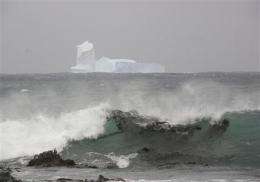
In this Nov. 16, 2009 photo released by the Australian Antarctic Division, an iceberg is seen at Sandy Bay on Macquarie Island's east coast, in the Southern Ocean 1,500 kilometers (930 miles) southeast of Tasmania, Australia. It is very rare to see icebergs from Macquarie Island and is uncommon to find icebergs in this general region. (AP Photo/Australian Antarctic Division, Eve Merfield)

(AP) -- Ships in the south Pacific Ocean have been alerted that hundreds of icebergs believed to have split off Antarctic ice shelves are drifting north toward New Zealand, officials said Tuesday.

The nearest one, measuring about 30 yards (meters) tall, was 160 miles (260 kilometers) southeast of New Zealand's Stewart Island and was part of a "flotilla" of icebergs that can be seen on satellite images, Australian glaciologist Neal Young said.

The alert comes three years after cold weather and favorable ocean currents saw dozens of icebergs float close to New Zealand's southern shores for the first time in 75 years.

New Zealand maritime officials have issued navigation warnings for the area south of the country.

"It's an alert to shipping to be aware these potential hazards are around and to be on the lookout for them," Maritime New Zealand spokeswoman Sophie Hazelhurst said.

No major shipping lanes or substantial fishing grounds are in the area, but most ships there have little hull protection if they collide with an iceberg - which typically has 90 percent of its mass under water.

On Monday, Rodney Russ, expedition leader on the tourist ship Spirit of Enderby, spotted a 500-foot-long (150-meter-long) about 60 miles (100 kilometers) northeast of Macquarie Island and heading north - about 500 miles (800 kilometers) south of New Zealand. Australian scientists reported another mass of 20 icebergs drifting north past Macquarie Island two weeks ago.

Young said showed the group of icebergs, spread over a sea area of 600 miles by 440 miles (1,000 kilometers by 700 kilometers), moving on ocean currents away from Antarctica. One of the images alone had 130 icebergs and another had 100, he said.

Large numbers of icebergs last floated close to New Zealand in 2006, when some were visible from the in the first such sighting since 1931.

It is rare for whole icebergs to drift so far north before melting, but a cold snap around southern New Zealand and favorable ocean currents have again combined to push the towering visitors to the region intact.

Icebergs are formed as the ice shelf develops. Snow falls on the ice sheet and forms more ice, which flows to the edges of the floating ice shelves. Eventually, pieces around the edge break off.

Young said that having the icebergs end up near New Zealand is not necessarily linked to global warming, but said that the rate of icebergs breaking off the Antarctic ice shelf in recent years may have increased due to dramatically rising temperatures on the continent over the past 60 years.

©2009 The Associated Press. All rights reserved. This material may not be published, broadcast, rewritten or redistributed.

Filter


Move the slider to adjust rank threshold, so that you can hide some of the comments.


Display comments: newest first

GrayMouser
Nov 26, 2009

Rank: not rated yet
the first such sighting since 1931

The 1930s were warmer than 1998 (much less now) and it is approaching summer down under.
Rank 3 /5 (5 votes)
Related Stories
Relevant PhysicsForums posts
  • Discrepancy between oxygen and carbon-dioxide levels
    created15 hours ago
  • where gems are found in the world
    created18 hours ago
  • Wind Waves in Reservoir ~ Wind run-up and Wind set-up
    createdFeb 08, 2012
  • Balance of oxygen in the atmosphere
    createdFeb 01, 2012
  • The case for a methanol-based economy
    createdJan 30, 2012
  • Weather in a rotating cylinder
    createdJan 25, 2012
  • More from Physics Forums - Earth

More news stories

Could Venus be shifting gear?

(PhysOrg.com) -- ESA’s Venus Express spacecraft has discovered that our cloud-covered neighbour spins a little slower than previously measured. Peering through the dense atmosphere in the infrared, the ...

Space & Earth / Space Exploration

created 3 hours ago | popularity 5 / 5 (4) | comments 4 | with audio podcast

Humans may have helped the decline of African rainforests 3000 years ago

(PhysOrg.com) -- Large areas of rainforests in Central Africa mysteriously disappeared over three thousand years ago, to be replaced by savannas. The prevailing theory has been that the cause was a change ...

Space & Earth / Environment

created 7 hours ago | popularity 5 / 5 (3) | comments 8 | with audio podcast report

Clam fields found at deep, low-temperature Mariana vents

(PhysOrg.com) -- Scientists have marveled at the unusual life forms thriving at high temperature hydrothermal vents of the deep ocean.

Space & Earth / Earth Sciences

created 4 hours ago | popularity not rated yet | comments 0 | with audio podcast

Mars Science Laboratory computer issue resolved

(PhysOrg.com) -- Engineers have found the root cause of a computer reset that occurred two months ago on NASA's Mars Science Laboratory and have determined how to correct it.

Space & Earth / Space Exploration

created 4 hours ago | popularity 5 / 5 (5) | comments 2 | with audio podcast

Two new moons for Jupiter

Advances in technology have lead to the discovery of new planets outside of our Solar System, and now even new moons in our own backyard.

Space & Earth / Space Exploration

created 3 hours ago | popularity not rated yet | comments 2


New understanding of DNA repair could eventually lead to cancer therapy

A research group in the Faculty of Medicine & Dentistry at the University of Alberta is hoping its latest discovery could one day be used to develop new therapies that target certain types of cancers.

Hovering not hard if you're top-heavy, researchers find

Top-heavy structures are more likely to maintain their balance while hovering in the air than are those that bear a lower center of gravity, researchers at New York University's Courant Institute of Mathematical Sciences ...

Grass to gas: Researchers' genome map speeds biofuel development

Researchers at the University of Georgia have taken a major step in the ongoing effort to find sources of cleaner, renewable energy by mapping the genomes of two originator cells of Miscanthus x giganteus, a large perenn ...

Night, weekend delivery OK for babies with birth defects

Weekday delivery is no better than night or weekend delivery for infants with birth defects, according to a new study presented today at The Pregnancy Meeting, the Society for Maternal-Fetal Medicine's annual conference. ...

Sonic Cradle lands spot in TED exhibition

A Simon Fraser University graduate student project that melds music, meditation and modern technology has landed a rare spot as an exhibit at TEDActive 2012 in Palm Springs, California this month.

Drug halts organ damage in inflammatory genetic disorder

A new study shows that Kineret (anakinra), a medication approved for the treatment of rheumatoid arthritis, is effective in stopping the progression of organ damage in people with neonatal-onset multisystem inflammatory disease ...