First Neutrino Events Observed at T2K Near Detector
(PhysOrg.com) -- Physicists from the Japanese-led multi-national T2K neutrino collaboration announced today that over the weekend they detected the first events generated by their newly built neutrino beam at the J-PARC accelerator laboratory in Tokai, Japan.
Protons from the 30-GeV Main Ring synchrotron were directed onto a carbon target, where their collisions produced charged particles called pions. These pions travelled through a helium-filled volume where they decayed to produce a beam of the elusive particles called neutrinos. These neutrinos then flew 200 metres through the earth to a sophisticated detector system capable of making detailed measurements of their energy, direction, and type. The data from the complex detector system is still be analysed, but the physicists have seen at least 3 neutrino events, in line with the expectation based on the current beam and detector performance.
Prof. Koichiro Nishikawa, director of the Institute for Particle and Nuclear physics at the KEK laboratory and founder of the T2K collaboration, said "The T2K experiment is about to reveal another mystery of neutrinos. I would like to thank everyone who has been supporting this experiment directly or indirectly and to thank our excellent collaborators from all over the world for making it possible to reach this stage of the experiment. All the people in T2K also owe a big debt to the accelerator physicists who worked so hard to build and commission the accelerators. And especially, I would like to thank Japanese government and all of the foreign governments for giving us a strong support and I would like to ask for continuing support. We are ready to do our best to reveal the full mysteries of neutrinos."
This detection marks the beginning of the operational phase of the T2K experiment, a ~500 physicist, 12 nation collaboration to measure new properties of the ghostly neutrino. Prof. Atsuto Suzuki, Director General of the KEK laboratory, said "Studies of neutrinos in the T2K experiment are going to unveil unknown properties of neutrinos. Researchers around the world must be jealous that once again neutrinos seem to like to reveal new properties in Japan! Neutrino detection is the first step toward it and I can hardly wait to see the experimental results."
Neutrinos interact only weakly with matter, and thus pass effortlessly through the earth (and mostly through the detectors!). Neutrinos exist in three types, called electron, muon, and tau; linked by particle interactions to their more familiar charged cousins like the electron. Measurements over the last few decades, notably by the Super-Kamiokande and KamLAND neutrino experiments in western Japan, have shown that neutrinos possess the strange property of neutrino oscillations, whereby one type of neutrino will turn into another as they propagate through space.
Neutrino oscillations, which require neutrinos to have mass and therefore were not allowed in our previous theoretical understanding of particle physics, probe new physical laws and are thus of great interest in the study of the fundamental constituents of matter. They may even be related to the mystery of why there is more matter than anti-matter in the universe, and thus are the focus of intense study worldwide. Dr. Takashi Kobayashi, Spokesperson of the T2K experiment, said "The study of neutrino oscillations is one of our best keys for really understanding the most fundamental laws of physics, and this weekend's progress brings us one more step towards fully understanding them."
Precision measurements of neutrino oscillations can be made using artificial neutrino beams, as pioneered by the K2K neutrino experiment where neutrinos from the KEK laboratory were detected using the vast Super-Kamiokande neutrino detector near Toyama. T2K is a more powerful and sophisticated version of the K2K experiment, with a more intense neutrino beam derived from the newly-built Main Ring synchrotron at the J-PARC accelerator laboratory. The beam was built by physicists from KEK in cooperation with other Japanese institutions and with assistance from the US, Canadian, UK and French T2K institutes.
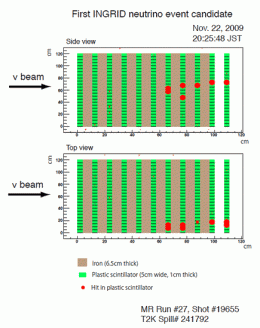
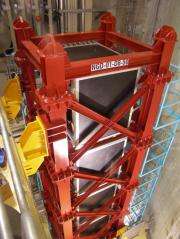
The first neutrino events were detected in a specialized detector, called the INGRID, whose purpose is to determine the neutrino beam's direction and profile. Prof. Tsuyoshi Nakaya of Kyoto University, who is leading the effort to build the near detectors, said "We found the first neutrino event in real time during the neutrino beam running. The detection of this event stands on huge efforts by many T2K colleagues all over the world. I would like to add special thanks to many young researchers who worked very hard for a long time, especially the Kyoto Ph. D. students who found the events analyzing the data online with much pressure from senior researchers".
Dr. Marco Zito from the CEA/Saclay Laboratory in Paris, who leads the CEA French effort on the experiment which helped build the INGRID, added "It is a great day for neutrino physics! This is the first of a new generation of international neutrino oscillation facilities to come to life. We are all looking forward to the first T2K run and its harvest of fundamental physics results. In particular, the near detector has been built using innovative technologies that will provide detailed information on neutrino interactions. This detector complex will allow us to make precision measurements and probably exciting discoveries".
Further tests of the T2K neutrino beam are scheduled for December, and the experiment plans to begin production running in mid-January. Another major milestone should be observed soon after -- the first observation of a neutrino event from the T2K beam in the Super-Kamiokande experiment. Running will continue until the summer, by which time the experiment hopes to have made the most sensitive search yet achieved for a so-far-unobserved critical neutrino oscillation mode dominated by oscillations between all three types of neutrinos. In the coming years this search will be improved even further, with the hope that the 3-mode oscillation will be observed, allowing measurements to begin comparing the oscillations of neutrinos and anti-neutrinos, probing the physics of anti-matter in the neutrino sector.
The T2K collaboration consists of 508 physicists from 62 institutes in 12 countries (Japan, South Korea, Canada, the United States, the United Kingdom, France, Spain, Italy, Switzerland, Germany, Poland, and Russia). The experiment consists of a new neutrino beam using the recently constructed 30 GeV synchrotron at the J-PARC laboratory in Tokai, Japan, a set of near detectors constructed 280m from the neutrino production target, and the Super-Kamiokande detector in western Japan.
Provided by KEK


