Venomous Aussie redback spiders invading Japan
November 25, 2009
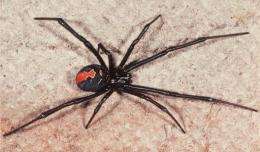
Redback spiders were first spotted in Japan in 1995

Enlarge

Australia's venomous redback spiders are on the march in Japan, where they are believed to have arrived years ago as stowaways on cargo ships, a wildlife expert warned Wednesday. The creepy-crawlies, named after their fiery markings, have infested the Osaka region and are drawing closer to the capital Tokyo, said Japan Wildlife Research Centre official Toshio Kishimoto.

Australia's venomous redback spiders are on the march in Japan, where they are believed to have arrived years ago as stowaways on cargo ships, a wildlife expert warned Wednesday.

The creepy-crawlies, named after their fiery markings, have infested the Osaka region and are drawing closer to the capital Tokyo, said Japan Wildlife Research Centre official Toshio Kishimoto.

A dozen people have reportedly been bitten in Osaka prefecture alone, media reports say, including a six-year-old boy who was treated with antivenom in June, the first time the medication had been used in the country.

"Their poison is strong and they are particularly dangerous to people in weak physical condition, like children and the elderly," Kishimoto told AFP.

"Redbacks are becoming a common species in Japan. They are very numerous, especially in the western region, and are now often sighted in residential areas.... Once the spiders spread, it's hard to eliminate them."

Redback bites, which inject a potent neurotoxin, have caused numerous deaths in Australia, although an antivenom stocked in hospitals has prevented fatalities more recently.

Redbacks were first spotted in Japan in 1995, around Osaka, a major port where, experts believe, they may have arrived in a container of Australian woodchips used to make paper in .

Several years ago a major redback infestation was found in the street drainage system of the city, and the arachnids have now spread to prefectures covering roughly a third of the country.

In one case, a man moving from Osaka north to the Tokyo region by car unknowingly took a redback with him after the animal had latched onto the vehicle, the wildlife researcher said.

He said Japanese people must become more aware of the dangers of redbacks, a species long feared in Australia, where the creatures are known to lurk in garden sheds, in shoes left outdoors, and under toilet seats.

"People need to be warned on how to treat them, and to be careful when they're out cleaning ditches, and to wear thick cotton gloves for example," said Kishimoto.

(c) 2009 AFP

4.7 /5 (3 votes)  

Rank 4.7 /5 (3 votes)
Related Stories
Relevant PhysicsForums posts
  • Protease cleavage
    created1 hour ago
  • Pertubance in a model
    created8 hours ago
  • Cancer drugs and Alzheimer's, Oh my!
    created16 hours ago
  • Squishing cells
    created17 hours ago
  • Any books/articles for evolutionary stable strategy models in humans?
    createdFeb 09, 2012
  • Science behind the bore feeling?
    createdFeb 09, 2012
  • More from Physics Forums - Biology

More news stories

The power of estrogen -- male snakes attract other males

A new study has shown that boosting the estrogen levels of male garter snakes causes them to secrete the same pheromones that females use to attract suitors, and turned the males into just about the sexiest ...

Biology / Plants & Animals

created 6 hours ago | popularity 5 / 5 (2) | comments 0 | with audio podcast

Experts reveal how plants don't get sunburn

(PhysOrg.com) -- Experts at the University of Glasgow have discovered how plants survive the harmful rays of the sun.

Biology / Cell & Microbiology

created 6 hours ago | popularity 5 / 5 (2) | comments 0 | with audio podcast

Grass to gas: Researchers' genome map speeds biofuel development

Researchers at the University of Georgia have taken a major step in the ongoing effort to find sources of cleaner, renewable energy by mapping the genomes of two originator cells of Miscanthus x giganteus, a large perenn ...

Biology / Biotechnology

created 3 hours ago | popularity 3.7 / 5 (3) | comments 0 | with audio podcast

Protein libraries in a snap

(PhysOrg.com) -- A Rice University undergraduate will depart with not only a degree but also a possible patent for his invention of an efficient way to create protein libraries, an important component of biomolecular ...

Biology / Cell & Microbiology

created 10 hours ago | popularity 5 / 5 (2) | comments 0 | with audio podcast

Miami battling invasion of giant African snails

No one knows how they got there. But an invasion of African giant snails has southern Florida in a panic over potential crop damage, disease and general yuckiness surrounding the slimy gastropods.

Biology / Ecology

created 10 hours ago | popularity not rated yet | comments 2


Complex wiring of the nervous system may rely on a just a handful of genes and proteins

Researchers at the Salk Institute have discovered a startling feature of early brain development that helps to explain how complex neuron wiring patterns are programmed using just a handful of critical genes. ...

CIA website offline, Anonymous takes credit

The website of the Central Intelligence Agency was unresponsive on Friday after the hacker group Anonymous claimed to have knocked it offline.

Q&A: Obama and the birth control controversy

(AP) -- What birth control debate? A half-century after the introduction of the pill, acceptance of birth control by American women is virtually universal.

New error-correcting codes guarantee the fastest possible rate of data transmission

Error-correcting codes are one of the triumphs of the digital age. They’re a way of encoding information so that it can be transmitted across a communication channel — such as an optical fiber o ...

Humans may have helped the decline of African rainforests 3000 years ago

(PhysOrg.com) -- Large areas of rainforests in Central Africa mysteriously disappeared over three thousand years ago, to be replaced by savannas. The prevailing theory has been that the cause was a change ...

Both maternal and paternal age linked to autism

Older maternal and paternal age are jointly associated with having a child with autism, according to a recently published study led by researchers at The University of Texas Health Science Center at Houston (UTHealth).