New computer cluster gets its grunt from games
November 25, 2009
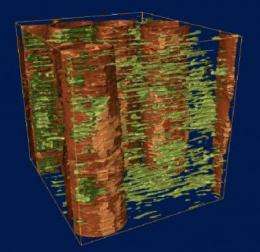
The GPU cluster will be able to speed up the reconstruction of 3-D images, such as this wood microstructure created from many 2-D images. Credit: CSIRO
Technology designed to blast aliens in computer games is part of a new GPU (Graphics Processing Units) computer cluster that will process CSIRO research data thousands of times faster and more efficiently than a desktop PC.
The new GPU cluster will complement the supercomputing resources available to CSIRO researchers such as the recently installed NCI facility at the Australian National University.
The cluster will allow CSIRO scientists to explore what may well be the next generation approach to supercomputing, the use of GPU technology for parallel processing.
The CSIRO GPU cluster will be launched today in Canberra.
The first of its kind in Australia, the cluster is about the size of six large refrigerators and contains 61,440 compute cores.
CSIRO Computational and Simulation Science leader Dr John Taylor said the computer cluster combines Central Processing Units (CPUs) like those in PCs with more powerful Graphics Processing Units (GPUs) to make it more efficient.
"GPUs have been around a while, hidden in your computer game console but now we're seeing them in scientific computing," Dr Taylor said.
"They were initially designed to render 3D scenes in computer games.
"GPUs speed up data processing by allowing a computer to massively multi-task through parallel processing."
This video is not supported by your browser at this time.
Per unit of processing power, a GPU cluster is typically less expensive and more energy efficient than a CPU-based supercomputer.
GPUs are not just useful for image data, they can tackle big science challenges - processing petabytes of data and more, very quickly.
Speeds of 30 to 70 times faster than CPUs are common.
Using GPUs to analyse complex research data is becoming a global trend in computing.
"It's pleasing to see the first installation of a GPU cluster in Australia," CSIRO Information Sciences Group Executive Dr Alex Zelinsky said.
"This cluster will be part of our family of high-end computers in CSIRO and important to our e-Research Strategy."
"It will enable CSIRO to, in a cost effective way, be globally competitive in addressing computational challenges for 'big science'."
It will be used for research in advanced materials, cloud computing, data and visualisation tools, genetics and more.
Projects to be run on the cluster include:
- figuring out where tiny fragments of genetic code sit on a genome
- 3D reconstruction of medical images from the Australian Synchrotron
- modelling the interactions between nutrients and plankton in the oceans.
"It requires a new approach to coding," Dr Taylor said.
"You have to divide up each task in a way that makes best use of the extra processors. It's like having to give instructions to 10 bricklayers building a wall, instead of one..
"We will be training others in the scientific community in how to use our facility.
"There's plenty of interest from universities and government."
Xenon Systems of Melbourne has installed the cluster in a data centre in Canberra. It will run Linux and Windows applications.
Source: CSIRO Australia
-
Programming tools facilitate use of video game processors for defense needs
Jun 24, 2009 |
not rated yet |
0
-
NVIDIA Ushers In the Era of Personal Supercomputing
Jun 21, 2007 |
not rated yet |
0
-
Game lets geeks compete to build virtual supercomputer
Nov 10, 2008 |
not rated yet |
0
-
Professor: 'Depression is like the worst disease you can get' (Video)
Nov 10, 2009 |
not rated yet |
0
-
New NVIDIA Tesla GPUs Reduce Cost Of Supercomputing By A Factor Of 10
Nov 16, 2009 |
not rated yet |
0
-
Engineers build first sub-10-nm carbon nanotube transistor
Feb 01, 2012 |
4.9 / 5 (30) |
30
-
Something old, something new: Evolution and the structural divergence of duplicate genes
Jan 31, 2012 |
4.6 / 5 (7) |
1
-
The hidden nanoworld of ice crystals: Revealing the dynamic behavior of quasi-liquid layers
Jan 30, 2012 |
5 / 5 (3) |
1
-
Stock market network reveals investor clustering
Jan 27, 2012 |
3.9 / 5 (23) |
8
-
Of microchemistry and molecules: Electronic microfluidic device synthesizes biocompatible probes
Jan 26, 2012 |
5 / 5 (1) |
0
-
Synergistic relations between computer science and technology.
Feb 06, 2012
-
how do iphone gloves work?
Feb 05, 2012
-
iPhone battery over time
Jan 30, 2012
-
Best alternate Tablet to an iPad for writing math or physics equations?
Jan 26, 2012
-
Sending SMS to a website
Jan 20, 2012
-
Need help with my technical fest!
Jan 19, 2012
- More from Physics Forums - Computing & Technology
More news stories
Zuckerberg's focus drives Facebook's ascent
When Mark Zuckerberg showed up to rent Judy Fusco's Los Altos, Calif., house in the fall of 2004, soon after he'd arrived in Silicon Valley, the landlord was immediately struck by his confidence.
36 minutes ago |
1 / 5 (1) |
0
Netflix light on flicks as viewers soak up TV shows
Like most fresh faces that arrive in Hollywood, Netflix wanted to be a movie star. But now it's learning what many in Tinseltown have known for decades: Movies are sexy, but the real money is in television.
1 hour ago |
not rated yet |
1
New error-correcting codes guarantee the fastest possible rate of data transmission
Error-correcting codes are one of the triumphs of the digital age. Theyre a way of encoding information so that it can be transmitted across a communication channel such as an optical fiber o ...
Technology / Computer Sciences
4 hours ago |
5 / 5 (3) |
2
|
Small modular reactor design could be a 'SUPERSTAR'
(PhysOrg.com) -- Though most of today's nuclear reactors are cooled by water, we've long known that there are alternatives; in fact, the world's first nuclear-powered electricity in 1951 came from a reactor ...
Technology / Energy & Green Tech
4 hours ago |
5 / 5 (6) |
10
|
Sony's Hirai refuses to abandon dire TV business
Struggling Japanese entertainment giant Sony will not abandon its cash-bleeding television business, its incoming CEO says, but he acknowledges tough decisions lie ahead including over redundancies.
2 hours ago |
not rated yet |
0
New understanding of DNA repair could eventually lead to cancer therapy
A research group in the Faculty of Medicine & Dentistry at the University of Alberta is hoping its latest discovery could one day be used to develop new therapies that target certain types of cancers.
Antidepressants and pregnancy: Women must consider the impact of drugs on baby, and of depression on baby, themselves
Upon learning they are pregnant, most women dutifully nix the alcohol, sushi and caffeine. But what about antidepressants?
Both maternal and paternal age linked to autism
Older maternal and paternal age are jointly associated with having a child with autism, according to a recently published study led by researchers at The University of Texas Health Science Center at Houston (UTHealth).
Night, weekend delivery OK for babies with birth defects
Weekday delivery is no better than night or weekend delivery for infants with birth defects, according to a new study presented today at The Pregnancy Meeting, the Society for Maternal-Fetal Medicine's annual conference. ...
Sonic Cradle lands spot in TED exhibition
A Simon Fraser University graduate student project that melds music, meditation and modern technology has landed a rare spot as an exhibit at TEDActive 2012 in Palm Springs, California this month.
From virginity to Viagra
Americans will spend more than $17 billion on Valentine's Day, but far less on programs like sex education for adolescents. The editors of the new book, Sex for Life, From Virginity to Viagra, How Sexuality Changes Throughout ...