Oceanic crust formation is dynamic after all
November 25, 2009
Oceanic crust formation is dynamic after all

Enlarge

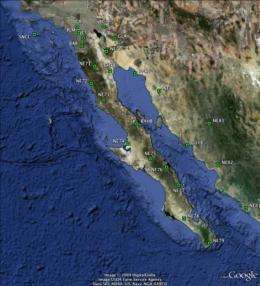
A research team led by Brown University studied seismic velocities -- the speed of seismic waves -- in the Gulf of California to determine that a geological phenomenon known as dynamic upwelling occurs in the Earth's mantle as oceanic crust is formed. Credit: Yun Wang, Brown University

Imagine the Earth's crust as the planet's skin: Some areas are old and wrinkled while others have a fresher, more youthful sheen, as if they had been regularly lathered with lotion.

Carry the metaphor a little further and a good picture emerges of the geological processes leading to the creation of the planet's crust. On land, continental crust, once created, can remain more or less unaltered for billions of years. But the oldest is only about 200 million years old, as new crust is continually forming at mid-ocean ridge spreading centers.

While geologists have known that oceanic crust continually replenishes itself, they have been unsure what occurs below the surface that leads to the resurfacing. What geodynamics are occurring in the mantle that eventually produces new crust, that new layer of skin on the ocean's bottom?

The answer has been elusive in part because oceanic crust is difficult to reach and instruments that can measure seismic activity have not fully covered the terrain to obtain an accurate picture of forces below the surface. Now earth scientists led by Brown University have observed — in detail and at unprecedented depths — a geological phenomenon known as dynamic upwelling in the underlying mantle beneath a spreading center. Their findings, reported in this week's Nature, may resolve a longstanding debate regarding the relative importance of passive and dynamic upwelling in the shallow mantle beneath spreading centers on the .

"We know the crust of the ocean is produced by upwelling beneath separating plates," said Don Forsyth, professor of geological sciences at Brown. "We just didn't know the upwelling pattern that took place, that there are concentrated upwelling centers rather than uniform upwelling."

Mantle upwelling and melting beneath spreading centers has been thought to be mostly a passive response to the separating oceanic plates above. The new finding shows there appears to be a dynamic component as well, driven by the buoyancy of melt retained in the rock or by the lighter chemical composition of rock from which melt has been removed.

The scientists from Brown and the University of Rhode Island based their findings on a high-resolution seismic study in the Gulf of California. In that region, there are 25 seismometers spaced along the western coast of Mexico and the Baja California peninsula, which lie on either side of the Gulf of California. Yun Wang, a Brown graduate student and the paper's lead author, tracked the velocity of seismic waves that traveled from one station to another. She noticed a pattern: The seismic waves in three localized centers, spaced about 250 kilometers (155 miles) apart, traveled more slowly than waves in the surrounding mantle, implying the presence of more melt in the localized centers and thus a more vigorous upwelling. From that, the geologists determined the centers, located 40-90 kilometers (25 to 56 miles) below the surface, showed evidence of dynamic upwelling in the mantle.

"We found a pattern that was predicted by some of the theoretical models of upwelling in mid-oceanic ridges," Forsyth said.

While other studies have been done of mantle geodynamics, most notably an experiment on the East Pacific Rise, the Brown-URI study imaged seismic activity, or the shear velocity of the seismic waves, some 200 kilometers (124 miles) below the surface — a far deeper seismic penetration into the mantle than previous experiments.

Brian Savage, assistant professor of geophysics at the University of Rhode Island and a contributing author on the paper, said the finding is important, because it helps to provide "a basic understanding of how a majority of the earth's crust is formed, how it emerges from the mantle below to create the oceanic crust. It's a basic science question that helps understand how crust is created."

Source: Brown University (news : web)

4.8 /5 (9 votes)  

Rank 4.8 /5 (9 votes)
Related Stories
Relevant PhysicsForums posts
  • Discrepancy between oxygen and carbon-dioxide levels
    created14 hours ago
  • where gems are found in the world
    created18 hours ago
  • Wind Waves in Reservoir ~ Wind run-up and Wind set-up
    createdFeb 08, 2012
  • Balance of oxygen in the atmosphere
    createdFeb 01, 2012
  • The case for a methanol-based economy
    createdJan 30, 2012
  • Weather in a rotating cylinder
    createdJan 25, 2012
  • More from Physics Forums - Earth

More news stories

Could Venus be shifting gear?

(PhysOrg.com) -- ESA’s Venus Express spacecraft has discovered that our cloud-covered neighbour spins a little slower than previously measured. Peering through the dense atmosphere in the infrared, the ...

Space & Earth / Space Exploration

created 3 hours ago | popularity 5 / 5 (4) | comments 4 | with audio podcast

Humans may have helped the decline of African rainforests 3000 years ago

(PhysOrg.com) -- Large areas of rainforests in Central Africa mysteriously disappeared over three thousand years ago, to be replaced by savannas. The prevailing theory has been that the cause was a change ...

Space & Earth / Environment

created 7 hours ago | popularity 5 / 5 (3) | comments 7 | with audio podcast report

Clam fields found at deep, low-temperature Mariana vents

(PhysOrg.com) -- Scientists have marveled at the unusual life forms thriving at high temperature hydrothermal vents of the deep ocean.

Space & Earth / Earth Sciences

created 3 hours ago | popularity not rated yet | comments 0 | with audio podcast

Mars Science Laboratory computer issue resolved

(PhysOrg.com) -- Engineers have found the root cause of a computer reset that occurred two months ago on NASA's Mars Science Laboratory and have determined how to correct it.

Space & Earth / Space Exploration

created 4 hours ago | popularity 5 / 5 (5) | comments 2 | with audio podcast

Two new moons for Jupiter

Advances in technology have lead to the discovery of new planets outside of our Solar System, and now even new moons in our own backyard.

Space & Earth / Space Exploration

created 3 hours ago | popularity not rated yet | comments 2


New understanding of DNA repair could eventually lead to cancer therapy

A research group in the Faculty of Medicine & Dentistry at the University of Alberta is hoping its latest discovery could one day be used to develop new therapies that target certain types of cancers.

Zuckerberg's focus drives Facebook's ascent

When Mark Zuckerberg showed up to rent Judy Fusco's Los Altos, Calif., house in the fall of 2004, soon after he'd arrived in Silicon Valley, the landlord was immediately struck by his confidence.

Both maternal and paternal age linked to autism

Older maternal and paternal age are jointly associated with having a child with autism, according to a recently published study led by researchers at The University of Texas Health Science Center at Houston (UTHealth).

Night, weekend delivery OK for babies with birth defects

Weekday delivery is no better than night or weekend delivery for infants with birth defects, according to a new study presented today at The Pregnancy Meeting, the Society for Maternal-Fetal Medicine's annual conference. ...

Sonic Cradle lands spot in TED exhibition

A Simon Fraser University graduate student project that melds music, meditation and modern technology has landed a rare spot as an exhibit at TEDActive 2012 in Palm Springs, California this month.

From virginity to Viagra

Americans will spend more than $17 billion on Valentine's Day, but far less on programs like sex education for adolescents. The editors of the new book, Sex for Life, From Virginity to Viagra, How Sexuality Changes Throughout ...