NASA's Aqua satellite sees Nida explode into a category 5 Super typhoon
November 25, 2009 NASA's Aqua satellite sees Nida explode into a category 5 Super typhoon

Enlarge

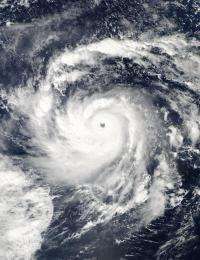
The MODIS instrument on NASA's Aqua satellite captured a visible image of Super Typhoon Nida early on Nov. 25 that shows a perfectly symmetrical storm and a clear eye, both hallmarks of a powerful typhoon. Credit: NASA MODIS Rapid Response Team

Typhoon Nida is in a favorable environment that has enabled it to intensify faster and stronger than previously forecast, and has now exploded into a Super typhoon. NASA's Aqua satellite passed over Nida and captured a visible image of the storm revealing a clear eye, which indicates a strong typhoon.

The Moderate Imaging Spectroradiometer or MODIS instrument that flies aboard NASA's captured a visible image of Super Nida on November 25 at 0355 UTC (November 24 at 10:55 p.m. ET). The image clearly revealed an eye that showed the surface of the northwestern Pacific Ocean! The MODIS image showed a tightly circulating symmetrical hurricane form.

At 10 a.m. ET on November 25, Nida had near 172 mph (150 knots) with gusts as high as 207 mph! A category five typhoon on the Saffir-Simpson scale has sustained winds greater than 155 mph. Typhoon-force winds extend as far as 45 miles from Nida's center, while tropical storm-force winds extend out as far as 105 miles from Nida's center.
NASA's Aqua satellite sees Nida explode into a category 5 Super typhoon
Enlarge

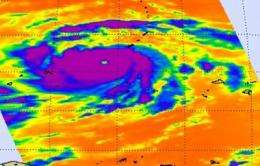
NASA's Aqua satellite captured a clear eye and cold, powerful thunderstorm cloud tops (colder than -63F) in Nida in this infrared image Nov. 25 at 0347 UTC. Nida is a Category 5 storm with sustained winds near 172 mph. Credit: NASA JPL, Ed Olsen

Nida was about 155 miles west-southwest of Guam, near 12.6 North latitude and 142.2 East longitude. It was moving to the northwest near 15 mph, and its powerful winds were kicking up dangerously high waves up to 44 feet high!

Fortunately, no landmasses are directly threatened by Nida, although today, Nida is passing between the island of Yap and Andersen Air Force Base. Those islands will experience heavy surf to their northeastern and southwestern sides, respectively. The Joint Typhoon Warning Center noted that Nida can strengthen even further as it is going to track over very warm in the next day.

Nida is forecast to remain in open waters over the next 5 days and is expected to pass far to the southwest of the island of Iwo Two on Monday, November 30.

Source: JPL/NASA (news : web)


Rate this story - 4 /5 (3 votes)


November 25, 2009 all stories

Comments: 0

4 /5 (3 votes)

  • hide
  • Related Stories


  • hide
  • Relevant PhysicsForums posts

  • Carbon Dioxide emissions question
    created Feb 08, 2010
  • Photosynthesis vs. carbonization
    created Feb 07, 2010
  • Sheep's footprints
    created Feb 05, 2010
  • How did Victorians estimate the ages of fossils?
    created Feb 03, 2010
  • More from Physics Forums - Earth

Other News

Space shuttle Endeavour pulls in at space station (AP)

Space shuttle Endeavour pulls in at space station

Space & Earth / Space Exploration

created 2 hours ago | popularity not rated yet | comments 0

(AP) -- Shuttle Endeavour arrived to a warm welcome at the International Space Station early Wednesday, delivering a new room and observation deck that will come close to completing construction 200 miles ...


Climate 'Tipping Points' May Arrive Without Warning, Says Top Forecaster

Space & Earth / Environment

created 12 hours ago | popularity 3 / 5 (8) | comments 8 | with audio podcast

(PhysOrg.com) -- A new University of California, Davis, study by a top ecological forecaster says it is harder than experts thought to predict when sudden shifts in Earth's natural systems will occur -- a worrisome finding ...


38 percent of world's surface in danger of desertification

38 percent of world's surface in danger of desertification

Space & Earth / Environment

created 9 hours ago | popularity 2.3 / 5 (3) | comments 5

A team of Spanish researchers has measured the degradation of the planet's soil using the Life Cycle Assessment (LCA), a scientific methodology that analyses the environmental impact of human activities, and ...


A new 3-D map of the interstellar gas within 300 parsecs from the sun

A new 3D map of the interstellar gas within 300 parsecs from the Sun

Space & Earth / Astronomy

created 15 hours ago | popularity 5 / 5 (5) | comments 0 | with audio podcast

(PhysOrg.com) -- Astronomy & Astrophysics is publishing new 3D maps of the interstellar gas in the local area around our Sun. A French-American team of astronomers presents new absorption measurements toward ...


Soil contributes to climate warming more than expected

Space & Earth / Environment

created 23 hours ago | popularity 3 / 5 (2) | comments 3

The climatic warming will increase the carbon dioxide emissions from soil more than previously estimated. This is a mechanism that will significantly accelerate the climate change. Already now the carbon dioxide emissions ...