Implant-based cancer vaccine is first to eliminate tumors in mice
November 25, 2009
Implant-based cancer vaccine is first to eliminate tumors in mice

Enlarge

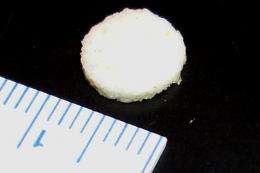
A polymer implant, 8.5 mm in diameter, is embedded with chemical signals that encourage immune cells to attack tumors. Photo: Omar Ali/Harvard University

(PhysOrg.com) -- A cancer vaccine carried into the body on a carefully engineered, fingernail-sized implant is the first to successfully eliminate tumors in mammals, scientists report this week in the journal Science Translational Medicine.

The new approach, pioneered by bioengineers and immunologists at Harvard University, uses plastic disks impregnated with tumor-specific antigens and implanted under the skin to reprogram the mammalian immune system to attack tumors. The new paper describes the use of such implants to eradicate melanoma tumors in mice.

"This work shows the power of applying engineering approaches to immunology," says David J. Mooney, the Robert P. Pinkas Family Professor of Bioengineering in Harvard's School of Engineering and Applied Sciences and Wyss Institute for Biologically Inspired Engineering. "By marrying engineering and immunology through this collaboration with Glenn Dranoff at the Dana-Farber Institute, we've taken a major step toward the design of effective cancer vaccines."

Most easily skirt the immune system, which operates by recognizing and attacking invaders from outside the body. The approach developed by Mooney's group redirects the immune system to target tumors, and appears both more effective and less cumbersome than other cancer vaccines currently in clinical trials.

Conventional cancer vaccinations remove immune cells from the body, reprogram them to attack malignant tissues, and return them to the body. However, more than 90 percent of reinjected cells have died before having any effect in experiments.

The slender implants developed by Mooney's group are 8.5 millimeters in diameter and made of an FDA-approved biodegradable polymer. Ninety percent air, the disks are highly permeable to immune cells and release cytokines, powerful recruiters of immune-system messengers called dendritic cells.

These cells enter an implant's pores, where they are exposed to specific to the type of tumor being targeted. The dendritic cells then report to nearby lymph nodes, where they direct the immune system's T cells to hunt down and kill tumor cells.

"Inserted anywhere under the skin -- much like the implantable contraceptives that can be placed in a woman's arm -- the implants activate an immune response that destroys tumor cells," Mooney says.

The technique may have powerful advantages over surgery and chemotherapy, and may also be useful in combination with existing therapies. It only targets tumor cells, avoiding collateral damage elsewhere in the body. And, much as an immune response to a bacterium or virus generates long-term resistance, researchers anticipate cancer vaccines will generate permanent and body-wide resistance against cancerous cells, providing durable protection against relapse.

Mooney says the new approach's strength lies in its ability to simultaneously regulate the two arms of the human immune system: one that destroys foreign material and one that protects tissue native to the human body. The implant-based vaccine recruits several types of that direct destructive immune responses, creating an especially potent anti-tumor response.

"This approach is able to simultaneously upregulate the destructive immune response to the tumor while downregulating the arm of the that leads to tolerance," Mooney says. "In cancer, this latter arm is typically a limiting feature of immunotherapies, since it can extinguish vaccine activity and afford tumors a degree of protection."

Source: Harvard University (news : web)

4.7 /5 (31 votes)  

Filter


Move the slider to adjust rank threshold, so that you can hide some of the comments.


Display comments: newest first

mdr
Nov 25, 2009

Rank: 5 / 5 (1)
I wonder how much we'll have to pay the patent holder and the doctors to have these installed once they finish getting them sorted and through clinical trials. They should be pretty cheap as far as materials and assembly, but I'm sure they'll want to have a hefty markup. Still, it should be cheaper than chemo and surgery. I'll definitely get one as soon as they work out a universal version for most cancers (if this one isn't already, anyone know if they are working on studies for other cancers with it yet?). It's not clear if it only works on melanomas, or if that's just the only type of tumor they used in the study. Do they know what antigens to use for other types of tumors, or do those still have to be discovered..
gmurphy
Nov 25, 2009

Rank: 5 / 5 (1)
outstanding work, but it must be reproduced elsewhere and preferably in other types of cancer before significant conclusions can be drawn. Every few months or so on phsyorg there's an example of an amazing cancer cure/result which works for a specific cancer in engineered mice but fails to persist beyond that result. Either way, another weapon in the arsnel against cancer is welcomed into the fray
fixer
Nov 25, 2009

Rank: 1 / 5 (1)
The immune system of mice is markedly different from human, hence most murine specific drugs fail.
Since Artemisinin was released for cancer therapy I have yet to read of any better treatment.
"Curing cancer" requires two discrete therapies, firstly removing the tumor mass, then modifying the immune system to prevent it reoccuring.
Artemisinin removes cancer by using the laws of physics rather than the speculation of medicine,
and there are now several protocols for modifying and repairing the immune system.
Both therapies using established drugs with no or minimal side effects but unknown to oncologists.
A google search will provide all the necessory info.
dirk_bruere
Nov 26, 2009

Rank: 5 / 5 (1)
Does this target all tumors or only specific types?
joefarah
Nov 26, 2009

Rank: not rated yet
Please read the article. It clearly says, twice, tumor-specific, not all tumors.
antialias
Nov 26, 2009

Rank: not rated yet
I think the major advantage over surgery and chemo/radiation therapy is that this could possibly affect tumors which have already spread.

While the mouse's immune system is not identical to the human one there are good mouse models for specific diseases and specific disease-immune system interactions. The value of this study is not to develop a drug that will work on humans just like on mice but a METHOD that could - suitably altered - provide a very effective way of treating some tumors.
fixer
Nov 26, 2009

Rank: 1 / 5 (1)
Well and good, Incidently, Artemisinin is now proven effective on 55 cancer lines, and is held back only by social inertia.
How many times do we have to read of theoretical treatments which may be available in a few years?
You don't die of cancer anymore, you die of ignorance.
Rank 4.7 /5 (31 votes)
Related Stories
Relevant PhysicsForums posts
  • Is Everyday Technology Killing Us?
    created21 hours ago
  • Exercise and weight loss
    createdFeb 08, 2012
  • Why do we have head aches? Our brains can't feel anything.
    createdFeb 07, 2012
  • "The end of diseases" by David Agus, interview from Daily Show with Jon Stewart
    createdFeb 04, 2012
  • Oncolytic adenovirus
    createdFeb 04, 2012
  • Nutrition label stuffs and diets
    createdFeb 02, 2012
  • More from Physics Forums - Medical Sciences

More news stories

Women who eat fish have lower colon polyp risk

(Medical Xpress) -- Women who eat at least three servings of fish per week have a reduced risk of developing some types of colon polyps according to a new study by Vanderbilt-Ingram Cancer Center investigators.

Medicine & Health / Health

created 4 minutes ago | popularity not rated yet | comments 0 | with audio podcast

Study shows calories drive earlier puberty

(Medical Xpress) -- Environmental pollutants, eating habits, lack of exercise and genetic traits have all been raised as possible causes of earlier puberty onset in girls in recent years.

Medicine & Health / Health

created 22 minutes ago | popularity not rated yet | comments 0 | with audio podcast

Commonly used vitamin could help produce 'good' cholesterol, researchers find

(Medical Xpress) -- Maintaining healthy cholesterol levels can keep heart disease, heart attack and stroke away. And a commonly used vitamin could help by increasing production of “good” cholesterol in the body, ...

Medicine & Health / Health

created 5 minutes ago | popularity not rated yet | comments 0 | with audio podcast

New study shows high cost of defensive medicine

Vanderbilt University Medical Center researchers estimate that U.S. orthopaedic surgeons create approximately $2 billion per year in unnecessary health care costs associated with orthopaedic care due to the practice of defensive ...

Medicine & Health / Health

created 1 hour ago | popularity 5 / 5 (1) | comments 1

'Fen-phen' derived drug responsible for thousands of hospitalizations and deaths in France

A new study published in the journal Pharmacoepidemiology & Drug Safety reveals that benfluorex, a fenfluramine derivative drug used in France under the name Mediator, is likely responsible for thousands of hospitalizations and de ...

Medicine & Health / Medications

created 1 hour ago | popularity not rated yet | comments 0


Researchers discover potential key to lowering energy costs of cell phones and data centers

(PhysOrg.com) -- A systematic analysis of power usage in microprocessors could help lower the energy consumption of both small cellphones and giant data centers, report computer science professors from The University of Texas ...

Log onto Facebook, contribute to scientific research

(PhysOrg.com) -- Logging on to Facebook could soon be a way of contributing to important scientific research, as well as finding out what’s going on in your world.

Bonding out: Making companies pay up front for potential environmental disasters

Whether it’s building an oil pipeline, drilling for fuel in the ocean or “fracking” to flush natural gas out of the Earth, we’re often asked to believe the process is safe, when companies want to do something ...

Soraa LED light may dim 50-watt halogen rivals

(PhysOrg.com) -- Soraa, a Fremont, California company founded in 2008, this week launched its first product, a light that uses LEDS (light emitting diodes). The "Soraa LED MR16 lamp" is the "perfect" replacement for traditional ...

Life in Antarctic lake? It's everywhere else

If scientists find microbes in a frigid lake two miles beneath the thick ice of Antarctica, it will illustrate once again that somehow life finds a way to survive in the strangest and harshest places.

Lenovo 3Q profit up by half, warns of disk supply

(AP) -- Lenovo Group Ltd., the world's second biggest personal computer maker, said Thursday that quarterly profit grew by more than half but warned hard drive costs would remain high amid a global shortage.