Rare woodland plant uses 'cryptic coloration' to hide from predators
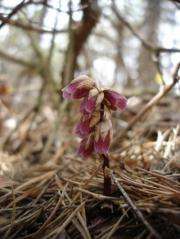
It is well known that some animal species use camouflage to hide from predators. Individuals that are able to blend in to their surroundings and avoid being eaten are able to survive longer, reproduce, and thus increase their fitness (pass along their genes to the next generation) compared to those who stand out more. This may seem like a good strategy, and fairly common in the animal kingdom, but who ever heard of a plant doing the same thing?
In plants, the use of coloration or pigmentation as a vital component of acquiring food (e.g., photosynthesis) or as a means of attracting pollinators (e.g., flowers) has been well studied. However, variation in pigmentation as a means of escaping predation has received little attention. In the December issue of the American Journal of Botany, Matthew Klooster from Harvard University and colleagues empirically investigated whether the dried bracts on a rare woodland plant, Monotropsis odorata, might serve a similar purpose as the stripes on a tiger or the grey coloration of the wings of the peppered moth, namely to hide.
"Monotropsis odorata is a fascinating plant species, as it relies exclusively upon mycorrhizal fungus, that associates with its roots, for all of the resources it needs to live," notes Klooster. "Because this plant no longer requires photosynthetic pigmentation (i.e., green coloration) to produce its own energy, it is free to adopt a broader range of possibilities in coloration, much like fungi or animals."
Using a large population of Monotropsis odorata, Klooster and colleagues experimentally removed the dried bracts that cover the 3- to 5-cm tall stems and flower buds of these woodland plants. The bracts are a brown color that resembles the leaf litter from which the reproductive stems emerge and cover the pinkish-purple colored buds and deep purple stems. When Klooster and colleagues measured the reflectance pattern of the different plant parts, they indeed found that the bracts functioned as camouflage, making the plant blend in with its surroundings; the bract reflectance pattern closely resembled that of the leaf litter, and both differed from that of the reproductive stem and flowers hidden underneath the bracts. Furthermore, they experimentally demonstrated that this camouflage actually worked to hide the plant from its predators and increased its fitness. Individuals with intact bracts suffered only a quarter of the herbivore damage and produced a higher percentage of mature fruits compared to those whose bracts were removed.
"It has long been shown that animals use cryptic coloration (camouflage) as a defense mechanism to visually match a component of their natural environment, which facilitates predator avoidance," Klooster said. "We have now experimentally demonstrated that plants have evolved a similar strategy to avoid their herbivores."
Drying its bracts early to hide its reproductive parts is a good strategy when the stems are exposed to predators for long periods of time: all the other species in the subfamily Monotropoideae have colorful fleshy bracts and are reproductively active for only a quarter of the length of time. Somewhat paradoxically however Monotropsis odorata actually relies on animals for pollination and seed dispersal. How does it accomplish this when it is disguised as dead leaf material and is able to hide so well? The authors hypothesize that the flowers emit highly fragrant odors that serve to attract pollinators and seed dispersal agents; indeed they observed bumble bees finding and pollinating many reproductive stems that were entirely hidden by the leaf litter itself.
More information: http://www.amjbot.org/cgi/reprint/ajb.0900124v1
Source: American Journal of Botany


