Monster Waves on the Sun are Real (w/ Video)
November 25, 2009 by Dr. Tony Phillips Monster Waves on the Sun are Real

Enlarge

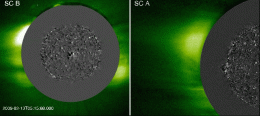
A solar tsunami seen by the STEREO spacecraft from orthogonal points of view. The gray part of the animation has been contrast-enhanced by subtracting successive pairs of images, resulting in a "difference movie." (Click "Enlarge" for animation)

Sometimes you really can believe your eyes. That's what NASA's STEREO (Solar Terrestrial Relations Observatory) spacecraft are telling researchers about a controversial phenomenon on the sun known as the "solar tsunami."

Years ago, when solar physicists first witnessed a towering wave of hot plasma racing along the sun's surface, they doubted their senses. The scale of the thing was staggering. It rose up higher than Earth itself and rippled out from a central point in a circular pattern millions of kilometers in circumference. Skeptical observers suggested it might be a shadow of some kind—a trick of the eye—but surely not a real wave.

"Now we know," says Joe Gurman of the Lab at the Goddard Space Flight Center. "Solar tsunamis are real."

You need Flash installed to watch this ideo

Solar tsunami movie. Feb. 13, 2009 -- observed by both STEREO-A and STEREO-B.

The twin confirmed their reality in February 2009 when sunspot 11012 unexpectedly erupted. The blast hurled a billion-ton cloud of gas (a "CME") into space and sent a tsunami racing along the sun's surface. STEREO recorded the wave from two positions separated by 90o, giving researchers an unprecedented view of the event:

"It was definitely a wave," says Spiros Patsourakos of George Mason University, lead author of a paper reporting the finding in the . "Not a wave of water," he adds, "but a giant wave of hot plasma and magnetism."

The technical name is "fast-mode magnetohydrodynamical wave"—or "MHD wave" for short. The one STEREO saw reared up about 100,000 km high, and raced outward at 250 km/s (560,000 mph) packing as much energy as 2400 megatons of TNT (1029 ergs).

Solar tsunamis were discovered back in 1997 by the Solar and Heliospheric Observatory (SOHO). In May of that year, a CME came blasting up from an active region on the sun's surface, and SOHO recorded a tsunami rippling away from the blast site.

"We wondered," recalls Gurman, "is that a wave—or just a shadow of the CME overhead?"

SOHO's single point of view was not enough to answer the question—neither for that first wave nor for many similar events recorded by SOHO in years that followed.
Monster Waves on the Sun are Real
Enlarge

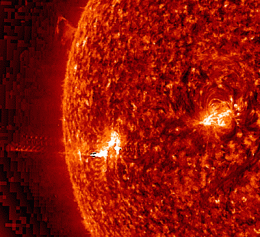
The dancing prominence (circled). Watch it bounce up and down after getting hit by a faint but powerful solar tsunami by clicking "Enlarge" button.

The question remained open until after the launch of STEREO in 2006. At the time of the February 2009 eruption, STEREO-B was directly over the blast site while STEREO-A was stationed at right angles —"perfect geometry for cracking the mystery," says co-author Angelos Vourlidas of the Naval Research Lab in Washington DC. (diagram)

The physical reality of the waves has been further confirmed by movies of the waves crashing into things. "We've seen the waves reflected by coronal holes (magnetic holes in the sun's atmosphere)," says Vourlidas. "And there is a wonderful movie of a solar prominence oscillating after it gets hit by a wave. We call it the 'dancing prominence.'"

Solar tsunamis pose no direct threat to Earth. Nevertheless, they are important to study. "We can use them to diagnose conditions on the sun," notes Gurman. "By watching how the waves propagate and bounce off things, we can gather information about the sun's lower atmosphere available in no other way."

"Tsunami waves can also improve our forecasting of space weather," adds Vourlidas, "Like a bull-eye, they 'mark the spot' where an eruption takes place. Pinpointing the blast site can help us anticipate when a CME or radiation storm will reach Earth."

And they're pretty entertaining, too. "The movies," he says, "are out of this world."

Source: Science@NASA, by Dr. Tony Phillips


Rate this story - 4.9 /5 (20 votes)

Rank Filter

Move the slider to adjust rank threshold, so that you can hide some of the comments.


Display comments: newest first

  • omatumr - Nov 26, 2009
    • Rank: 3 / 5 (2)
    This finding illustrates that the interior of the Sun is highly structured - unlike that expected in a ball of Hydrogen.

    See this "running difference" image recorded by the TRACE satellite using a filter that is sensitive to iron ion (Fe IX/X) emissions. The TRACE satellite recorded an eruption and mass ejection from this region of AR 9143 on 28 August 2000. A video of the flare event on 28 August 2000 is available here: http://tinyurl.com/c3ec5u

    With kind regards,
    Oliver K. Manuel
  • omatumr - Nov 28, 2009
    • Rank: 4 / 5 (2)
    It Ain't Rocket Science!

    My good astronomer friend, Hilton Ratcliffe, recently commented:

    An Earth-quake produces an oceanic tsunami.
    A Sun-quake produces a solar tsunami.

    With kind regards,
    Oliver K. Manuel

November 25, 2009 all stories

Comments: 2

4.9 /5 (20 votes)

  • hide
  • Related Stories

  • Mystery of the Solar Tsunami -- Solved (w/ Video)
    created Nov 19, 2009 | popularity not rated yet | comments 0
  • The Surprising Shape of Solar Storms (w/Video)
    created Apr 14, 2009 | popularity not rated yet | comments 0
  • NASA releases first 3-D images of the sun from STEREO
    created Apr 23, 2007 | popularity not rated yet | comments 0
  • The Sun's X-file under the Spotlight
    created Sep 03, 2004 | popularity not rated yet | comments 0
  • STEREO Reveals the Anatomy of a Solar Storm in 3D
    created Apr 28, 2009 | popularity not rated yet | comments 0


  • hide
  • Relevant PhysicsForums posts

Other News

Orion in a New Ligh

Orion in a New Ligh (w/ Video)

Space & Earth / Astronomy

created 29 minutes ago | popularity not rated yet | comments 0 | with audio podcast

(PhysOrg.com) -- The Orion Nebula reveals many of its hidden secrets in a dramatic image taken by ESO’s new VISTA survey telescope. The telescope’s huge field of view can show the full splendour of the whole ...


India announces long-range nuclear-capable missile test

Space & Earth / Space Exploration

created 1hour ago | popularity 5 / 5 (1) | comments 0

India will test a nuclear-capable missile with a range of over 5,000 kilometres (3,000 miles) within a year, its top military scientist said Wednesday, risking a rise in regional tensions.


Space shuttle Endeavour pulls in at space station (AP)

Space shuttle Endeavour pulls in at space station

Space & Earth / Space Exploration

created 6 hours ago | popularity 5 / 5 (1) | comments 0

(AP) -- Shuttle Endeavour arrived to a warm welcome at the International Space Station early Wednesday, delivering a new room and observation deck that will come close to completing construction 200 miles ...


Climate 'Tipping Points' May Arrive Without Warning, Says Top Forecaster

Space & Earth / Environment

created 16 hours ago | popularity 3.5 / 5 (11) | comments 11 | with audio podcast

(PhysOrg.com) -- A new University of California, Davis, study by a top ecological forecaster says it is harder than experts thought to predict when sudden shifts in Earth's natural systems will occur -- a worrisome finding ...


38 percent of world's surface in danger of desertification

38 percent of world's surface in danger of desertification

Space & Earth / Environment

created 13 hours ago | popularity 2 / 5 (4) | comments 6

A team of Spanish researchers has measured the degradation of the planet's soil using the Life Cycle Assessment (LCA), a scientific methodology that analyses the environmental impact of human activities, and ...