Invading camels to be shot in Australian town
November 26, 2009
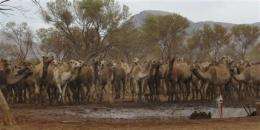
In this undated photo released by the Northern Territory government, camels are seen crowded around a drinking trough in MacDonnell Shire of the Northern Territory, Australia. State authorities announced Wednesday, Nov. 25, 2009, they plan to corral about 6,000 wild camels with helicopters and gun them down after they overran a small town in Australia's Outback in search of water, trampling fences, smashing tanks and contaminating supplies. (AP Photo)
(AP) -- Australian authorities plan to corral about 6,000 wild camels with helicopters and gun them down after they overran a small Outback town in search of water, trampling fences, smashing tanks and contaminating supplies.
The Northern Territory government announced its plan Wednesday for Docker River, a town of 350 residents where thirsty camels have been arriving daily for weeks because of drought conditions in the region.
"The community of Docker River is under siege by 6,000 marauding, wild camels," local government minister Rob Knight said in Alice Springs, 310 miles (500 kilometers) northeast of Docker. "This is a very critical situation out there, it's very unusual and it needs urgent action."
The camels, which are not native to Australia but were introduced in the 1840s, have smashed water tanks, approached houses to try to take water from air conditioning units, and knocked down fencing at the small airport runway, Knight said.
The carcasses of camels killed in stampedes at water storage areas are contaminating the water supply, he added.
The government plans to use helicopters to herd the camels about nine miles (15 kilometers) outside of town next week, where they will be shot and their carcasses left to decay in the desert. The state government will give a 49,000 Australian dollar ($45,000) grant for the cull and to repair damaged infrastructure in the town.
"We don't have the luxury of time because the herd is getting bigger," Knight said.
It is common to see some camels in the remote community, but a continuing drought and an early heat wave have dried up other water sources and forced great numbers of them into town. Much of Australia is gripped by some of the worst drought conditions on record.
In August, the federal government set aside 19 million Australian dollars for a program to slash the wild camel population, including a possible mass slaughter.
Glenys Oogjes, executive director of national advocacy group Animals Australia, said the plan to kill camels by helicopter was barbaric, and that the community could instead focus on setting up barriers to keep out the camels.
"It's a terrible thing that people react to these events by shooting," she said. "The real concern is the terrible distress and wounding when shot by helicopter. ... There will be terrible suffering."
Camels were first brought to Australia to help explorers travel through the desert, and now an estimated 1 million roam wild across the country.
They compete with sheep and cattle for food, trample vegetation and invade remote settlements in search of water, scaring residents as they tear apart bathrooms and rip up water pipes.
Docker River residents were not especially concerned when about 30 camels came into the town looking for water a few weeks ago, said Graham Taylor, head of the local council. But their fears grew as more animals arrived day by day.
He said many people were too frightened to leave their homes because of the big, strong animals, which can grow up to 7 feet (2.1 meters) tall and weigh 2,000 pounds (900 kilograms).
"We need to get the risk and that threat away from the people," Taylor said.
©2009 The Associated Press. All rights reserved. This material may not be published, broadcast, rewritten or redistributed.
-
Study shows how camels keep their cool
Jul 15, 2009 |
not rated yet |
0
-
MIT team describes unique desert cloud forest
Sep 06, 2006 |
not rated yet |
0
-
Drought leaves Tenn. town dry
Nov 09, 2007 |
not rated yet |
0
-
Australia might drink recycled waste water
May 27, 2006 |
not rated yet |
0
-
Plague patient 'near death' in remote Chinese town
Aug 05, 2009 |
not rated yet |
0
-
Engineers build first sub-10-nm carbon nanotube transistor
Feb 01, 2012 |
4.9 / 5 (31) |
30
-
Something old, something new: Evolution and the structural divergence of duplicate genes
Jan 31, 2012 |
4.6 / 5 (7) |
1
-
The hidden nanoworld of ice crystals: Revealing the dynamic behavior of quasi-liquid layers
Jan 30, 2012 |
5 / 5 (3) |
1
-
Stock market network reveals investor clustering
Jan 27, 2012 |
3.9 / 5 (23) |
8
-
Of microchemistry and molecules: Electronic microfluidic device synthesizes biocompatible probes
Jan 26, 2012 |
5 / 5 (1) |
0
-
Mitosis
6 hours ago
-
Stem cell question.
8 hours ago
-
Protease cleavage
14 hours ago
-
Pertubance in a model
21 hours ago
-
Cancer drugs and Alzheimer's, Oh my!
Feb 09, 2012
-
Squishing cells
Feb 09, 2012
- More from Physics Forums - Biology
More news stories
The power of estrogen -- male snakes attract other males
A new study has shown that boosting the estrogen levels of male garter snakes causes them to secrete the same pheromones that females use to attract suitors, and turned the males into just about the sexiest ...
19 hours ago |
4.8 / 5 (6) |
2
|
Miami battling invasion of giant African snails
No one knows how they got there. But an invasion of African giant snails has southern Florida in a panic over potential crop damage, disease and general yuckiness surrounding the slimy gastropods.
23 hours ago |
4 / 5 (1) |
4
Grass to gas: Researchers' genome map speeds biofuel development
Researchers at the University of Georgia have taken a major step in the ongoing effort to find sources of cleaner, renewable energy by mapping the genomes of two originator cells of Miscanthus x giganteus, a large perenn ...
16 hours ago |
3.8 / 5 (5) |
0
|
Experts reveal how plants don't get sunburn
(PhysOrg.com) -- Experts at the University of Glasgow have discovered how plants survive the harmful rays of the sun.
19 hours ago |
4.8 / 5 (5) |
0
|
Protein libraries in a snap
(PhysOrg.com) -- A Rice University undergraduate will depart with not only a degree but also a possible patent for his invention of an efficient way to create protein libraries, an important component of biomolecular ...
22 hours ago |
4.8 / 5 (4) |
1
|
Anonymous knocks CIA website offline (Update)
The website of the Central Intelligence Agency was inaccessible on Friday after the hacker group Anonymous claimed to have knocked it offline.
New error-correcting codes guarantee the fastest possible rate of data transmission
Error-correcting codes are one of the triumphs of the digital age. Theyre a way of encoding information so that it can be transmitted across a communication channel such as an optical fiber o ...
Humans may have helped the decline of African rainforests 3000 years ago
(PhysOrg.com) -- Large areas of rainforests in Central Africa mysteriously disappeared over three thousand years ago, to be replaced by savannas. The prevailing theory has been that the cause was a change ...
Small modular reactor design could be a 'SUPERSTAR'
(PhysOrg.com) -- Though most of today's nuclear reactors are cooled by water, we've long known that there are alternatives; in fact, the world's first nuclear-powered electricity in 1951 came from a reactor ...
New power source discovered
(PhysOrg.com) -- Researchers at the Massachusetts Institute of Technology (MIT) and RMIT University have made a breakthrough in energy storage and power generation.
Google users warned of threat to smartphone wallets
Users of Google smartphone wallets were being warned on Friday that there is a way to crack pass codes intended to thwart thieves from going on illicit shopping sprees.