Superconductor magnet spacecraft heat shield being developed
November 26, 2009 by Lin Edwards
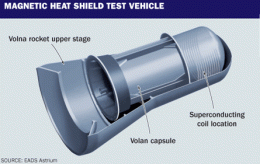
(PhysOrg.com) -- European space agencies and an aerospace giant are developing a new re-entry heat shield that will use superconductor magnets to generate a magnetic field strong enough to deflect the superhot plasma formed during re-entry of returning spacecraft. They plan to test the new technology by attaching a test module to a missile and using a Russian submarine to fire it into space.
As spacecraft re-enter the Earth's atmosphere at high speeds super-hot temperatures are produced through friction. Traditional heat shields use temperature-resistant ablative coatings that burn off on re-entry, or tough insulating materials, such as the tiles used on the space shuttle. If the new magnetic shielding is successful it could be more reliable and make the craft lighter and easier to re-use, since it would reduce or eliminate the need for other shielding materials.
The project is being run cooperatively by the European Space Agency, EADS Astrium, and the German aerospace center, DLR (Deutschen Zentrums for Luft- und Raumfahrt). The idea is to use a superconducting coil at front of the craft to generate a strong magnetic field projecting beyond the front of the craft.
The scientists are currently assessing the superconducting coil's performance, and have not yet finalized the technical details of exactly how they will fit it into a Russian "Volan" escape capsule for the test. Also uncertain at this stage are the modifications that will be needed to the trajectory to compensate for the deflected air. Telemetry data recovery will also present challenges because the ionized gases that will form around the craft will block radio signals.
The Volan and its magnetic heat shield would be launched into a suborbital trajectory from a Russian submarine at sea. The missile, a modified ballistic missile called Volna, would re-enter the Earth's atmospher at Mach 21 and come back to Earth in the Kamchatka peninsula, a remote region of the Russian Far East.
Detlev Konigorski of EADS Astrim, speaking in Manchester last month at the 2009 European air and space conference, said he expected the test to take place three years after it is approved, and that should be some time in the next decade.
More information: http://www.flightglobal.com/landingpage/eads.html
© 2009 PhysOrg.com


Step Two: Maintaining the shield over the entire space craft during space voyage to deflect solar wind and space debris, all powered by ... ?
Nuclear is unpopular down here, but up there the power station could be assembled and commissioned separately, and then docked to the spacecraft for the voyages.
Shielding from the solar wind is one of the primary problems of even short manned voyages in space, and a concern for the Mars conquest. If this heat shield is developed successfully, it will be one less problem for future missions.
Congratulations ESA and their colleagues, not only for the R&D on this technology, but also for the collaboration between governments and corporations of different countries.
Hopefully the rest of the world is watching, and learning, from your example.
Just guessing here, but do you need to power it once it is set up? I thought that the power would stay in a super-conducting loop more or less indefinitely unless depleted. Shouldn't the magnetic field stay on (Meissner Effect)?
So you could basically power it up on the space station, detach and drop without any additional power source. Although you might need some to keep the cooling of the super conductors intact but that could be done by lugging a few cyinders of liquid nitrogen along.
Yyz, superconducting magnet coils are typically cooled with liquid helium (4 K), which is kept cool by liquid nitrogen.
Sorry, probes, I think you have a seriously misplaced decimal: 1 KW is a modest kitchen kettle...
The ablative layer might be able to be kept as a backup if it is so much lighter than tiles as long as the magnet kept it from burning off each time.
The cause of heat is called RAM pressure and it is due to the extremely. compressed gas in the front face of any body moving with a high enough speed!
Please, just Google Ram pressure!
OMG!
http://en.wikiped...dynamics
Either way, IMHO, you must physically interact with the plasma sheath in ways a heat-shield is trying to avoid...
Where to get the power to charge up the toroid ? Perhaps by braking from orbit using a conductive tether cutting Earth's mag-field ??
Most of that energy would be required to energize plasma itself. Magnetic confinement does not require so much energy. In our disputed case, energetic plasma is free of charge.
i think you are imagining that the shield device would create a plasma independantly of the re-entry environment. I dont think this is the case.
I suspect the shielding effect would only become apparent when the crafts ram pressure from descent causes ionization of the air it is moving.
Think polystyrene bean-bag beans being thrown into a fan, rather than umbrella made of the beans.
http://www.adastr...c/VASIMR
If this new tech get successful, the craft will be really lighter and easier to re-use?
I think the traditional heat shields made of tiles are still be remained when imergency condition appears.
The conditons would be include radio signals are block by the ionized gases,
or the trajectory are affected by the deflected air.
If you are very interesting in the craft stucture, pls read some books found at here : http://www.buyusi...shuttle/
Anyway,I hope the project can achieve success. if this happens, we have a new choice at least. By using supercondution magnets to deflect the superhot plasma caused by fliction, this is a great test.
I hope the coils or shield would be installed in the Russion escape capsule and get acchivements!
VASIMR is all about efficiency, not speed.
Its about replacing expensive heavy fuel with cheap light fuel.
Im cautious to quote wikipedia, but they seem to have some "realistic" numbers
like a typical VASIMR taking 14 days from Lunar orbit to earth.