Nanowires key to future transistors, electronics
November 26, 2009 by Emil Venere Nanowire Formation

Enlarge

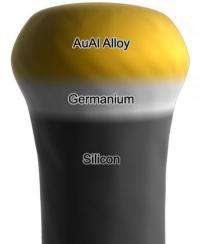
Researchers are closer to using tiny devices called semiconducting nanowires to create a new generation of ultrasmall transistors and more powerful computer chips. The researchers have grown the nanowires with sharply defined layers of silicon and germanium, offering better transistor performance. As depicted in this illustration, tiny particles of a gold-aluminum alloy were alternately heated and cooled inside a vacuum chamber, and then silicon and germanium gases were alternately introduced. As the gold-aluminum bead absorbed the gases, it became "supersaturated" with silicon and germanium, causing them to precipitate and form wires. Credit: Purdue University, Birck Nanotechnology Center/Seyet LLC

(PhysOrg.com) -- A new generation of ultrasmall transistors and more powerful computer chips using tiny structures called semiconducting nanowires are closer to reality after a key discovery by researchers at IBM, Purdue University and the University of California at Los Angeles.

The researchers have learned how to create nanowires with layers of different materials that are sharply defined at the , which is a critical requirement for making efficient transistors out of the structures.

"Having sharply defined layers of materials enables you to improve and control the flow of electrons and to switch this flow on and off," said Eric Stach, an associate professor of materials engineering at Purdue.

Electronic devices are often made of "heterostructures," meaning they contain sharply defined layers of different semiconducting materials, such as silicon and germanium. Until now, however, researchers have been unable to produce nanowires with sharply defined silicon and germanium layers. Instead, this transition from one layer to the next has been too gradual for the devices to perform optimally as transistors.

The new findings point to a method for creating nanowire transistors.

The findings are detailed in a research paper appearing Friday (Nov. 27) in the journal Science. The paper was written by Purdue postdoctoral researcher Cheng-Yen Wen, Stach, IBM materials scientists Frances Ross, Jerry Tersoff and Mark Reuter at the Thomas J. Watson Research Center in Yorktown Heights, N.Y, and Suneel Kodambaka, an assistant professor at UCLA's Department of Materials Science and Engineering.

Whereas conventional transistors are made on flat, horizontal pieces of silicon, the silicon nanowires are "grown" vertically. Because of this vertical structure, they have a smaller footprint, which could make it possible to fit more transistors on an integrated circuit, or chip, Stach said.

"But first we need to learn how to manufacture nanowires to exacting standards before industry can start using them to produce transistors," he said.

Nanowires might enable engineers to solve a problem threatening to derail the electronics industry. New technologies will be needed for industry to maintain Moore's law, an unofficial rule stating that the number of transistors on a computer chip doubles about every 18 months, resulting in rapid progress in computers and telecommunications. Doubling the number of devices that can fit on a computer chip translates into a similar increase in performance. However, it is becoming increasingly difficult to continue shrinking electronic devices made of conventional silicon-based semiconductors.

"In something like five to, at most, 10 years, silicon transistor dimensions will have been scaled to their limit," Stach said.

Transistors made of nanowires represent one potential way to continue the tradition of Moore's law.

The researchers used an instrument called a transmission electron microscope to observe the nanowire formation. Tiny particles of a gold-aluminum alloy were first heated and melted inside a vacuum chamber, and then silicon gas was introduced into the chamber. As the melted gold-aluminum bead absorbed the silicon, it became "supersaturated" with silicon, causing the silicon to precipitate and form wires. Each growing wire was topped with a liquid bead of gold-aluminum so that the structure resembled a mushroom.

Then, the researchers reduced the temperature inside the chamber enough to cause the gold-aluminum cap to solidify, allowing germanium to be deposited onto the silicon precisely and making it possible to create a heterostructure of silicon and germanium.

The cycle could be repeated, switching the gases from germanium to as desired to make specific types of heterostructures, Stach said.

Having a heterostructure makes it possible to create a germanium "gate" in each transistor, which enables devices to switch on and off.

More information: Formation of Compositionally Abrupt Axial Heterojunctions in Si/Ge , C.-Y. Wen, et at., Science.

Provided by Purdue University (news : web)


Rate this story - 4.6 /5 (12 votes)

Rank Filter

Move the slider to adjust rank threshold, so that you can hide some of the comments.


Display comments: newest first

  • sender - Nov 27, 2009
    • Rank: 1 / 5 (1)
    Liquid crystal polymer coils and strings will create molecular grade wiring adjuncts, nanotech is outdated.
  • Mac_Daddy - Nov 27, 2009
    • Rank: not rated yet
    Allan Campbell and Heaven Media are stealing your news without crediting the Source.

    http://www.driver...wsid=388

    We posted this yesterday on TNHW giving full credit to your forum as we always do. I signed up to post this as I couldn't find a contact email link.

    http://www.techne...p?t=1665

    Dave
    Mac Daddy
    TNHW Reviewer and Co-Owner

November 26, 2009 all stories

Comments: 2

4.6 /5 (12 votes)

  • hide
  • Related Stories

  • Findings suggest nanowires ideal for electronics manufacturing
    created Nov 13, 2008 | popularity not rated yet | comments 0
  • New 'finFETs' promising for smaller transistors, more powerful chips
    created Nov 10, 2009 | popularity not rated yet | comments 0
  • Research shows there could be no end in sight for Moore's Law
    created Dec 09, 2008 | popularity not rated yet | comments 0
  • Nano World: Superior nanowire transistors
    created May 30, 2006 | popularity not rated yet | comments 0
  • Nanosys Announces Issued Patent Covering Fundamental Nanowire Heterostructures
    created May 06, 2005 | popularity not rated yet | comments 0


  • hide
  • Relevant PhysicsForums posts

  • How to find static friction
    created 3 hours ago
  • Calculating decible increases
    created 10 hours ago
  • Coefficients of friction
    created 10 hours ago
  • Deduction of centripetal force
    created 11 hours ago
  • Touching both terminals of a battery
    created 11 hours ago
  • Deduction of thrust force
    created 11 hours ago
  • More from Physics Forums - General Physics

Other News

Nanoscale Structures with Superior Mechanical Properties Developed

Nanoscale Structures with Superior Mechanical Properties Developed

Nanotechnology / Nanomaterials

created 11 hours ago | popularity 4.5 / 5 (8) | comments 1 | with audio podcast

(PhysOrg.com) -- Researchers at the California Institute of Technology have developed a way to make some notoriously brittle materials ductile -- yet stronger than ever -- simply by reducing their size.


Spray-on liquid glass

Spray-on liquid glass is about to revolutionize almost everything

Nanotechnology / Nanomaterials

created Feb 02, 2010 | popularity 4.7 / 5 (240) | comments 93 | with audio podcast report

(PhysOrg.com) -- Spray-on liquid glass is transparent, non-toxic, and can protect virtually any surface against almost any damage from hazards such as water, UV radiation, dirt, heat, and bacterial infections. ...


IBM Scientists Demonstrate World's Fastest Graphene Transistor

IBM Scientists Demonstrate World's Fastest Graphene Transistor

Nanotechnology / Nanophysics

created Feb 05, 2010 | popularity 4.9 / 5 (38) | comments 25 | with audio podcast

(PhysOrg.com) -- In a just-published paper in the magazine Science, IBM researchers demonstrated a radio-frequency graphene transistor with the highest cut-off frequency achieved so far for any graphene device ...


Conductive eTextiles: Stanford finds a new use for cloth

Conductive eTextiles: Researchers move from making batteries from paper to making batteries from cloth

Nanotechnology / Nanomaterials

created Feb 05, 2010 | popularity 4.3 / 5 (7) | comments 4 | with audio podcast

(PhysOrg.com) -- Stanford researchers have moved from making batteries from paper to making batteries from cloth. Your-T-shirt could become a lighted, moving display.


Carbon Based Chips May One Day Replace Silicon Transistors

Carbon Based Chips May One Day Replace Silicon Transistors

Nanotechnology / Nanomaterials

created Feb 03, 2010 | popularity 4.7 / 5 (18) | comments 3 | with audio podcast weblog

(PhysOrg.com) -- IBM researchers are hopeful that, over the next decade, silicon-based transistors will be replaced by carbon-based transistors. IBM has already laid out the ground work for carbon-based transistors.