Spin polarization achieved in room temperature silicon
November 27, 2009 by Lin Edwards
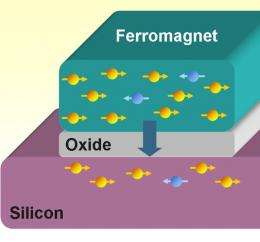
(PhysOrg.com) -- A group in The Netherlands has achieved a first: injection of spin-polarized electrons in silicon at room temperature. This has previously been observed only at extremely low temperatures, and the achievement brings spintronic devices using silicon as a semiconductor a step closer.
Spintronics, or spin electronics, is an emerging field of electronics that aims to be able to represent digital information by using the spin of electrons as well as their charge. When fully developed, spintronic devices could profoundly change data storage devices, computer architecture and so on, and they could reduce energy use to ultra-low levels.
Electrons are basically a two-state system with their spins either "up" or "down". For a spintronics device to work, it must have a system (the spin injector) that produces a spin-polarized electric current, which has more of its electrons in one spin state than the other. It also needs a spin detector that can detect whether the electrons are up or down.
In metallic systems spin polarization is generally achieved by passing an electric current through a ferromagnet. (It is magnetic because the electrons within it are polarized, and as they pass from the magnet to the metal they remain polarized for a short time.) Spin polarization has also been achieved at room temperature in ferromagnetic semiconductors such as manganese-doped gallium arsenide.
Until recently spin polarization in non-magnetic semiconductors like silicon has only been achieved at temperatures of 150 K, but new research has achieved spin polarization at ambient temperature. Scientists Saroj P. Dash and colleagues at the MESA Institute for Nanotechnology at the University of Twente in The Netherlands used a single nickel-iron electrode on top of silicon, with a layer of aluminum oxide between them. When they applied a current to the electrode they observed a "puddle" of electrons in the silicon, which could then be dissipated by applying a magnetic field. This caused an observable voltage drop across the contact.
As a control they inserted a layer of ytterbium between the electrode and the aluminum oxide, since ytterbium is known to destroy spin polarization. When the current and magnetic field were applied, no voltage drop was observed, which indicates that spin polarized electrons had caused the effect.
Spintronics could eventually lead to extremely low energy use devices, and perhaps ultimately to quantum computers. More research is needed to prove the spin-polarized currents really flow through the silicon, and it may still be several years before the promised ultra-low power devices are developed.
The research was published yesterday in the journal, Nature.
More information: Electrical creation of spin polarization in silicon at room temperature, Nature 462, 491-494 (26 November 2009), doi:10.1038/nature08570
© 2009 PhysOrg.com
-
NRL scientists demonstrate efficient electrical spin injection into silicon
Jul 16, 2007 |
not rated yet |
0
-
Scientists generate, modulate, and electrically detect pure spin currents in silicon
Dec 03, 2007 |
not rated yet |
0
-
Spin-polarized electrons on demand
Jan 21, 2009 |
not rated yet |
0
-
Spin-polarized electrons on demand
Jan 15, 2009 |
not rated yet |
0
-
Novel magnetic semiconductor puts new spin on electronics
May 24, 2006 |
not rated yet |
0
-
Engineers build first sub-10-nm carbon nanotube transistor
Feb 01, 2012 |
4.9 / 5 (29) |
30
-
Something old, something new: Evolution and the structural divergence of duplicate genes
Jan 31, 2012 |
4.6 / 5 (7) |
1
-
The hidden nanoworld of ice crystals: Revealing the dynamic behavior of quasi-liquid layers
Jan 30, 2012 |
5 / 5 (3) |
1
-
Stock market network reveals investor clustering
Jan 27, 2012 |
3.9 / 5 (23) |
8
-
Of microchemistry and molecules: Electronic microfluidic device synthesizes biocompatible probes
Jan 26, 2012 |
5 / 5 (1) |
0
-
Pure energy
5 hours ago
-
How to remove the magnetic property for screw driver?
8 hours ago
-
How to magnetize a concrete wall?
12 hours ago
-
Upward speed of an object in water
13 hours ago
-
flipping quarks
14 hours ago
-
partial derivation question
14 hours ago
- More from Physics Forums - General Physics
More news stories
Physics research suggests new pathways for cancer progression
Observing that certain cancer cells may exhibit greater flexibility than normal cells, some scientists believe that this capability promotes rapid tumor growth. Now computer simulations developed by Boston University Biomedical ...
26 minutes ago |
not rated yet |
0
Borexino Collaboration succeeds in spotting pep neutrinos emitted from the sun
(PhysOrg.com) -- To learn more about how the sun works, scientists study particles that are emitted from it into space due to thermonuclear reactions that occur inside; by applying known physics principles, ...
Transparent iron? For the first time, an experiment shows that atomic nuclei can become transparent
At the high-brilliance synchrotron light source PETRA III, a team of DESY scientists headed by Dr. Ralf Röhlsberger has succeeded in making atomic nuclei transparent with the help of X-ray light. At the ...
21 hours ago |
5 / 5 (8) |
3
|
Physicists build highly efficient 'no-waste' laser
A team of University of California, San Diego researchers has built the smallest room-temperature nanolaser to date, as well as an even more startling device: a highly efficient, "thresholdless" laser that ...
21 hours ago |
5 / 5 (17) |
4
|
Explained: Sigma
It's a question that arises with virtually every major new finding in science or medicine: What makes a result reliable enough to be taken seriously? The answer has to do with statistical significance -- but ...
2 hours ago |
5 / 5 (3) |
2
Tidal forces could squeeze out planetary water
Alien planets might experience tidal forces powerful enough to remove all their water, leaving behind hot, dry worlds like Venus, researchers said.
Google launches Chrome browser for Android smartphones
With more and more people connecting to the Internet through a phone or a tablet instead of a PC, Google Inc. is bringing its fast-growing browser, Chrome, to the newest Android-powered mobile devices.
Kodak to stop making cameras, digital frames
Kodak says it will stop making digital cameras, pocket video cameras and digital picture frames in order to focus on its more profitable businesses.
Oracle to pay $1.9B for Taleo, extends SAP rivalry
(AP) -- Oracle Corp. is escalating its rivalry with German business-software maker SAP AG and plans to pay $1.9 billion for Taleo Corp., a company that helps businesses hire and manage their employees.
Antarctic lake could reveal evolution, new life: scientists
Russian scientists said Thursday a probe to a pristine lake deep under the ice of Antarctica could bring revelations on the planet's evolution and possibly even new life forms.
Can indigenous insects be used against the light brown apple moth?
The light brown apple moth (LBAM), Epiphyas postvittana (Walker), an invasive insect from Australia, was found in California in 2006. The LBAM feeds on apples, pears, stonefruits, citrus, grapes, berries and many other plants ...