Living buildings could mop up carbon dioxide
November 27, 2009
Living buildings could mop up carbon dioxide

Enlarge

(PhysOrg.com) -- Architecture could help us tackle climate change, if we start to design our buildings with 'living' materials, according to Dr Rachel Armstrong, UCL Bartlett School of Architecture.

Speaking today at a UCL Lunch Hour Lecture, Dr Armstrong argued that biological systems could be engineered into ‘smart’ paints to protect our buildings and improve our atmosphere.

“Our buildings offer a huge engineered surface area on which we could develop new applications, especially biological ones,” said Dr Armstrong. “We’ve been building with the same Victorian technologies for so long, now it’s time to try something new.

“Adapting to create ‘living’ buildings may seem outlandish, and is not without its problems, given the time it takes to grow organisms and the need to feed them and manage their waste. But if architects can overcome these limitations and make the connection between artificial structures and natural ones, we could harness ‘metabolic materials’ such as bioluminescent bacteria that produce light through biochemistry, for example, and reduce our energy drain on the grid.

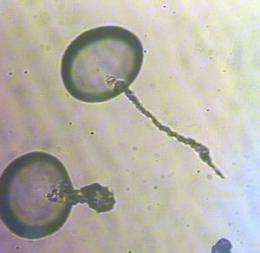
“In collaboration with Martin Hanczyc of the University of Southern Denmark, we’ve been exploring protocell systems which act like chemical computers whose hardware is based on the self-assembling properties of oils and whose software is programmed through chemical reactions that affect the properties of the oil. We aim to program protocells to make carbonates from carbon dioxide, thus acting as a ‘carbon sink’. This is the first step towards developing a ‘smart’ surface coating that could extract carbon dioxide and other pollutants from the environment.

“Venice might also be saved using this kind of approach, by growing an artificial reef from protocells underneath the historic city, to prevent it from sinking.

“Although these technologies are immature, they offer potential new ways of addressing as an additional strategy to energy conservation. By developing these green technologies we hope to retool architects to help them meet sustainable and climate change challenges of the future.”

Provided by University College London (news : web)


Rank 1 /5 (2 votes)
Related Stories
Relevant PhysicsForums posts

More news stories

Employers feel no love for unscrupulous practice of 'service sweethearting'

A new study led by two Florida State University marketing professors finds that some frontline service employees who are rewarded for hikes in customer loyalty and satisfaction also may engage in "service ...

Other Sciences / Economics & Business

created 6 hours ago | popularity 4 / 5 (1) | comments 4

A frank discussion of the power law and linking correlation to causation

(PhysOrg.com) -- Michael Stumpf a mathematics professor at Imperial College in London, and Mason Porter a lecturer at Oxford have teamed together to write and publish a perspective piece in Science regarding the in ...

Other Sciences / Mathematics

created 12 hours ago | popularity 5 / 5 (2) | comments 2 | with audio podcast report

The question of life in the ancient world

There’s a general feeling that we don’t get the Greeks – ancient or modern. Many, including heads of state like Angela Merkel, visibly shake their head in exasperation, rightly or wrongly, at ...

Other Sciences / Archaeology & Fossils

created 12 hours ago | popularity 1 / 5 (2) | comments 4

Sonic Cradle lands spot in TED exhibition

A Simon Fraser University graduate student project that melds music, meditation and modern technology has landed a rare spot as an exhibit at TEDActive 2012 in Palm Springs, California this month.

Other Sciences / Other

created 8 hours ago | popularity not rated yet | comments 0

Chilean miners' rescue capsule on show in London

The capsule used to rescue Chilean miners trapped underground for two months goes on display Saturday at the Science Museum in London -- the first time it has been seen in Europe.

Other Sciences / Other

created 11 hours ago | popularity not rated yet | comments 0


Google users warned of threat to smartphone wallets

Users of Google smartphone wallets were being warned on Friday that there is a way to crack pass codes intended to thwart thieves from going on illicit shopping sprees.

Anonymous knocks CIA website offline (Update)

The website of the Central Intelligence Agency was inaccessible on Friday after the hacker group Anonymous claimed to have knocked it offline.

Complex wiring of the nervous system may rely on a just a handful of genes and proteins

Researchers at the Salk Institute have discovered a startling feature of early brain development that helps to explain how complex neuron wiring patterns are programmed using just a handful of critical genes. ...

New error-correcting codes guarantee the fastest possible rate of data transmission

Error-correcting codes are one of the triumphs of the digital age. They’re a way of encoding information so that it can be transmitted across a communication channel — such as an optical fiber o ...

Putting the squeeze on planets outside our solar system

(PhysOrg.com) -- Using high-powered lasers, scientists at Lawrence Livermore National Laboratory and collaborators discovered that molten magnesium silicate undergoes a phase change in the liquid state, abruptly ...

The power of estrogen -- male snakes attract other males

A new study has shown that boosting the estrogen levels of male garter snakes causes them to secrete the same pheromones that females use to attract suitors, and turned the males into just about the sexiest ...