Golden Oldie: Key Role for Ancient Protein in Algae Photosynthesis
The discovery that an ancient light harvesting protein plays a pivotal role in the photosynthesis of green algae should help the effort to develop algae as a biofuels feedstock. Researchers with the Lawrence Berkeley National Laboratory have identified the protein LHCSR as the molecular "dimmer switch" that acts to prevent green algae from absorbing too much sunlight during photosynthesis and suffering oxidation damage as a consequence.
“We’ve shown that for green algae, and probably most other eukaryotic algae, the LHCSR protein is used to dissipate excess light energy and protect the photosynthetic apparatus from damage,” says Krishna Niyogi, a biologist who holds joint appointments with Berkeley Lab’s Physical Biosciences Division and the University of California Berkeley’s Department of Plant and Microbial Biology. “We describe LHCSR as an ancient member of the family of light harvesting proteins because it seems to have been one of the first to branch off from a common ancestor shared long ago by both algae and plants.”
Niyogi is the corresponding author on a paper published in the journal Nature entitled: “An ancient light-harvesting protein is critical for the regulation of algal photosynthesis.” Co-authoring the paper with Niyogi were Graham Peers, Thuy Truong, Elisabeth Ostendorf, Andreas Busch, Dafna Elrad, Arthur Grossman and Michael Hippler.
It is a popular misconception that algae are simply aquatic plants. While algae share with plants a reliance on photosynthesis, the protein machinery differs. Understanding the photosynthetic machinery unique to algae is important because algae are considered prime candidates to serve as feedstocks for future biofuels. Algae boast high energy content and yield, rapid growth, and the ability to thrive in seawater or wastewater. Also, the oil extracted from algae can be refined into biodiesel, and jet fuel or ethanol, in addition to gasoline.
Cultivating algae on a scale for commercial biofuels production, however, has proven to be a major challenge. Growing algae in closed photobioreactors is effective but probably too expensive for commercial scale production. Growing algae in open ponds has proven problematic primarily because of photosynthesis.
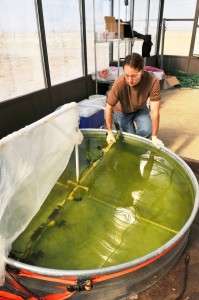
“Mass cultures of algae cells in open ponds do not use sunlight very efficiently, and their productivity can be limited by light-induced damage,” says Niyogi. “Cells at the surface of the culture hog all the sunlight and end up wasting most of it because the absorption of excess sunlight makes the cells more susceptible to photoinhibition.”
The findings of Niyogi and his colleagues could enable researchers to engineer green algae cells that make better use of light. Like green plants, algae use photosynthesis to harvest energy from sunlight and convert it to chemical energy. Also like green plants, when pigment molecules such as chlorophyll absorb an excess of solar energy, the result is severe oxidative damage that can be fatal to the cells. However, both plants and algae have evolved a photo-protective mechanism-called energy-quenching-by which excess energy can be safely dissipated from one molecular system to another for routing down relatively harmless chemical reaction pathways.
“Despite the significant importance of aquatic photosynthesis for determining the influences of oceans and lakes on climate and biogeochemistry, little has been known about the energy-quenching mechanism in algae,” says Niyogi.
In 2008, Niyogi and Graham Fleming, a physical chemist with Berkeley Lab and UC Berkeley, were part of a collaboration that identified the light-harvesting protein CP29 as a valve that either permits or blocks the critical release of excess solar energy in green plants during photosynthesis. CP29 was shown to drain energy off from chlorophyll and into the carotenoid zeaxanthin, which Fleming and his research group earlier identified as the safety valve for the photo-protection of green plants.
“We believe that CP29 is one of several light-harvesting proteins involved in dissipating excess light energy for green plants, with another protein, PsbS, acting as a light sensor that turns on the dissipation mechanism when needed,” Niyogi says. “In green algae, the LHCSR protein, which also binds chlorophyll and zeaxanthin, appears to perform both the sensing and dissipating functions.”
For the green algae study, Niyogi and his collaborators worked with an algal organism called Chlamydomonas, which is considered “the fruit fly of the algae world,” in terms of being a genetic model for other eukaryotic algae. They compared an energy-quenching mutant of Chlamydomonas, in which two of the three LHCSR-coding genes were absent, to a wild type of Chlamydomonas in a series of light exposure tests. While cells in the two cultures had a statistically identical rate of survival when exposed to low levels of light, the mutant culture showed a 40 percent reduction in cell survival compared to the wild culture when exposed to high levels of light.
“It was surprising to see how nature has used related proteins in different ways for light harvesting and light dissipation,” says Niyogi. ”LHCSR, CP29 and PsbS are proteins that share a common ancestor with the main light-harvesting proteins in algae and plants, but they are like distant cousins. This suggests that the photoprotection function arose early in the evolution of the light-harvesting protein family.”
Niyogi and his research group are now active in another collaboration with the Fleming group to investigate exactly how the LHCSR protein gets rid of excess light. Preliminary results indicate that the biophysical process is much the same as the process for green plants even though the protein environment is different. Having identified LHSCR as the key dissipater of light energy and understanding how it does the job should not only be a boon for biofuels research, but should also help in the effort to design artificial photosynthesis systems that would be sustainable and secure sources of energy.
“The LHCSR protein provides us with another blueprint from nature that might be used to control the harvesting of sunlight by future artificial photosynthesis systems,” Niyogi says.
Provided by Lawrence Berkeley National Laboratory (news : web)


