Japan launches 5th spy satellite
November 28, 2009 By SHINO YUASA , Associated Press Writer
Japan launches 5th spy satellite (AP)

Enlarge

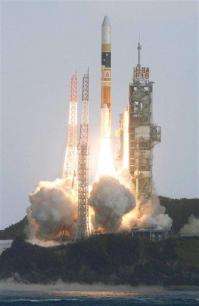
An H-2A rocket carrying a spy satellite lifts off from a space center on the southern island of Tanegashima, on Saturday Nov. 28, 2009. Japan launched its fifth spy satellite Saturday in a bid to boost its ability to independently gather intelligence, the government said. (AP Photo/Kyodo News)

(AP) -- Japan launched its fifth spy satellite into orbit Saturday in a bid to boost its ability to independently gather intelligence, the government said.

The domestically developed H-2A rocket carrying the $565 million lifted off from a space center on the southern island of Tanegashima, said Hisashi Michigami, an official at the Cabinet Office.

"The satellite will gather intelligence for our defense and diplomatic purposes," Michigami said. "We hope to upgrade our ability to gather intelligence on our own. Intelligence gathering is vital to our ."

Michigami said the launch was successful.

has long relied on the United States for intelligence. But it launched its first pair of spy satellites in 2003, prompted by concerns over North Korea's missile program.

North Korea shocked Tokyo in 1998 when it test-fired a missile over Japan. Since then, Japan has launched spy satellites primarily to watch developments in North Korea.

In April this year, a North Korean long-range rocket flew over Japan and landed in the Pacific Ocean.

Michigami said Japan has three working spy satellites. The fourth spy satellite became unresponsive in 2007 due to apparent electrical problems. Each spy satellite will last around five years, he said.

Japan has long been one of the world's leading space-faring nations, having launched its first satellite in 1970. But it has been struggling to get out from under China's shadow in recent years.

While China put its first men into orbit in 2003, Japan has yet to send astronauts on its own, though Japanese have joined U.S. space missions.

Last year, Japan's parliament voted to allow the nation's space programs to be used for defense for the first time as part of Tokyo's push to give its military a greater international role.

In January this year, Japan launched its first satellite to monitor , a tool to help scientists better judge where global warming emissions are coming from, and how much is being absorbed by the oceans and forests.

The country also plans to have a two-legged robot walk on the moon by around 2020.

©2009 The Associated Press. All rights reserved. This material may not be published, broadcast, rewritten or redistributed.

3.6 /5 (9 votes)  

Filter


Move the slider to adjust rank threshold, so that you can hide some of the comments.


Display comments: newest first

omatumr
Nov 28, 2009

Rank: 3 / 5 (2)
What is at stake?

Why does the Japanese government believe that "Intelligence gathering is vital to our national security"?

With kind regards,
Oliver K. Manuel
Truth
Nov 29, 2009

Rank: not rated yet
I am amazed that Japan restrained itself from reacting to a North Korean missle sailing over their island, in apparent violation of Japanese air-space. Would the North Koreans be so "gentle minded" in allowing a Japanese or American missle to fly through their air-space? I think not!
frajo
Nov 30, 2009

Rank: 1 / 5 (1)
Why does the Japanese government believe that "Intelligence gathering is vital to our national security"?

If you don't know who's gonna be your fellow in, say, 50 years, you better prepare to have something to offer instead of depending on the other's good will.
Rank 3.6 /5 (9 votes)
Related Stories
Relevant PhysicsForums posts
  • Titan's lack of impact craters
    createdFeb 09, 2012
  • Real pictures of black hole eating a star?
    createdFeb 08, 2012
  • Hypothetical way to travel faster than light, but not technically exceed lightspeed
    createdFeb 06, 2012
  • How do scientists monitor the Sun's activity?
    createdFeb 05, 2012
  • Search patterns in observational studies
    createdFeb 05, 2012
  • Derivation of Pogson's law
    createdFeb 03, 2012
  • More from Physics Forums - General Astronomy

More news stories

Could Venus be shifting gear?

(PhysOrg.com) -- ESA’s Venus Express spacecraft has discovered that our cloud-covered neighbour spins a little slower than previously measured. Peering through the dense atmosphere in the infrared, the ...

Space & Earth / Space Exploration

created 3 hours ago | popularity 5 / 5 (4) | comments 4 | with audio podcast

Humans may have helped the decline of African rainforests 3000 years ago

(PhysOrg.com) -- Large areas of rainforests in Central Africa mysteriously disappeared over three thousand years ago, to be replaced by savannas. The prevailing theory has been that the cause was a change ...

Space & Earth / Environment

created 7 hours ago | popularity 5 / 5 (3) | comments 8 | with audio podcast report

Clam fields found at deep, low-temperature Mariana vents

(PhysOrg.com) -- Scientists have marveled at the unusual life forms thriving at high temperature hydrothermal vents of the deep ocean.

Space & Earth / Earth Sciences

created 4 hours ago | popularity not rated yet | comments 0 | with audio podcast

Mars Science Laboratory computer issue resolved

(PhysOrg.com) -- Engineers have found the root cause of a computer reset that occurred two months ago on NASA's Mars Science Laboratory and have determined how to correct it.

Space & Earth / Space Exploration

created 4 hours ago | popularity 5 / 5 (5) | comments 2 | with audio podcast

Two new moons for Jupiter

Advances in technology have lead to the discovery of new planets outside of our Solar System, and now even new moons in our own backyard.

Space & Earth / Space Exploration

created 3 hours ago | popularity not rated yet | comments 2


New understanding of DNA repair could eventually lead to cancer therapy

A research group in the Faculty of Medicine & Dentistry at the University of Alberta is hoping its latest discovery could one day be used to develop new therapies that target certain types of cancers.

Hovering not hard if you're top-heavy, researchers find

Top-heavy structures are more likely to maintain their balance while hovering in the air than are those that bear a lower center of gravity, researchers at New York University's Courant Institute of Mathematical Sciences ...

Grass to gas: Researchers' genome map speeds biofuel development

Researchers at the University of Georgia have taken a major step in the ongoing effort to find sources of cleaner, renewable energy by mapping the genomes of two originator cells of Miscanthus x giganteus, a large perenn ...

Night, weekend delivery OK for babies with birth defects

Weekday delivery is no better than night or weekend delivery for infants with birth defects, according to a new study presented today at The Pregnancy Meeting, the Society for Maternal-Fetal Medicine's annual conference. ...

Sonic Cradle lands spot in TED exhibition

A Simon Fraser University graduate student project that melds music, meditation and modern technology has landed a rare spot as an exhibit at TEDActive 2012 in Palm Springs, California this month.

Drug halts organ damage in inflammatory genetic disorder

A new study shows that Kineret (anakinra), a medication approved for the treatment of rheumatoid arthritis, is effective in stopping the progression of organ damage in people with neonatal-onset multisystem inflammatory disease ...