Rat pack: Scientists warming up to African rodent
November 28, 2009 By PAUL J. WEBER , Associated Press Writer Rat pack: Scientists warming up to African rodent (AP)

Enlarge

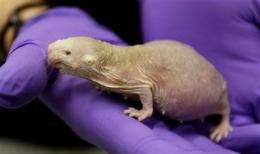
In this Oct. 21, 2009 photo, a pregnant naked mole rat is shown at the Barshop Institute at the UT Health Science Center in San Antonio. Naked mole rats are becoming more popular in research laboratories, where the seemingly invulnerable rodents have surprised scientists with their ability to live up to 30 years and their potential to offer insights into human health. They're being used to study everything from aging to cancer to strokes. (AP Photo/Eric Gay)

(AP) -- Naked mole rats don't get cancer. They shrug off brushes with acid and age so well, some are older than the college-aged researchers handling them.

"They really are from Mars, I think," said Thomas Park, a professor of biological sciences at the University of Illinois at Chicago.

Actually, they're from the horn of Africa. But naked mole rats are becoming more popular in research laboratories, where the seemingly invulnerable rodents have surprised scientists with their ability to live up to 30 years and their potential to offer insights into human health. They're being used to study everything from aging to cancer to strokes.

About 1,500 naked mole rats live in clear tanks connected by long tubes at the University of Texas Health Science Center in San Antonio, where researcher Rochelle Buffenstein nurtures the largest colony in the U.S. At least a half-dozen other universities also have colonies.

Nearly blind and hairless, the rodents resemble wrinkled spring rolls with tiny legs and buck teeth. They normally live in underground tunnels with a social structure comparable to bees. Buffenstein is studying their longevity.

Whereas laboratory mice live an average two years, naked mole rats can live up 30 years with little creaking in old age. Buffenstein said their bone quality doesn't start to diminish until they're about 24 years old.

They look fragile - several can fit into a palm, and it's possible to see beneath their pinkish skin - but naked mole rats are like tough, tube-shaped stuntmen.

Squirting lemon juice on a cut would sting anyone, but Park said naked mole rats don't feel pain because they lack a neurotransmitter known as substance P. The discovery has opened up ideas for pain research.

Park and researcher John Larson report in next month's journal NeuroReport that the brains of adult naked mole rats can withstand oxygen depravation for a half-hour or more. That knowledge could eventually help in stroke research, Park said.

Cancer? Buffenstein said the disease has never been found in the rodent.

A study published in October found their resistance may come from a gene called p16 that prevents cells from crowding together. Cancer occurs when cells grow uncontrollably.

Vera Gorbunova, an associate professor of biology at the University of Rochester who published the findings, said she hopes to have her own colony of mole rats to study by next summer.

"We shouldn't just be looking where it's easy to look," Gorbunova said. "We should be looking in species where we can find something ... instead of studying mice, which live relatively short lives."

As recently as the 1990s, Buffenstein said only she and one other group were really studying naked mole rats. Now she expects them to be common in laboratories by 2020.

"It takes time for people to realize that an animal has got a lot going for it," Buffenstein said.

On the Net: UT Health Science Center: http://www.barshop.uthscsa.edu/

©2009 The Associated Press. All rights reserved. This material may not be published, broadcast, rewritten or redistributed.


Rate this story - 5 /5 (10 votes)


November 28, 2009 all stories

Comments: 0

5 /5 (10 votes)

  • hide
  • Related Stories

  • Ugly duckling mole rats might hold key to longevity
    created Oct 05, 2007 | popularity not rated yet | comments 0
  • Naked mole-rat unfazed by oxidative stress
    created Oct 09, 2006 | popularity not rated yet | comments 0
  • Naked mole-rats bear chili pepper heat
    created Jan 29, 2008 | popularity not rated yet | comments 0
  • Scientists discover gene that 'cancer-proofs' rodent's cells
    created Oct 26, 2009 | popularity not rated yet | comments 0
  • In the Palace of the Naked Mole-Rat
    created Feb 24, 2009 | popularity not rated yet | comments 0


  • hide
  • Relevant PhysicsForums posts

Other News

Cells can read damaged DNA without missing a beat

Biology / Cell & Microbiology

created 6 hours ago | popularity 5 / 5 (1) | comments 0 | with audio podcast

Scientists have shown that cells' DNA-reading machinery can skim through certain kinds of damaged DNA without skipping any letters in the genetic "text." The studies, performed in bacteria, suggest a new mechanism that can ...


Great tits: birds with character

Great tits: birds with character

Biology / Plants & Animals

created 7 hours ago | popularity 5 / 5 (2) | comments 3 | with audio podcast

(PhysOrg.com) -- In humans and animals alike, individuals differ in sets of traits that we usually refer to as personality. An important part of the individual difference in personality is due to variation ...


Researchers find genes that 'tune' flower fragrances

Biology / Biotechnology

created 10 hours ago | popularity not rated yet | comments 0 | with audio podcast

(PhysOrg.com) -- Shakespeare famously wrote, "That which we call a rose by any other name would smell as sweet." With all due respect to the Bard, University of Florida researchers may have to disagree: no matter what you ...


Researchers map all the fragile sites of the yeast Saccharomyces cerevisiae's genome

Biology / Cell & Microbiology

created 10 hours ago | popularity not rated yet | comments 0 | with audio podcast

The research group of Dr. François Robert, a researcher at the Institut de recherches cliniques de Montréal (IRCM), in collaboration with the team of Dr. Daniel Durocher (Samuel Lunenfeld Research Institute and University ...


Study carried out into biological risks of eating reptiles

Study carried out into biological risks of eating reptiles

Biology / Cell & Microbiology

created 9 hours ago | popularity 5 / 5 (1) | comments 3

Reptiles are bred in captivity primarily for their skins, but some restaurants and population groups also want them for their meat. A study shows that eating these animals can have side effects that call into ...