Scientists explain puzzling lake asymmetry on Titan
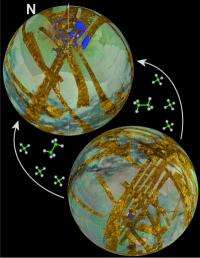
Researchers at the California Institute of Technology (Caltech) suggest that the eccentricity of Saturn's orbit around the sun may be responsible for the unusually uneven distribution of methane and ethane lakes over the northern and southern polar regions of the planet's largest moon, Titan. On Earth, similar "astronomical forcing" of climate drives ice-age cycles.
A paper describing the theory appears in the November 29th advance online edition of Nature Geoscience.
As revealed by Synthetic Aperture Radar (SAR) imaging data taken by NASA's Cassini spacecraft, which has been surveying Saturn and its moons since 2004, liquid hydrocarbon-filled lakes in Titan's northern high latitudes cover 20 times more area than lakes in the southern high latitudes. There are also significantly more partially filled and now-empty lakes in the north. (In the SAR data, smooth features—like the surfaces of lakes—appear as dark areas, while rougher features—such as the bottom of an empty lake—appear bright.)
Assuming that the asymmetry is not a statistical fluke (which is unlikely because of the large amount of data collected by Cassini), scientists initially considered the idea that "there is something inherently different about the northern polar region versus the south in terms of topography, such that liquid rains, drains, or infiltrates the ground more in one hemisphere," says Oded Aharonson, associate professor of planetary science at Caltech and lead author of the Nature Geoscience paper. However, he notes, there are no substantial known differences between the north and south to support this possibility.
Alternatively, the mechanism may be seasonal. One year on Titan lasts 29.5 Earth years. Every 15 Earth years the seasons reverse, so that it becomes summer in one hemisphere and winter in the other. (Currently, summer has just begun in the northern hemisphere, and winter in the south.) According to the seasonal hypothesis, methane rainfall and evaporation vary in different seasons—recently filling lakes in the north while drying lakes in the south.
The problem with this idea, Aharonson says, is that it explains decreases of about one meter per year in the depths of lakes in the summer hemisphere. But Titan's lakes are a few hundred meters deep on average, and wouldn't drain (or fill) in just 15 years.
In addition, seasonal variation can't account for the disparity between the hemispheres in the number of empty lakes; the northern pole has roughly three times as many dried-up lake basins as the south (and seven times as many partially filled ones).
"How do you move the hole in the ground?" Aharonson asks. "The seasonal mechanism may be responsible for part of the global transport of liquid methane, but it's not the whole story."
A more plausible explanation, say Aharonson and his colleagues, is related to the eccentricity of the orbit of Saturn—and hence of Titan, its satellite—around the sun.
Like Earth and the other planets, Saturn's orbit is not perfectly circular, but is instead somewhat elliptical—or eccentric—and oblique. Because of this, during its southern summer, Titan is about 12 percent closer to the sun than it is during the northern summer. As a result, northern summers are long and subdued while southern summers are short and intense.
Aharonson and his colleagues think these differences in the characteristics of the seasons could somehow affect the relative amounts of precipitation and evaporation of methane in the hemispheres' respective summers.
"We propose that, in this orbital configuration, the difference between evaporation and precipitation is not equal in opposite seasons, which means there is a net transport of methane from south to north," he says. This imbalance would lead to an accumulation of methane—and hence the formation of many more lakes—in the northern hemisphere.
This situation is only true right now, however. Over very long time scales of tens of thousands of years, Saturn's orbital parameters vary, at times causing Titan to be closer to the sun during its northern summer and farther away in southern summers, and producing a reverse in the net transport of methane. This should lead to a buildup of the hydrocarbon—and an abundance of lakes—in the southern hemisphere.
"Like Earth, Titan has tens-of-thousands-of-year variations in climate driven by orbital motions," Aharonson says. On Earth, these variations, known as Milankovitch cycles, are linked to the global redistribution of water in the form of glaciers, and are responsible for ice-age cycles. "On Titan, there are long-term climate cycles in the global movement of methane that make lakes and carve lake basins. In both cases we find a record of the process embedded in the geology," he adds.
"We may have found an example of present-day climate change, analogous to Milankovitch climate cycles on Earth, on another object in the solar system," he says.
More information: "Titan's Asymmetric Lake Distribution and its Potential Astronomical Evolution," Nature Geoscience.
Source: California Institute of Technology (news : web)


