Study shows new brain connections form rapidly during motor learning
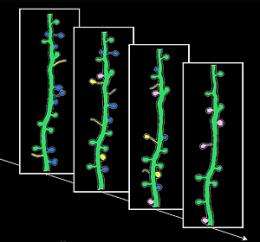
(PhysOrg.com) -- New connections begin to form between brain cells almost immediately as animals learn a new task, according to a study published this week in Nature. Led by researchers at the University of California, Santa Cruz, the study involved detailed observations of the rewiring processes that take place in the brain during motor learning.
The researchers studied mice as they were trained to reach through a slot to get a seed. They observed rapid growth of structures that form connections (called synapses) between nerve cells in the motor cortex, the brain layer that controls muscle movements.
"We found very quick and robust synapse formation almost immediately, within one hour of the start of training," said Yi Zuo, assistant professor of molecular, cell and developmental biology at UCSC.
Zuo's team observed the formation of structures called "dendritic spines" that grow on pyramidal neurons in the motor cortex. The dendritic spines form synapses with other nerve cells. At those synapses, the pyramidal neurons receive input from other brain regions involved in motor memories and muscle movements. The researchers found that growth of new dendritic spines was followed by selective elimination of pre-existing spines, so that the overall density of spines returned to the original level.
"It's a remodeling process in which the synapses that form during learning become consolidated, while other synapses are lost," Zuo said. "Motor learning makes a permanent mark in the brain. When you learn to ride a bicycle, once the motor memory is formed, you don't forget. The same is true when a mouse learns a new motor skill; the animal learns how to do it and never forgets."
Understanding the basis for such long-lasting memories is an important goal for neuroscientists, with implications for efforts to help patients recover abilities lost due to stroke or other injuries.
"We initiated the motor learning studies to understand the process that takes place after a stroke, when patients have to relearn how to do certain things. We want to find out if there are things we can do to speed up the recovery process," Zuo said.
The lead authors of the Nature paper, Tonghui Xu and Xinzhu Yu, are a postdoctoral researcher and doctoral student, respectively, in Zuo's lab at UCSC. Coauthors include Andrew Perlik, Willie Tobin, and Jonathan Zweig of UCSC and Kelly Tennant and Theresa Jones of the University of Texas, Austin.
The study used mice that had been genetically altered to make a fluorescent protein within certain neurons in the brain. The researchers were then able to use a special microscopy technique (two-photon microscopy) to obtain clear images of those neurons near the surface of the brain. The noninvasive imaging technique enabled them to view changes in individual brain cells of the mice before, during, and after the mice were trained in the seed-reaching task.
"We were able to follow the same synapses over time, which had not been done before in a motor learning study," Zuo said. "We showed that structural changes occur in the brain at a much earlier stage than people had believed."
Results from the study suggested that the newly formed dendritic spines are initially unstable and undergo a prolonged selection process during the course of training before being converted into stable synapses.
When previously trained mice were reintroduced to the reaching task four months later, their skill at the task remained high, and images of their brains did not show increased spine formation. When previously trained mice were taught a new skill, however, they showed enhanced spine formation and elimination similar to that seen during the initial training. Furthermore, spines that had formed during the initial training persisted after the remodeling process that accompanied the learning of a new task.
These findings suggest that different motor behaviors are stored using different sets of synapses in the brain, Zuo said. One of the questions she would like to explore in future studies is how these findings apply to different types of learning.
"In China, where I grew up, we memorize a lot in school. What are the changes that take place in the brain during learning and memorizing, and what are the best ways to consolidate those memories? We don't really know the best way to learn and memorize," she said.
Source: University of California - Santa Cruz (news : web)


