November 30, 2009 feature
Researchers Design Triple Quantum Dot for Quantum Information Applications
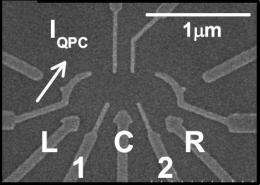
(PhysOrg.com) -- While quantum dots have existed since the 1980s, only in the past decade have physicists successfully created lateral few-electron single quantum dots. These quantum dots enable physicists to manipulate quantum spins, which could be used as qubits for quantum information applications. Along these lines, a team of physicists from the National Research Council in Canada who were responsible for the original lateral few-electron single quantum dot have recently designed a new few-electron triple quantum dot circuit, and demonstrated that all three quantum dots can be tuned in resonance.
As the scientists explained in a recent issue of Applied Physics Letters, the triple quantum dot design could be useful in research studies of quantum dots where knowing the exact number of electrons is important. The design could also have applications in future quantum information devices involving electron spin qubits.
“Having all three dots in resonance is a requirement for certain quantum information functionalities such as a spin bus for coherently transmitting spin information across a circuit,” coauthor Louis Gaudreau told PhysOrg.com.
The group fabricated and tried several device designs, but the early versions were found to be marginal as triple quantum dots and not tunable enough to be useful. Finally the researchers found a design which allowed one to three electrons to be isolated in a center dot with a wider occupation number range available for the outer two dots.
To demonstrate the required tunability of the circuit, the scientists adjusted the various gate voltages to settings where all three quantum dots were in resonance with each other. These locations are called quadruple points. Close to the quadruple points, the group demonstrated the presence of charge reconfigurations analogous to quantum cellular automata effects.
“Going from double quantum dots, which are being studied in several laboratories, to a triple quantum dot is a more significant step than just adding one extra spin qubit,” Gaudreau said. “There are many concepts which require three quantum dots, such as demonstrating entanglement, running simple quantum algorithms and quantum computing error correction schemes.
“Ultimately, we plan to use our device for running simple quantum information applications, but as a first step we need to demonstrate we can manipulate spins in such a compelx circuit. One of the interesting concepts we are also studying with this device is ‘backaction’ i.e. the way making the measurement itself affects the result.”
More information: L. Gaudreau, A. Kam, G. Granger, S. A. Studenikin, P. Zawadzki, and A. S. Sachrajda. “A tunable few electron triple quantum dot.” Applied Physics Letters 95, 193101 (2009).
Copyright 2009 PhysOrg.com.
All rights reserved. This material may not be published, broadcast, rewritten or redistributed in whole or part without the express written permission of PhysOrg.com.


